
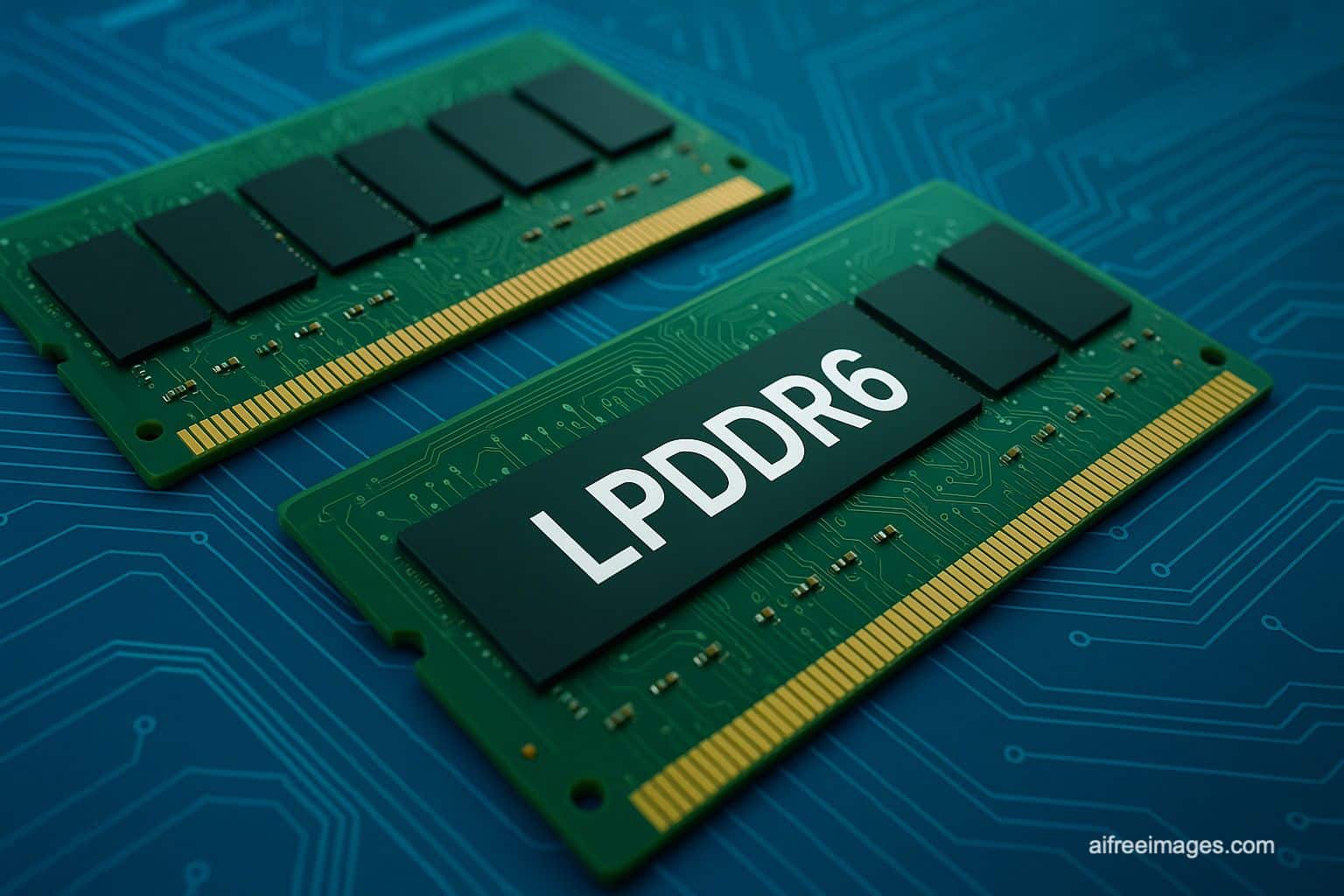
Micron has unveiled EIM (Edge Inference Memory), a memory still in development that stacks LPDDR chips over a logic die to speed up on-device artificial intelligence (AI) inference in robots, self-driving cars, and augmented and virtual reality glasses. The company showed it off on October 16 at SEDEX 2026 in Seoul, without giving performance figures or a launch date. Industry sources cited by the Korean outlet TheElec put mass production in the second half of 2028.
Micron’s EIM memory in 20 seconds
- EIM stacks LPDDR over a logic die to cut latency and boost bandwidth for local AI.
- It targets humanoid robots, self-driving cars, and augmented and virtual reality first.
- Micron is working to bring it to LPDDR6; the industry talks about 2028, with no official confirmation.
The presentation was given by Lee Cheol, a Micron vice president, at a conference on semiconductors for humanoid robots held as part of SEDEX, at the COEX convention center in the South Korean capital. His starting point is that memory has become a bottleneck for so-called physical AI: it does little good for the processor to compute faster if the data doesn’t reach it in time. According to TheElec, the executive argued that conventional DRAM and storage will struggle to keep up with what this market will demand.
What is known about EIM, and what isn’t
EIM sits between the AI chip and memory. Its design stacks several LPDDR chips, the low-power memory used in phones and laptops, over a logic die at the base, aiming to reduce latency (how long it takes for data to arrive) and increase bandwidth (how much data can move at once). In a robot that has to interpret what it sees and react instantly, and that also runs on battery, both of those matter as much as the power cost of moving data around.
Micron hasn’t explained exactly what that logic die does. It hasn’t revealed EIM’s compute architecture or performance targets, so it can’t be described as a memory capable of running an AI model on its own. The company does distinguish it from PIM (processing-in-memory) memories, which build compute units directly into the memory itself, a line Samsung and SK hynix have been exploring for years. What is known is that both technologies are chasing the same goal: working alongside the AI chip so it spends less time waiting for data.
The next step is bringing EIM to LPDDR6, the standard JEDEC published in July 2025 with speeds from 10,667 to 14,400 MT/s and a dual-subchannel architecture designed to cut latency. Several manufacturers are already preparing that memory, such as CXMT, whose LPDDR6 will debut in a Xiaomi foldable. The 2028 date for EIM comes from industry observers, and Micron hasn’t confirmed it.
Robots that will need far more memory
The figures Micron gave explain why it’s targeting this market. According to the company, the AI models robots use today have between 1 billion and 2 billion parameters, and a current service robot carries about 12 GB of DRAM and 256 GB of storage. For the high-performance humanoids to come, it estimates around 200 GB of DRAM and 4 TB of storage. As vision and language models grow, Micron expects these robots will eventually need HBM memory, because LPDDR alone won’t be enough.
Lee Cheol said Micron is already talking with major customers to develop products tailored to these markets, though he gave no names. The humanoid robotics industry is still in the pilot phase and isn’t yet manufacturing at large volumes, so EIM is, for now, a medium-term bet, in line with other industry moves to bring memory closer to compute, like AMD’s Versal packaging for physical AI.
What about gaming? A hypothesis with plenty of caveats
Some specialized outlets have asked whether a memory like this could end up benefiting upscaling and frame-generation techniques such as NVIDIA DLSS, AMD FSR, or Intel XeSS, which run neural networks on every frame. The relationship between graphics and inference exists and grows with each version of these technologies. But Micron hasn’t mentioned gaming, and there are several reasons not to assume the leap.
The first is that dedicated graphics cards don’t use LPDDR; they use GDDR memory, a market where Micron just lost ground after discontinuing its 2 GB GDDR7 chips. Where it would fit better is in devices that already use LPDDR, such as laptops with integrated graphics or handheld consoles. The second is that a different memory only helps if the bottleneck is data access; if the limit is compute capacity, nothing changes. And the third is that it would require specific integration in both hardware and software, since moving a task to another component has its own cost that can cancel out the advantage. With production that, at best, would start in 2028, any gaming application remains, for now, speculation.
Frequently Asked Questions
What is Micron EIM?
Edge Inference Memory is a memory still in development that stacks LPDDR over a logic die to reduce latency and increase bandwidth for AI inference running on the device itself.
When will EIM memory arrive?
There’s no official date. Industry observers cited by TheElec put mass production in the second half of 2028, on LPDDR6.
How does EIM differ from PIM memory?
PIM memory builds compute units directly into the memory itself. Micron distinguishes EIM from that idea, but hasn’t revealed how its logic die works.
Will EIM improve DLSS or FSR performance?
It’s only a possibility. Micron hasn’t talked about gaming, dedicated graphics cards use GDDR rather than LPDDR, and any improvement would depend on memory access being the limiting factor.
Sources:
