
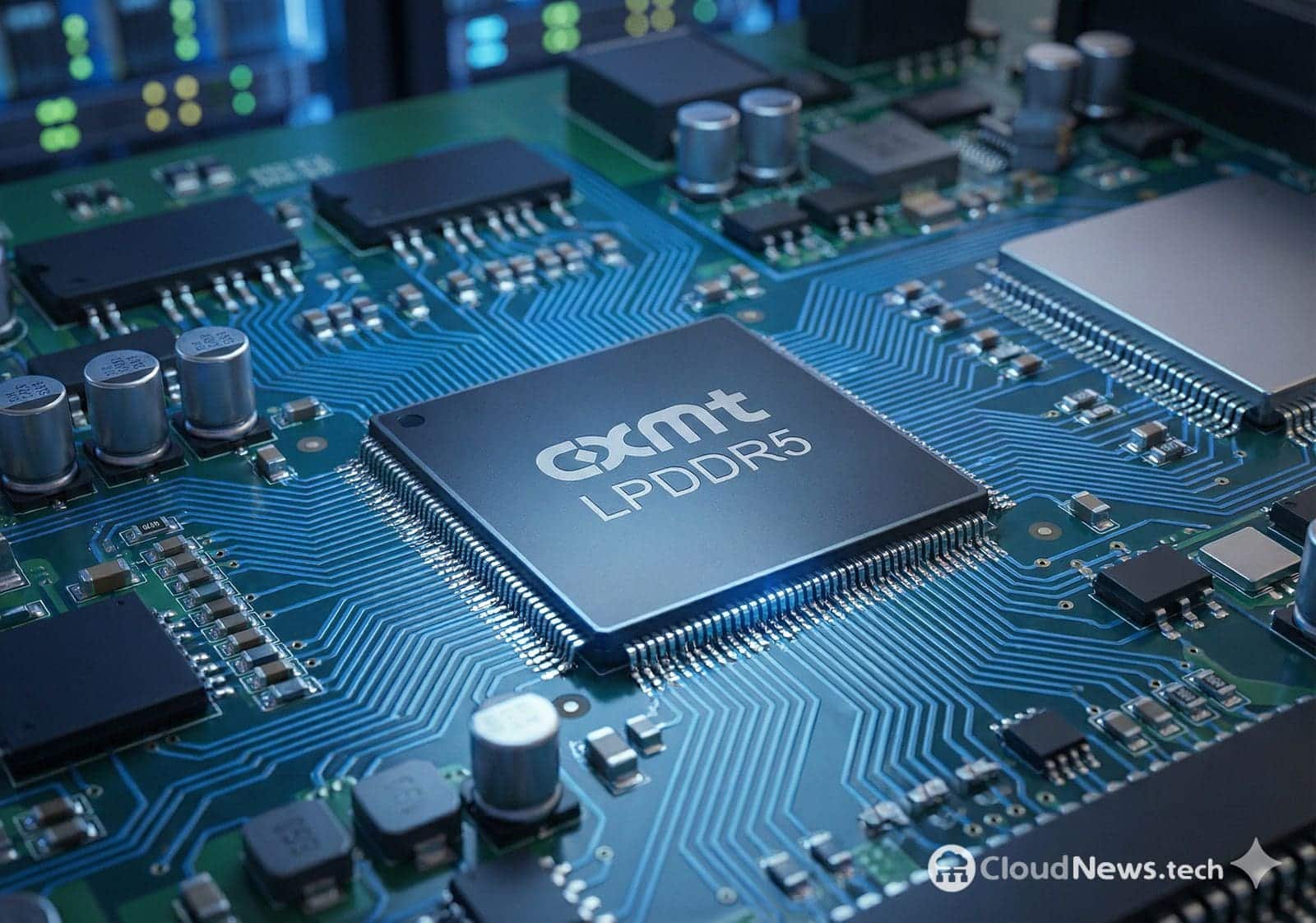
Chinese memory maker ChangXin Memory Technologies (CXMT) has announced the start of mass production of its LPDDR6 memory, which will have one of its first confirmed commercial destinations in the Xiaomi 18 Fold, expected in September. The move puts CXMT in the first wave of manufacturers able to take the new generation of mobile DRAM from samples and validation all the way to an actual consumer device.
CXMT’s LPDDR6: the key points in 20 seconds
- CXMT says its LPDDR6 memory has already entered mass production.
- Xiaomi will use these chips in the Xiaomi 18 Fold, expected in September.
- CXMT’s memory can reach up to 12.8Gbps, though the device may run it at a lower speed.
- LPDDR6 boosts bandwidth and is aimed at workloads like graphics and on-device AI.
- The announcement brings CXMT closer to Samsung, SK hynix, and Micron in advanced DRAM technology.
The news matters more for its timing than for any race to hit the highest speed. In early August, the information available still placed CXMT’s new memory in the final stages of validation. Now there’s a mass-production announcement, a smartphone maker that has confirmed it will use it, and a commercial product where it should be possible to check the results within a matter of weeks.
There are, however, some important caveats. CXMT hasn’t published its initial production volume, its wafer yield, or how many chips it can supply per month. Nor can these announcements alone be taken to mean it has technologically overtaken Samsung, SK hynix, or Micron.
What can be said is that the gap between China’s leading DRAM maker and the international leaders is narrowing in certain product generations.
From samples to a Xiaomi phone that will actually ship
CXMT confirmed on August 29 that it had begun mass-producing LPDDR6, and Xiaomi separately confirmed it will use this memory in its next foldable phone.
The Xiaomi 18 Fold is expected in September and will pair the new memory with the XRing O3, the processor Xiaomi designed in-house and built to work with LPDDR6.
This combination is especially interesting for China’s semiconductor industry.
A smartphone needs many components from different manufacturers, but two of the most important for its performance will, in this case, be Chinese-designed or Chinese-supplied: Xiaomi’s XRing O3 processor and CXMT’s DRAM.
That doesn’t make the phone a product fully independent of foreign technology. Chip manufacturing still relies on a very complex international supply chain, from the machines used in fabs to design software, materials, packaging, and production processes.
But it does represent considerable progress compared with the situation just a few years ago.
CXMT is trying to do in memory something similar to what other Chinese manufacturers have achieved in different semiconductor segments: gradually closing the technological gap with the big international suppliers.
LPDDR6 is a good test of how far it has come.
The new standard succeeds LPDDR5 and LPDDR5X, which are currently widely used in smartphones, tablets, and other low-power devices. LPDDR stands for Low Power Double Data Rate and is specifically designed to deliver high bandwidth while trying to keep power consumption in check, a combination that matters especially for battery-powered devices.
The LPDDR6 specification was developed by JEDEC, the organization behind many of the memory standards used across the industry.
CXMT had announced maximum speeds of 12.8Gbps and capacities of up to 16GB per product for its implementation, though the latter shouldn’t be confused with a claim that each individual die has a 16Gb density. The available documentation for the product refers to the maximum capacity of the assembled package.
The chip’s maximum speed also doesn’t necessarily mean the Xiaomi 18 Fold will actually use it.
Reports about the XRing O3 place its initial LPDDR6 operation at 10.667Gbps, while CXMT’s memory can reach a higher spec. The gap between a component’s maximum capability and the configuration chosen for a commercial device is common and can come down to power consumption, stability, thermal design, or the manufacturer’s own requirements.
More bandwidth for phones running ever more AI
The move to LPDDR6 arrives at a fairly convenient moment for smartphone makers.
For years, faster memory mainly served to feed increasingly powerful processors and graphics units. Now there’s a third consumer gaining importance: neural processing units (NPUs) dedicated to artificial intelligence.
Manufacturers want to run more models directly on-device.
Photo processing, image generation and editing, translation, voice recognition, personal assistants, and generative models can all benefit from local execution when the hardware has enough capacity.
Memory is an important part of that equation.
A processor can carry out an enormous number of operations per second, but it needs to receive data fast enough. That’s why memory bandwidth is gaining prominence both in massive data center accelerators and in chips built for smartphones.
LPDDR6 also reworks the interface layout compared with earlier generations, using two independent 12-bit subchannels per die, along with changes related to power management, reliability, and availability.
| Feature | CXMT’s LPDDR6 |
|---|---|
| Generation | LPDDR6 |
| Reported maximum speed | Up to 12.8Gbps |
| Announced maximum capacity | Up to 16GB |
| First confirmed device | Xiaomi 18 Fold |
| Paired processor | Xiaomi XRing O3 |
| Expected launch | September 2026 |
Power consumption will likely matter just as much as performance.
In a smartphone, every speed increase has to coexist with a limited battery and an extremely tight space for dissipating heat. Faster memory that sent power draw soaring would have fairly limited practical value.
That’s why the power efficiency improvements introduced across successive LPDDR generations matter so much for devices aiming to run more AI tasks without constantly relying on remote servers.
CXMT enters a race dominated by three giants
The other side of this story is who actually makes the memory.
The global DRAM market has for years been concentrated mainly around Samsung Electronics, SK hynix, and Micron. Entering the most advanced generations requires enormous investment, manufacturing processes that are difficult to develop, and the ability to produce millions of chips while keeping yields high enough.
CXMT still has to prove precisely that last part with LPDDR6.
Announcing mass production confirms the product has cleared an important milestone, but it doesn’t reveal how many good chips the company gets per wafer or what its effective supply capacity will actually be.
That’s an important distinction.
In semiconductors, it’s entirely possible to have a technically competitive design and, at the same time, struggle to manufacture it at scale at a reasonable cost.
SK hynix, for example, unveiled its 16Gb LPDDR6 in March 2026, based on its 1c process, the sixth generation of its 10-nanometer-class DRAM technology. The company said at the time it would ramp up mass production during the first half of the year and commercial supply during the second half.
So it would be premature to present CXMT as the global leader in LPDDR6.
Public announcements from the various manufacturers don’t use exactly the same metrics, nor do they provide enough information to compare volumes, manufacturing yields, power consumption, and costs on equal footing.
What stands out is something else: CXMT is taking part right from the start of LPDDR6’s commercial cycle.
A few years ago, China’s DRAM industry was several generations behind South Korean and American manufacturers. The company has now managed to reach a new memory generation almost at the same time as the rest of the major players are rolling out their own commercial launch.
On top of that, Xiaomi provides something any chipmaker needs after clearing the lab stage: real volume and a device where it can prove the technology actually works.
The Xiaomi 18 Fold will therefore be quite a bit more than just another foldable phone once it reaches the market.
It will show what speed the memory ultimately runs at, what configurations commercial units actually ship with, and whether CXMT can supply LPDDR6 on a sustained basis.
It will also be worth watching whether other manufacturers adopt its chips.
That will be the next important indicator. Going from samples to production is progress. Landing a major customer is too. Turning LPDDR6 into a product supplied steadily to multiple manufacturers would be a considerably bigger leap.
For China, the goal doesn’t end with smartphones either.
CXMT has flagged servers and smart vehicles among LPDDR6’s possible applications, though those mentions shouldn’t yet be read as confirmed commercial contracts. Each market has its own requirements and validation processes.
The Xiaomi 18 Fold’s arrival will provide the first real answers.
If commercial devices confirm the announced performance and CXMT manages to gradually scale up volumes, the Chinese manufacturer will have achieved something more significant than launching a new memory: proving it can take part from the earliest commercial stages of an advanced DRAM generation.
Frequently asked questions
Is CXMT already mass-producing LPDDR6?
Yes. CXMT announced on August 29, 2026, that its LPDDR6 has entered mass production. The company hasn’t publicly detailed its initial volumes or manufacturing yields.
Which phone will be first to use CXMT’s LPDDR6?
Xiaomi has confirmed it will use it in the Xiaomi 18 Fold, expected to launch in September 2026. The phone will pair this memory with Xiaomi’s XRing O3 processor.
What speed does CXMT’s LPDDR6 reach?
CXMT has announced a maximum speed of up to 12.8Gbps for its LPDDR6. That doesn’t mean every device that uses it will necessarily run at that maximum speed.
Is CXMT already on par with Samsung, SK hynix, and Micron?
Starting LPDDR6 production narrows the generational gap, but comparable data on volume, manufacturing yield, efficiency, cost, and supply are still missing to draw a direct equivalence with the world’s three major DRAM manufacturers.
