
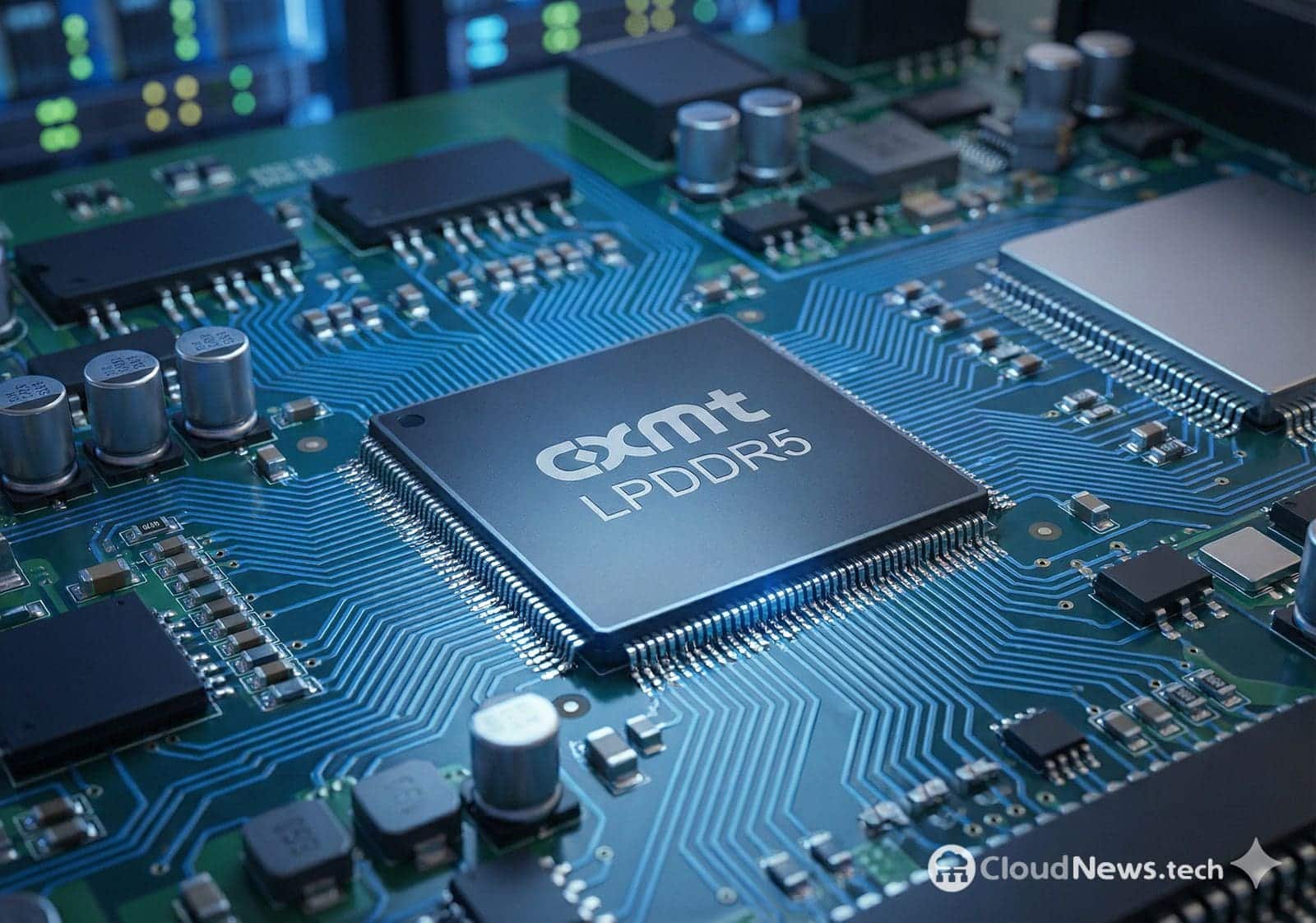
Chinese ChangXin Memory Technologies (CXMT) continues advancing its strategy to reduce the country’s dependence on foreign memory chip manufacturers. According to several Asian media outlets, the company has surpassed the R&D verification phase of its first LPDDR6 chips, a preliminary step before small-batch validation and later mass production. Although the company has not officially confirmed the timeline, this move reinforces the impression that it aims to compete as soon as possible in one of the most critical technologies for the next generation of devices with artificial intelligence.
The key points about CXMT’s LPDDR6 in 20 seconds
- CXMT has reportedly completed the R&D verification phase of its first LPDDR6 chips.
- Initial models suggest speeds of up to 12.8 Gbps, with a baseline speed of 10.7 Gbps, and a capacity of 16 Gb per chip.
- The next step would be validation in small batches before potential mass production.
- The company is trying to strengthen its presence in the mobile memory market while Samsung, SK Hynix, and Micron devote significant resources to HBM and server DRAM.
- This progress is part of China’s effort to bolster its domestic semiconductor industry.
The news comes just days after reports revealed that SK Hynix is preparing for mass production of its own LPDDR6 memory chips in the second half of 2026, signaling a new phase of competition in low-power memory segments for smartphones, AI laptops, and future smart devices.
LPDDR6 to become a key component for AI-enabled devices
LPDDR6 (Low Power Double Data Rate 6) memory is expected to gradually replace LPDDR5X over the coming years.
Besides increasing bandwidth, the new generation aims to improve power efficiency, a crucial aspect for smartphones, ultraportable computers, and devices designed to run AI models locally.
According to published information, CXMT’s initial chips are expected to achieve a maximum speed of 12,800 Mbps (12.8 Gbps), with a baseline speed of 10,667 Mbps (10.7 Gbps), a capacity of 16 Gb, and encapsulation of 1295 Ball PoP (Package on Package). These specifications align with early implementations planned for this standard.
While these figures still need validation in subsequent industrial phases, they indicate that the Chinese manufacturer aims to be close to international leaders from the start of the LPDDR6 transition.
Further expansion for CXMT
The verification phase does not mean the product is ready for commercial release.
Typically, in DRAM development, this stage is followed by validation in small batches, where manufacturing processes, performance, and production rates are adjusted before initiating large-scale fabrication.
Meanwhile, various reports suggest that CXMT is also adapting its supply chain and encapsulation processes to prepare for future memory generations, including LPDDR6 and DDR6.
All of this coincides with the company’s rapid expansion. After leading one of the largest IPOs of the year in Asia, CXMT’s shares closed their first trading day with an increase of nearly 466%, reflecting investor interest in China’s growing memory industry.
The battle is no longer just about HBM
Over the past two years, market attention has been focused on HBM (High Bandwidth Memory), essential for training large AI models.
However, the next significant competition will also be in low-power memories.
The expansion of so-called AI PCs, smartphones with integrated AI models, and other devices capable of local inference will drive demand for faster, lower-power LPDDR memories.
In this context, CXMT appears to be seeking opportunities different from those of Samsung, SK Hynix, or Micron. While major manufacturers focus most of their capacity on HBM and server DRAM, the Chinese company is attempting to strengthen its presence in the mobile and low-power computing sectors.
China accelerates its memory independence
CXMT’s progress in LPDDR6 complements other recent moves by the company.
It already manufactures DDR4, DDR5, LPDDR4X, and LPDDR5/5X memories, significantly increasing its production capacity over recent years as part of China’s strategy to develop a domestic semiconductor supply chain.
While still behind Samsung, SK Hynix, and Micron in advanced technologies and global market share, its investment and expansion pace suggest that competition in the international memory market will continue to intensify in the coming years.
The next milestone will occur when CXMT completes validation in small batches and confirms whether it will proceed toward commercial LPDDR6 production.
Frequently Asked Questions
What does it mean that CXMT has passed R&D verification?
It indicates that the initial chip design has completed a phase of technical validation. Before large-scale manufacturing, it still needs to pass small-batch production tests.
What speed will CXMT’s LPDDR6 memories have?
Published reports mention a maximum speed of 12.8 Gbps, with a baseline speed of 10.7 Gbps, and chips of 16 Gb capacity.
What devices are LPDDR6 intended for?
Primarily smartphones, laptops, tablets, and other low-power devices that require higher bandwidth to run AI applications.
Can it compete with Samsung and SK Hynix?
It’s still early to say. Samsung and SK Hynix lead in technology and market share, but CXMT’s developments confirm that China continues reducing the gap in the memory market.
