
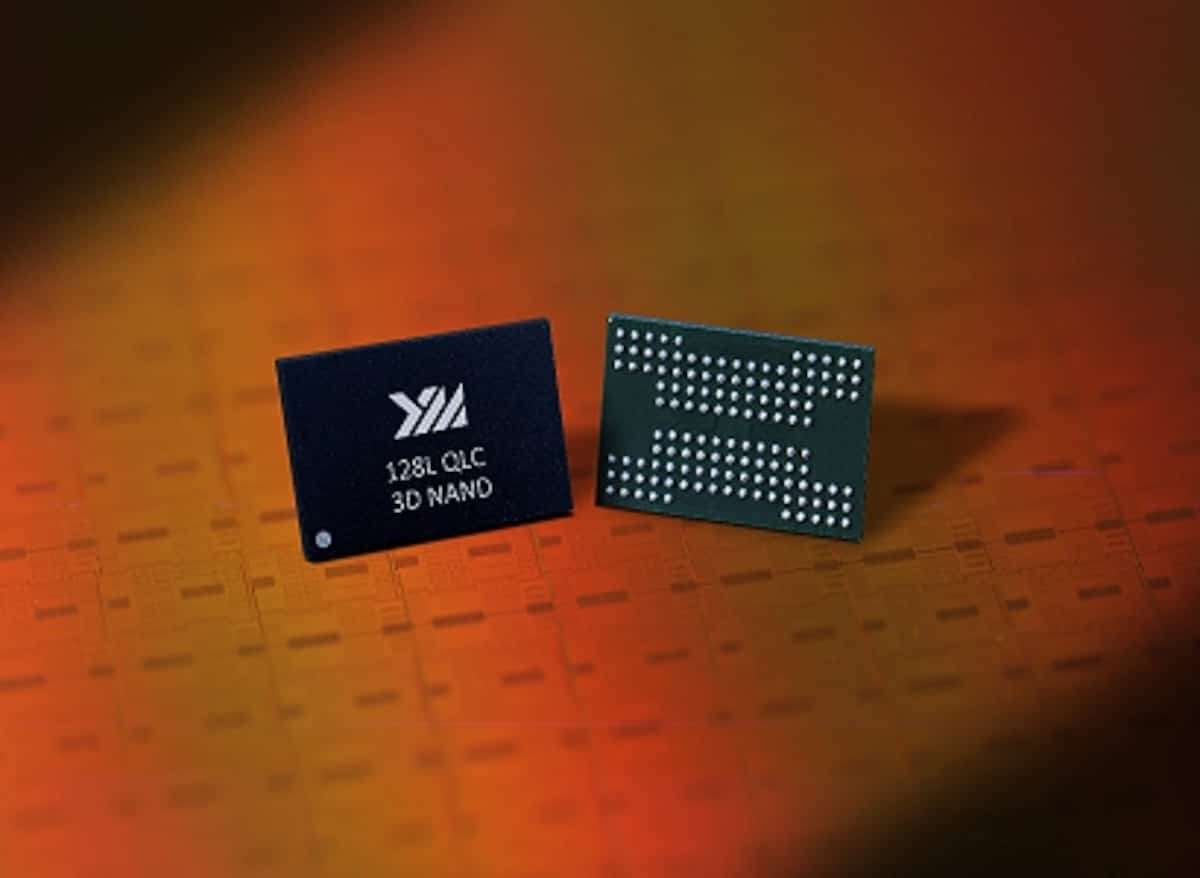
Chinese manufacturer Yangtze Memory Technologies (YMTC) wants to become the world’s largest NAND flash memory producer before the end of 2027, a goal that would mean overtaking Samsung and SK hynix in just over a year. The ambition comes after the company entered the global top three by NAND shipment volume for the first time, while it prepares an IPO aiming to raise about $4.9 billion to expand production and develop new technologies.
YMTC’s rise in 30 seconds
- YMTC now accounts for around 14% of NAND bits shipped worldwide, compared with 25% for Samsung and 22% for SK hynix.
- The Chinese company wants to reach the number one spot worldwide before the end of 2027 and is preparing an IPO worth about $4.9 billion.
- AI-driven demand for enterprise SSDs is reshaping the market: it now accounts for 48% of NAND bits shipped.
- YMTC’s challenge isn’t just producing more memory: it’s still only fifth worldwide by revenue.
The goal is especially ambitious given how far YMTC still trails its two main rivals. According to Counterpoint Research data for the second quarter of 2026, Samsung retains the lead with 25% of NAND bits shipped, followed by SK hynix, including Solidigm, at 22%. YMTC has reached 14% and has slightly overtaken Kioxia by volume, continuing the climb that first put it in third place worldwide.
The picture changes, however, when the business is measured by revenue. YMTC remains in fifth place, behind manufacturers it already surpasses in volume. That’s an important difference, because it shows that becoming the largest NAND producer doesn’t just depend on filling more wafers with chips — it also depends on gaining ground in higher-value products, especially those aimed at data centers.
From 14% to challenging for the global lead
YMTC has taken advantage of an especially favorable moment for the memory business.
Its shipments rose 22% year over year and 5% versus the previous quarter, according to Counterpoint. At the same time, Samsung has shifted part of its capacity to higher-margin DRAM products, which has helped push its NAND volume share down from 32% two years earlier to the current 25%.
The gap remains sizable.
Using current market share simply as a reference point, YMTC would need to grow its volume share by roughly 79% to go from 14% to the 25% Samsung currently holds. That figure isn’t a real forecast of the growth needed, since Samsung’s, SK hynix’s, and other manufacturers’ shares will also change over that period, but it helps put the scale of the goal into perspective.
Being third by volume but fifth by revenue also points to another of the Chinese manufacturer’s outstanding challenges.
Much of its expansion has come in consumer products, while the segment currently reshaping NAND market economics is on the server side.
Enterprise SSDs (eSSDs) accounted for 48% of all NAND bits shipped during the second quarter of 2026, up from 26% in the same period a year earlier. Counterpoint expects them to pass half the market before the year is out.
Artificial intelligence explains much of that shift.
Growing inference workloads increase the need to store and retrieve large datasets and caches quickly. That’s pushing a growing share of demand toward high-capacity, high-performance enterprise drives.
For YMTC, that means fighting on two fronts at once: producing more NAND and getting a larger share of it into high-value products.
An IPO to fund the expansion
The financial tool for speeding up those plans will be its Shanghai IPO.
YMTC has filed for an initial public offering aiming to raise roughly 33 billion yuan, about $4.9 billion, in one of the largest recent deals in China’s semiconductor sector, as we reported when the Shanghai listing process began.
The known filing documentation covers the issuance of roughly 2 to 2.4 billion new shares. The proceeds will mainly go toward upgrading and expanding manufacturing capacity and developing next-generation products.
The company arrives at this deal after an exceptional quarter.
During the first three months of 2026, it posted 47.04 billion yuan in revenue, around $7 billion, a figure higher than all of its 2024 revenue. Net profit reached 33.38 billion yuan.
But extrapolating those results would be risky.
YMTC is benefiting from a period of tight supply, high prices, and heavy factory utilization. The memory market is historically cyclical, and the huge amount of new capacity being planned across the industry could change those conditions.
That’s precisely where one of the biggest question marks in its strategy comes in.
The risk of swinging from NAND shortage to NAND glut
The current market favors manufacturers.
Strong demand for enterprise storage has coincided with supply constraints in consumer products. Counterpoint notes that NAND industry revenue during the second quarter multiplied roughly fivefold compared with the same period in 2025.
But building a semiconductor fab takes years, and investment decisions made during a period of shortage can start producing chips once the market has already shifted.
If YMTC rapidly ramps up capacity while Samsung, SK hynix, Kioxia, Micron, and SanDisk stick to their own investment plans, the market could end up with more NAND available than it needs.
That scenario would put pressure on prices and margins.
It wouldn’t be anything new. NAND and DRAM memory have historically gone through cycles where periods of strong demand and high prices encourage new investment, until rising production eventually creates a glut.
That’s why it’s too simplistic to read YMTC’s growth purely as a race to flood the market with cheap memory.
The company needs to increase production if it genuinely intends to move from its current 14% share to challenging for the global lead. But it also needs to do so without destroying the profitability that is funding that very expansion.
And it faces another obstacle that can’t be solved simply by building more fabs.
YMTC remains subject to US restrictions that limit its access to certain advanced semiconductor manufacturing technologies. The company has responded by leaning more heavily on domestic suppliers and technologies, and continues developing its Xtacking architecture, with 267-layer 3D NAND production and work on generations beyond 300 layers.
The goal of leading the market by 2027 will have to be achieved within those constraints.
The situation also reflects how much China’s semiconductor industry has changed.
Just a few years ago, YMTC had a much smaller international presence compared with Samsung, SK hynix, Kioxia, or Micron. It’s now in third place worldwide by NAND volume and has enough scale that its capacity decisions can affect the global balance of the market.
Even so, the current 14% share is still well behind Samsung’s 25%.
Reaching the top spot before the end of 2027 would require increasing production, winning customers, and advancing in the higher-value enterprise segments while its rivals keep investing.
YMTC has already proven it can gain share.
The next part will be considerably harder: proving it can turn that volume into a business capable of competing with Samsung and SK hynix on a sustained basis.
Frequently Asked Questions
What NAND market share does YMTC currently have?
YMTC reached roughly 14% of NAND bits shipped worldwide during the second quarter of 2026, according to Counterpoint Research. Samsung led with 25%, and SK hynix, including Solidigm, took second place with 22%.
When does YMTC want to become the largest NAND manufacturer?
The company’s stated goal is to reach the number one spot worldwide in NAND memory production before the end of 2027. Achieving that would mean overtaking both Samsung and SK hynix.
Why is demand for NAND memory growing so much?
One of the main drivers is growth in enterprise storage tied to data centers and artificial intelligence. Enterprise SSDs accounted for 48% of NAND bits shipped during the second quarter of 2026, up from 26% a year earlier.
Does YMTC already lead Samsung on any metric?
Not in the global NAND market. YMTC ranks third by bits shipped but is still fifth by revenue. Samsung continues to lead shipments with a roughly 25% share.
