
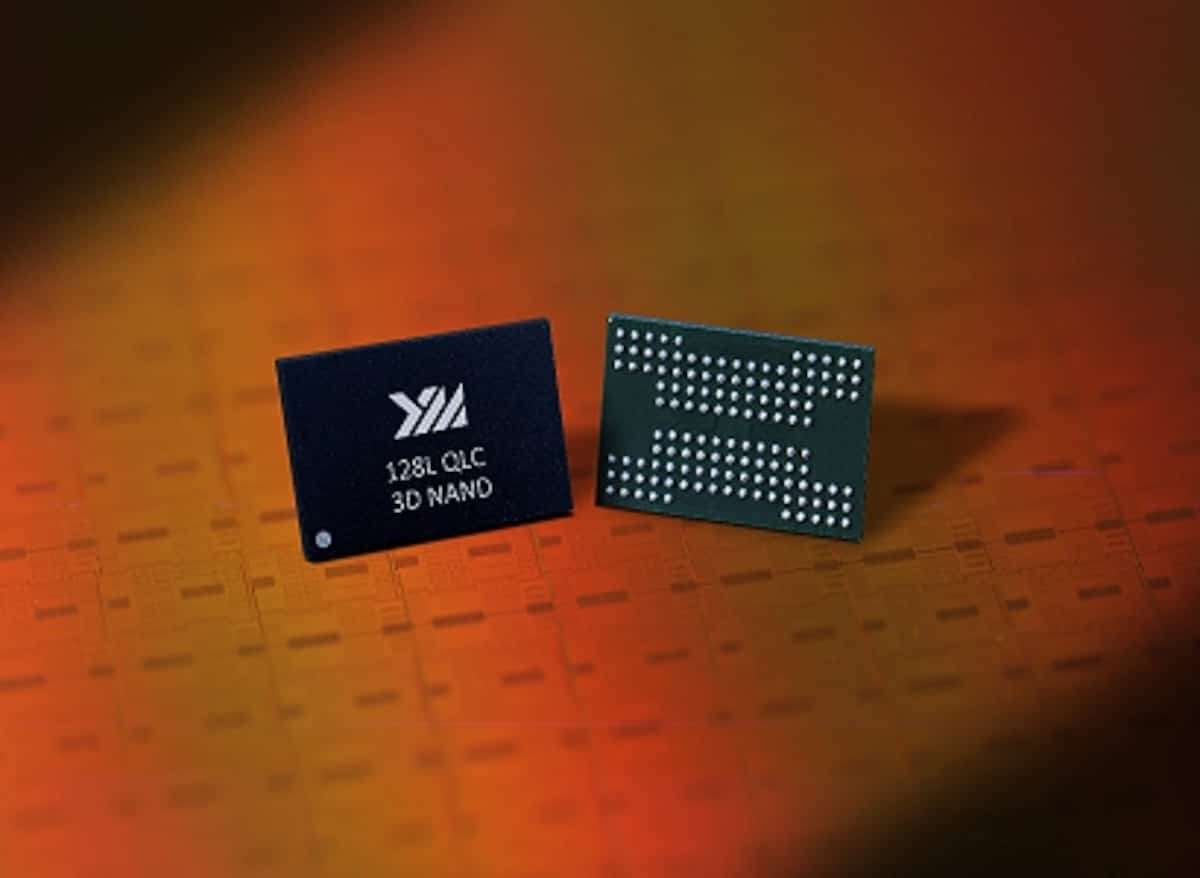
China is preparing another major stock market move in its semiconductor industry. CCSH Corporation, the parent of Yangtze Memory Technologies Corporation (YMTC), has started the process to list on Shanghai’s STAR Market, with an investment plan of 33 billion yuan, about 4 billion euros, mainly to expand production capacity and speed up new NAND memory and storage technologies.
YMTC’s IPO in 20 seconds
- CCSH plans to issue between 1,980 and 2,430 million shares, or 10-12% of the company’s equity after the deal.
- It’s weighing an over-allotment option of up to 15%.
- It has reserved 33 billion yuan for industrial investment and R&D.
- YMTC generates more than 90% of its parent’s revenue.
- The move follows CXMT’s historic IPO in July.
The final amount the company will raise isn’t set yet, since it depends on the offer price and investor demand. So it’s more accurate to talk about the 33 billion yuan CCSH plans to put toward its projects than to present that as the definitive proceeds from the initial public offering (IPO).
The timing is also favorable for Chinese memory makers. AI is raising storage needs in data centers, while Beijing keeps pushing to reduce reliance on foreign technology.
33 billion yuan for factories and R&D
CCSH’s prospectus lays out the issue of between 1,980 and 2,430 million new shares, or 10% to 12% of its expanded capital. It also includes an over-allotment option of up to 15%.
The company has earmarked 20.8 billion yuan to modernize and expand production lines, and another 12.2 billion for research and development. Together that’s 33 billion yuan.
CCSH is the entity going public, but the technically important asset in the group is YMTC, its wholly owned subsidiary that accounts for over 90% of revenue.
YMTC is one of the pillars of China’s plan to build a domestic memory industry. It specializes in NAND flash memory, used to store data non-volatilely in phones, computers, SSDs, servers, and enterprise storage.
That sets it apart from CXMT, another big Chinese company in the sector. CXMT mostly specializes in DRAM, while YMTC competes in NAND against international makers like Samsung Electronics, SK hynix, Kioxia, Micron, and SanDisk.
That distinction matters. China is trying to build capacity across different memory segments rather than create a single manufacturer covering everything.
The CXMT precedent raises expectations
The IPO comes just weeks after one of the year’s most striking listings.
CXMT debuted on the STAR Market on July 27, 2026. Its initial offer price was 8.66 yuan per share, raising about 57.9 billion yuan, beating the previous record held by Semiconductor Manufacturing International Corporation (SMIC) on this market. With the over-allotment exercised, estimates put the final figure above 66 billion yuan.
But it was the stock’s later performance that turned the deal into an extraordinary event.
CXMT closed its first day at 49 yuan per share, 465.82% above the offer price, reaching a market capitalization over 3.2 trillion yuan.
That doesn’t mean YMTC will repeat it. Each IPO has its own conditions, and key factors like the final offer price are still to be decided.
Still, the precedent explains why there’s so much attention on this new listing.
CCSH initially proposed a 33 billion yuan investment, above the 29.5 billion yuan CXMT first reserved for its own projects before going to market. CXMT ended up raising far more thanks to its structure and valuation at the final offer.
If CCSH draws comparable demand and expands its offering, the final amount could go well past its initial reference. For now that’s a possibility, not a confirmed figure.
AI is also reshaping the NAND business
YMTC’s strategic weight reaches beyond smartphones and consumer SSDs.
The spread of AI is reshaping the whole memory industry. Large AI systems need vast amounts of DRAM and high-bandwidth memory (HBM), but also growing demand for high-performance, high-capacity NAND storage.
Training models, storing massive datasets, keeping vector databases, supporting retrieval-augmented generation (RAG) systems, and running large-scale inference all mean handling ever larger volumes of data.
So the AI race touches not just NVIDIA and other accelerator makers but also DRAM, HBM, NAND, controllers, enterprise SSDs, and the whole storage chain.
YMTC plans to put part of its capital specifically toward researching advanced storage technologies and raising its industrial capacity.
The timing helps. Strong demand and supply tensions have improved NAND market conditions, even though memory is a historically cyclical business. Too much capacity expansion could lead to oversupply and downward price pressure later.
YMTC is still constrained by U.S. restrictions
The IPO also has a geopolitical side that’s hard to separate from the business.
YMTC was added in 2022 to the U.S. Department of Commerce’s Entity List, limiting its access to certain U.S.-origin equipment and technologies.
The company has gradually adapted its supply chain and manufacturing to that reality.
The challenge is to raise capacity and advance technologically while some of the most advanced chipmaking equipment stays under export controls. China’s industry is responding with more investment in domestic machinery, materials, and processes, but replacing an entire international chip fabrication supply chain takes time.
The IPO could give CCSH extra resources to speed that transition.
It also positions YMTC and CXMT as two complementary parts of China’s memory strategy: one aiming to gain ground internationally in NAND, the other in DRAM.
Their development will have effects beyond China. Samsung, SK hynix, Micron, Kioxia, and SanDisk have operated for decades in a sector marked by huge investments, cycles of oversupply and shortage, and a shrinking number of major players.
Chinese competitors able to invest tens of billions add a new dynamic.
AI may speed that up. As memory and storage demand in data centers keeps growing, China will have more economic and strategic reasons to fund manufacturers that can reduce reliance on foreign suppliers.
The CCSH IPO still has to finish its process and set a final price. But after CXMT’s spectacular debut, YMTC has become the next key test of how far Chinese markets will fund the drive for advanced memory manufacturing.
Frequently Asked Questions
How much does YMTC aim to raise with its IPO?
CCSH has reserved 33 billion yuan for projects tied to the deal, though the final amount raised will depend on the offer price and how many shares it ultimately sells.
Does YMTC make DRAM memory?
Its main product is NAND flash memory. CXMT, by contrast, specializes in DRAM, so the two occupy different spots in China’s semiconductor strategy.
What will CCSH use the money for?
The plan puts 20.8 billion yuan toward upgrading and expanding production lines and 12.2 billion toward research and development.
Could it beat CXMT’s IPO?
It’s possible, but not confirmed. CXMT raised over 66 billion yuan including the over-allotment, while CCSH hasn’t set a final offer price yet.
via: scmp
