
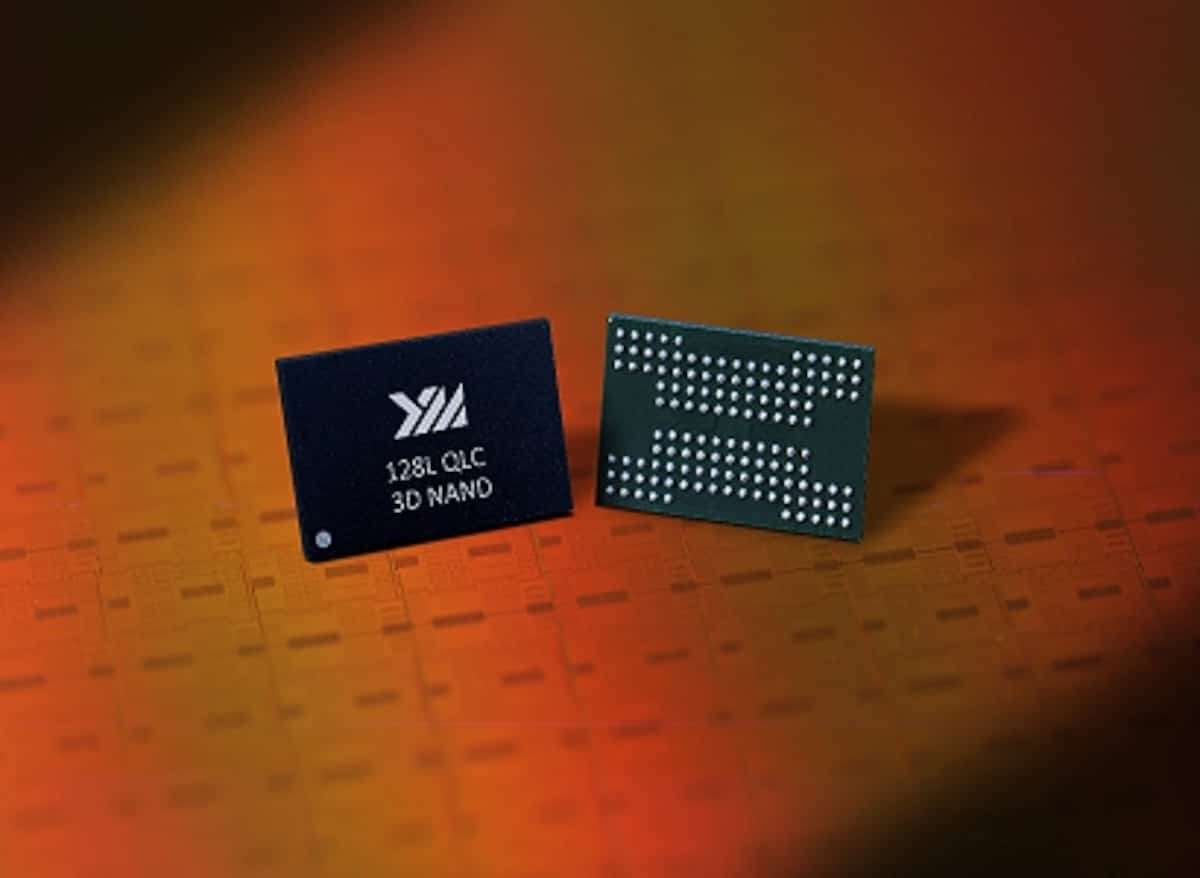
Yangtze Memory Technologies (YMTC) has reached a significant milestone for China’s semiconductor industry. The manufacturer ranked as the third largest NAND Flash memory supplier worldwide by volume of bits shipped in Q2 2026, with approximately 14% of the market share, according to Counterpoint Research. This data is especially noteworthy as the company is increasing capacity in Wuhan and gradually reducing its reliance on foreign equipment.
The key points of YMTC’s rise in 20 seconds
- YMTC achieved approximately 14% of the total NAND bits shipped globally in Q2 2026.
- Samsung maintains its leadership with a 25% share, while SK hynix, including Solidigm, ranks second with 22%.
- YMTC’s shipments grew by 22% year-over-year.
- AI is transforming the market: enterprise SSDs now account for 48% of NAND bits shipped.
- YMTC produces 3D NAND with 267 layers and is developing designs exceeding 300 layers.
However, the rise requires an important clarification. Being third in volume does not yet make YMTC the third-largest manufacturer by revenue. Counterpoint ranks the Chinese company in fifth position in terms of revenue, behind manufacturers with a greater presence in high-priced enterprise products.
This difference explains quite clearly what YMTC’s next battleground will be. Manufacturing large volumes of NAND is no longer enough. The growth of AI data centers is shifting the business toward high-capacity enterprise SSDs, where each sold bit can generate higher revenues.
Samsung and SK Hynix remain ahead, but YMTC is now among the front runners
The NAND market is still led by Samsung Electronics. Counterpoint attributes a 25% share of bits shipped during Q2 2026 to Samsung, although its share has decreased from 32% two years earlier.
Part of this evolution relates to a peculiar situation in the memory market. The enormous demand for DRAM, especially HBM (High Bandwidth Memory) used in AI accelerators, has led manufacturers to prioritize the most profitable products.
SK hynix ranks second with approximately 22%. Its NAND business has been strengthened by Solidigm, whose bits shipped grew by 40% compared to the previous quarter, according to Counterpoint.
Following behind is YMTC.
The Chinese company achieved 14% and narrowly surpassed Kioxia. The rounded percentages might make both appear similar, but Counterpoint explicitly places YMTC in third position. Micron trails with around 13%.
The evolution is remarkable considering where the Chinese manufacturer started. Its shipments increased by a 22% year-over-year and 5% compared to the previous quarter.
The NAND shortage has also played in its favor. YMTC has been able to increase supplies to Chinese manufacturers precisely when other suppliers were struggling to meet demand growth.
But another longer-term factor is even more important: its technology is beginning to approach that of manufacturers who have been developing memory for decades.
YMTC already manufactures volume NAND 3D TLC with 267 layers using Xtacking 4.0 and is working on generations exceeding 300 layers. DigiTimes reported this technological leap as early as 2025.
The company itself confirms that its fifth-generation NAND TLC entered mass production in 2024, followed by fifth-generation QLC products.
AI is turning enterprise SSDs into the major NAND business
The timing of YMTC achieving this position is not accidental.
AI is shifting the demand for memory. Counterpoint estimates that enterprise SSDs accounted for 48% of all NAND bits shipped in Q2 2026, up from 26% a year earlier.
That’s almost double.
AI inference expansion is adding another layer of demand to infrastructure. Servers need to store models, datasets, and large amounts of operational data, as well as scenarios where storage can play a role in managing KV caches.
Counterpoint expects SSDs for servers to absorb more than half of all NAND bits before the end of 2026.
This trend helps explain why YMTC’s shipment volume does not yet directly translate into revenue comparable to its competitors.
Its portfolio remains more focused on consumer applications, whereas companies like Kioxia or Micron have a larger presence in high-value enterprise SSDs.
Therefore, a predictable next move is that YMTC aims to increase the share of enterprise SSDs in its sales during the second half of 2026.
If successful, its volume ranking could also shift toward the revenue ranking as well.
More factories and increasingly Chinese machinery
The other part of the story is in Wuhan.
Currently, YMTC operates two factories with a combined capacity of around 200,000 wafers per month, according to various reports published this year.
The next phase of expansion is already underway.
A third factory aims to reach approximately 50,000 wafers per month by 2027. EE Times also reports that more than 50% of the equipment, materials, and tools in this new facility are sourced from Chinese suppliers.
This percentage might be even more significant than the additional capacity itself.
For years, YMTC has been subject to US restrictions that hinder its access to certain Western semiconductor manufacturing technologies. China’s response has been to develop its own supply chain for machinery, materials, and components.
The new factory becomes a large-scale industrial test: national tools are not enough; they must also achieve acceptable performance, availability, and wafer-level yield to compete economically with established manufacturers.
Known plans extend even further.
Various reports point to two additional facilities, each with a potential capacity of up to 100,000 wafers per month when fully operational.
This does not necessarily mean all this capacity will immediately enter the NAND market. Timelines are still uncertain, and some of the new facilities could also be dedicated to other types of memory.
Therefore, it’s premature to sum all numbers and assume YMTC will automatically have hundreds of thousands of additional NAND wafers.
However, the industrial direction is clear: China is building capacity to reduce dependence on foreign suppliers.
Xtacking remains YMTC’s technological hallmark
Much of YMTC’s technological competitiveness comes from Xtacking.
In conventional NAND, memory cells and many of the peripheral circuits needed for control are part of the same manufacturing process. YMTC’s approach involves separately fabricating the NAND array and peripheral circuits, then bonding the two components later.
The company publicly introduced this architecture in 2018. According to their technical description, circuits responsible for operations and I/O are processed on a separate wafer and later connected to the NAND array via numerous vertical interconnections.
This method allows for optimized design of logic and storage cells independently.
Xtacking 4.0 is the current evolution of this architecture, enabling YMTC to stay close to major manufacturers despite restrictions on access to some international tools.
The number of layers, however, should not be used alone as a measure of technological superiority. Performance, actual density, latency, power consumption, durability, costs, and manufacturing yield are equally important factors.
The third-place position broadens YMTC’s scope, but another battle remains
YMTC is no longer just a Chinese manufacturer trying to reduce the country’s external dependence.
With 14% of the NAND bits shipped globally, it now competes in volume within the main group of manufacturers.
It now needs to demonstrate that it can do the same in the most profitable segments.
The contrast between third place in shipments and fifth place in revenue probably best defines its current situation. YMTC has scale, but it still needs to improve its product mix to capture a larger share of the money flowing into enterprise storage.
The expansion of server SSDs provides exactly that opportunity.
It also poses a threat to its competitors. If YMTC combines new factories, over 300-layer NAND, a larger presence in enterprise SSDs, and an increasingly localized supply chain in China, Samsung, SK Hynix, Kioxia, and Micron will face a rival with significantly greater capacity to compete both technologically and on price.
And there is one last variable beyond YMTC’s control.
AI is capturing an increasingly larger share of global NAND production. If servers indeed surpass 50% of bits shipped in 2026, manufacturers will be strongly incentivized to allocate capacity to the most profitable enterprise products.
This could maintain pressure on supply for PCs, smartphones, and consumer SSDs, even as companies like YMTC increase their output.
Frequently Asked Questions
Is YMTC already the third-largest NAND manufacturer worldwide?
According to Counterpoint Research, yes—by bits shipped during Q2 2026, with about 14%. Samsung holds the first position, and SK Hynix is second.
Is it also third in terms of revenue?
No. Counterpoint ranks YMTC fifth by revenue because its portfolio is more exposed to consumer markets and has a lower share of high-priced enterprise SSDs.
What NAND technology is YMTC manufacturing?
The company produces fifth-generation 3D NAND using its Xtacking architecture. Industry sources estimate its current production at 267 layers, with designs in development exceeding 300 layers.
Why is NAND demand increasing so much?
Data centers and AI are boosting demand for enterprise SSDs. According to Counterpoint, these products already represented 48% of all NAND bits shipped in Q2 2026.
