
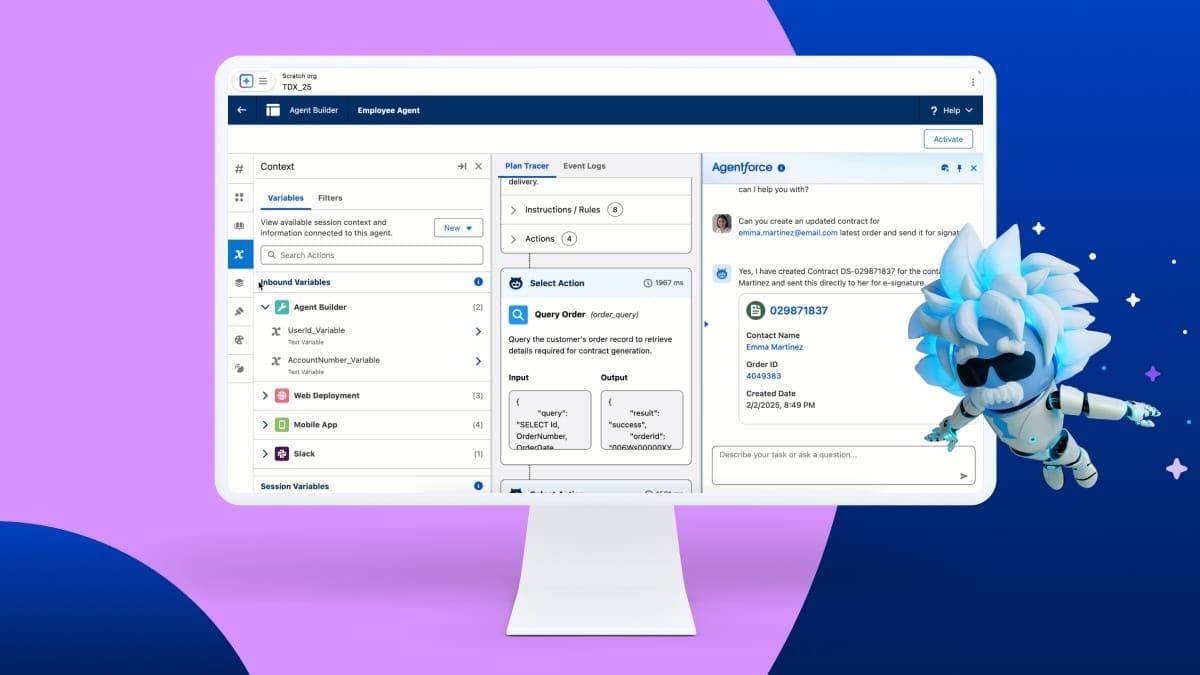
Siemens and Salesforce have expanded their alliance to connect Siemens’ industrial digital twins with Salesforce’s autonomous artificial intelligence in sales and service processes. The integration between Teamcenter and Agentforce aims to bring engineering data directly into commercial and customer-support workflows, with use cases ranging from identifying spare parts for a specific machine to checking whether a given upgrade is technically valid before preparing a quote. Siemens: Siemens and Salesforce Deepen AI Partnership to Redefine Industrial Sales and Service
The Siemens-Salesforce alliance in 20 seconds
- Siemens integrates its industrial digital twins with Salesforce’s Agentforce.
- Teamcenter brings technical product and machine data into sales workflows.
- AI agents can help select spare parts and validate possible upgrades.
- Siemens already uses Agentforce to manage sales leads in 132 countries.
- Two agents work together to contact, qualify, and route leads to salespeople.
The alliance starts from a common problem at industrial companies: much of the knowledge needed to respond to a customer sits in engineering systems, while sales and after-sales service run on different tools. Siemens and Salesforce want to connect both worlds so that specific technical information can be used directly during a sales or support interaction.
The offering combines Teamcenter, Siemens’ product lifecycle management platform, with Agentforce, Salesforce’s artificial intelligence agent platform. According to the companies, that connection makes it possible to bring product information and customer context into processes that until now might have required a specialist.
From the digital twin to customer service
One of the examples Siemens raises concerns technical service. A technician could look up which spare part matches a specific machine using its serial number before traveling to the customer’s site.
In sales, the system could help determine which upgrades are compatible with a given product configuration and which ones can actually be manufactured. For the end customer, that same information could be used to locate and request a part without waiting on a response from engineering.
The difference is that the product’s technical data becomes available directly inside the sales or service workflow. Siemens and Salesforce want agents to be able to use that information to answer certain queries without constantly bouncing them between departments.
The German company describes this model as part of building industrial enterprises with agentic AI capabilities. Salesforce, for its part, contributes Agentforce as a layer for working with data, business processes, actions, and governance mechanisms across different agent-based interfaces.
The approach also ties into the after-sales business. Siemens and Salesforce argue that connecting product information with customer context can help speed up service and quoting processes and open up new possibilities for services tied to equipment already installed in the field.
The announcement cites an industry analysis claiming the after-sales business grows roughly six times faster and carries about four times the margin of new equipment sales. That figure comes from a sector analysis cited by the companies, not from Siemens’ or Salesforce’s own financial results. Siemens: Siemens and Salesforce Deepen AI Partnership to Redefine Industrial Sales and Service
Siemens already uses agents in its own sales operation
The collaboration isn’t limited to the Teamcenter-Agentforce integration. Siemens has also deployed Agentforce to automate part of how it handles the leads that come through its sales channels.
The company was receiving more than 2,500 unqualified leads a month and, as it explains in the announcement, had no way to determine upfront which ones deserved a salesperson’s attention. Siemens now uses two AI agents that work in a coordinated fashion inside Sales Cloud.
The first is an engagement agent. Its job is to reach out to incoming leads and keep the conversation going when there’s interest. The second acts as a qualification agent, analyzing each opportunity before handing off the ones that meet the criteria to the relevant salesperson.
The system uses CRM data to personalize email messages. Each message includes a public key that identifies the lead without exposing the internal identifier of their record.
When the interested party clicks the qualification link, that key lets the agent pull up the corresponding sales record, confirm information, and add new data during the conversation. The information it can gather includes things like available budget or expected timelines.
Siemens says this system currently lets it interact with 100% of incoming leads across 132 countries. The announcement doesn’t provide a comparison against the share of contacts handled before the rollout, nor does it detail the conversion results achieved with the agents, so that figure alone doesn’t measure the system’s commercial impact.
The company also notes that this infrastructure supports its 18,000 salespeople, although the announcement doesn’t say all of them are being replaced or directly managed by agents. The role described is filtering and preparing opportunities before they’re routed to the sales team.
Connecting engineering, operations, and the business
Expanding the alliance points to an issue that especially affects manufacturers of complex products: the information needed to sell, maintain, or upgrade a machine can be scattered across multiple systems.
A digital twin can hold information about a product’s configuration and specs, while the sales system keeps customer data and the relationship history. By connecting both sources, an agent can work with technical and commercial information inside a single process, a pattern also showing up in other industrial AI deployments moving beyond digital assistants and into physical operations.
The scope announced still has to be understood as a combination of technology integration and business use cases. The announcement doesn’t describe a single platform replacing engineering, sales, or service systems, but rather a connection between Siemens’ and Salesforce’s technologies to bring AI capabilities into those workflows, similar to the integrations Salesforce has been building with other partners such as AWS.
For Siemens, the alliance is part of its industrial AI strategy, built on combining sector-specific expertise with AI systems. Salesforce, in turn, contributes its agent infrastructure and its integration with enterprise data, processes, actions, and policies.
The German company closed its 2025 fiscal year, which ended September 30 of that year, with €78.9 billion in revenue and €10.4 billion in net profit, according to figures included in the announcement. Siemens had around 318,000 employees worldwide at the close of that fiscal year, based on continuing operations.
The expanded alliance now puts the focus on a specific part of industrial activity: using the product’s technical information right where the customer interaction happens. If these integrations work as the companies describe, certain queries that previously required moving information between sales, service, and engineering could be resolved within the same workflow.
Frequently asked questions
What are Siemens and Salesforce integrating?
The alliance connects Siemens’ digital twins and industrial information, particularly through Teamcenter, with Salesforce’s Agentforce and its AI agent capabilities.
What can this integration be used for?
Described use cases include identifying spare parts for a specific machine, checking compatible upgrades, and consulting technical information during sales or service processes.
How does Siemens use Agentforce in its own sales?
The company uses two agents, one for engagement and one for qualification, to manage incoming leads before routing the relevant opportunities to salespeople.
In how many countries does Siemens use this agent system?
Siemens says it currently interacts with 100% of its incoming leads through this system across 132 countries.
