
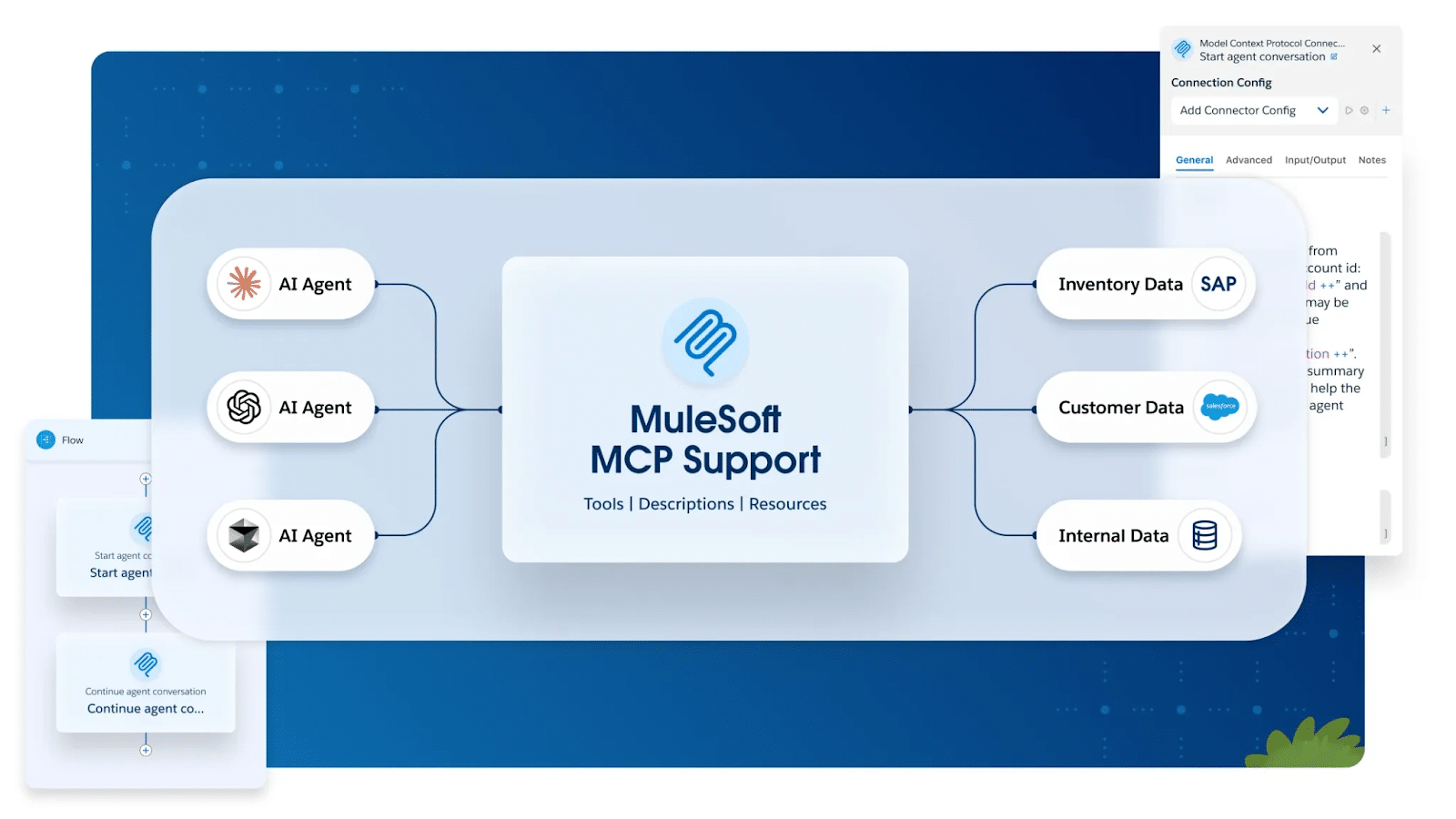
AWS and Salesforce have expanded their alliance with a batch of integrations that connect CRM data, AI agents, foundation models, and voice communications across their respective platforms. The updates include access to Salesforce context from Amazon Quick, AWS agents inside Slack, more sources supported by Data 360 Zero Copy, and communication between Agentforce Voice and Amazon Connect via the Agent2Agent (A2A) protocol. Some features are already available, and others will arrive during fall 2026.
The AWS-Salesforce alliance: the key points in 20 seconds
- Amazon Quick can access Salesforce’s enterprise context and data via the Model Context Protocol (MCP).
- AWS DevOps Agent can already work from within Slack; other AWS agents will arrive in the fall.
- Agentforce is expanding its access to models available through Amazon Bedrock.
- Data 360 Zero Copy adds new AWS data sources without duplicating data.
- Agentforce Voice and Amazon Connect will add real-time, two-way audio A2A communication.
The announcement brings together different technologies, but shares one idea: keeping companies from having to continuously move data and users between applications to use artificial intelligence. Rather than creating another standalone environment for agents, AWS and Salesforce want to embed them into the tools where conversations, data, and business processes already exist.
There’s also an interoperability component. MCP is used to connect tools with enterprise context, while A2A shows up in agent-to-agent communication, in this case to coordinate voice services. These are different protocols and shouldn’t be confused, though both are part of an architecture aimed at reducing one-off integrations between applications.
Amazon Quick gains access to Salesforce’s enterprise context
One of the most visible integrations makes it possible to use Salesforce information directly from Amazon Quick.
Salesforce’s headless architecture exposes data, context, and capabilities using the Model Context Protocol (MCP). According to the companies, this lets Quick work with Salesforce without every customer having to build a custom integration for that access.
A sales team, for example, could request information on the status of opportunities, accounts, open cases, or recent activity, and pull it together to prepare for a meeting.
The difference from simply querying a database lies in the context.
CRM systems contain relationships between customers, opportunities, activities, cases, and business processes. For an agent to give useful answers, finding a record isn’t necessarily enough — it needs to interpret those relationships while respecting established permissions and rules.
AWS and Salesforce present the integration as a way to preserve that context when working from Quick.
At the same time, AWS agents are entering Slack.
AWS DevOps Agent is already available inside Salesforce’s collaboration tool. AWS Security Agent, AWS FinOps Agent, and the AWS Partner Central agents are planned for fall 2026.
The idea is that a technical team can investigate certain issues without leaving the channel where they’re coordinating their work.
For example, during an incident, engineers could interact with DevOps Agent directly from the Slack conversation, keeping the exchange taking place among team members as context.
This can cut down on switching between applications, though it also raises the stakes for controlling what information from a conversation an agent can use and what actions it’s authorized to take.
Agentforce expands the models available through Amazon Bedrock
The collaboration also touches the model layer.
Salesforce Agentforce customers can access models available through Amazon Bedrock from their agents, including Anthropic and NVIDIA models mentioned in the announcement.
AWS and Salesforce also say that OpenAI models, already available on Amazon Bedrock, will come to Agentforce later.
That last point matters: availability on Bedrock doesn’t mean the Agentforce integration is already live. The announcement frames it as a future addition.
The architecture reflects a growing trend among enterprise platforms: allowing different models to be used depending on the task.
Not every task necessarily needs the biggest model. A company might weigh cost, latency, reasoning ability, code generation, available context, or regulatory requirements before choosing which model to use for each agent.
Salesforce layers its Trust Layer on top of this architecture, while AWS says Bedrock enforces policies designed to keep providers from using customer data to train their models.
The announcement also mentions requirements and frameworks such as HIPAA, PCI, SOC 2, and ISO 42001. Their specific applicability depends on the service, configuration, region, and use case, so the presence of these capabilities on the platform doesn’t automatically make any given customer deployment compliant with a particular regulation.
Zero Copy expands available sources without duplicating data
Probably one of the most important pieces of the announcement sits outside generative models altogether.
Salesforce is expanding Data 360 Zero Copy to access more sources hosted on AWS.
The list includes Apache Iceberg tables managed through AWS Glue, Iceberg tables stored in Amazon S3, Amazon Aurora, Amazon Relational Database Service (RDS), and SageMaker Lakehouse. These options add to existing support for Amazon Redshift and S3 with private connectivity.
The goal is to query and use enterprise information without necessarily creating an additional copy inside Salesforce.
| Integration | Main function | Announced availability |
|---|---|---|
| Salesforce in Amazon Quick | Access to CRM data and context | Available |
| AWS DevOps Agent in Slack | Assisted operations from conversations | Available |
| Other AWS agents in Slack | Security, FinOps, and Partner Central | Fall 2026 |
| Bedrock models in Agentforce | Model choice for agents | Available, with more planned |
| Data 360 Zero Copy | Access to more AWS sources without duplication | Available |
| Informatica + AgentCore/Quick | Data context and quality via MCP | Available |
| Agentforce Voice + Amazon Connect | Voice A2A communication | Fall 2026 |
| Voice dictation in Slack | Transcription on AWS Trainium | Available |
Avoiding duplication can cut costs and simplify governance, but Zero Copy doesn’t mean no data moves between systems at all. Applications still run queries and process information. The difference lies in avoiding another persistent copy of the dataset solely to make it usable from the connected platform.
This matters even more with AI agents.
If an organization needs to copy information from different systems every time it wants to give an agent context, it ends up accumulating replicas whose updates, permissions, and lifecycle all need to be managed.
The proposed alternative is to bring the agent closer to the data while preserving existing controls as much as possible.
AWS and Salesforce are also exploring sharing semantic information bidirectionally with AWS Glue Data Catalog. The announcement presents this as exploratory work, not as a feature currently available.
Informatica brings its MCP servers to AgentCore and Amazon Quick
The collaboration also includes Informatica.
The company is expanding its MCP servers’ capabilities to provide catalog management, discovery, and enrichment functions, data quality scoring, and master data retrieval.
These integrations can be used from Amazon Bedrock AgentCore and Amazon Quick.
This raises another common problem in enterprise AI: letting a model query information doesn’t guarantee that information is fit for purpose.
Duplicates, stale records, different names for the same entity, or incomplete fields can degrade an agent’s answers even when the model itself works correctly.
The catalog, quality, and master data capabilities try to provide an extra layer before that information ends up inside the context used by the AI.
Agentforce and Amazon Connect will let two agents talk by voice
The most technically eye-catching integration will arrive this fall.
Agentforce Voice and Amazon Connect Customer will add Agent2Agent (A2A) support to establish direct communication between agents via real-time, two-way audio over WebSockets.
The idea is for agents to coordinate across both platforms during a voice interaction.
This opens up the possibility of keeping a specialized system in Salesforce and another within AWS’s customer service environment without necessarily having to replace either one.
The announcement doesn’t mean, however, that this capability is already available. AWS and Salesforce place its arrival in fall 2026.
There will also be voice dictation within Slack.
Salesforce AI Research has worked with AWS to adapt its proprietary speech recognition models to AWS Trainium accelerators. Users will be able to dictate content within a thread and get a low-latency transcription.
The companies say using purpose-built hardware cuts inference costs and passes that benefit on to customers, though the announcement doesn’t provide figures that would let the savings be quantified publicly.
An alliance that also simplifies buying Salesforce through AWS
The relationship between the two companies also has a commercial component.
Salesforce Clouds products are available through AWS Marketplace in 33 countries. Certain customers can apply eligible AWS spending commitments to Salesforce products, including Agentforce, and consolidate part of their contracting and billing.
This can matter for large organizations that already hold spending commitments with a cloud provider.
But the technology side of the announcement reflects a broader shift.
During the first stage of enterprise generative AI, many organizations connected chatbots to individual documents or applications. The next phase is shifting attention toward agents capable of using different models, querying distributed data, and acting inside existing enterprise tools.
That requires solving problems that don’t depend solely on model quality: identity, permissions, data provenance, context, auditing, and agent-to-agent communication.
AWS and Salesforce are trying to cover several of those pieces by using MCP to connect tools and context, Zero Copy to access information without maintaining new replicas, and A2A to let agents on different platforms coordinate.
The result isn’t yet a fully vendor-independent environment. Many of the announced capabilities remain tied to specific AWS and Salesforce products. But it does show how two major enterprise platforms are trying to let their respective agents, data, and services work together without forcing users to concentrate everything inside a single application or move all their data into another repository first.
