
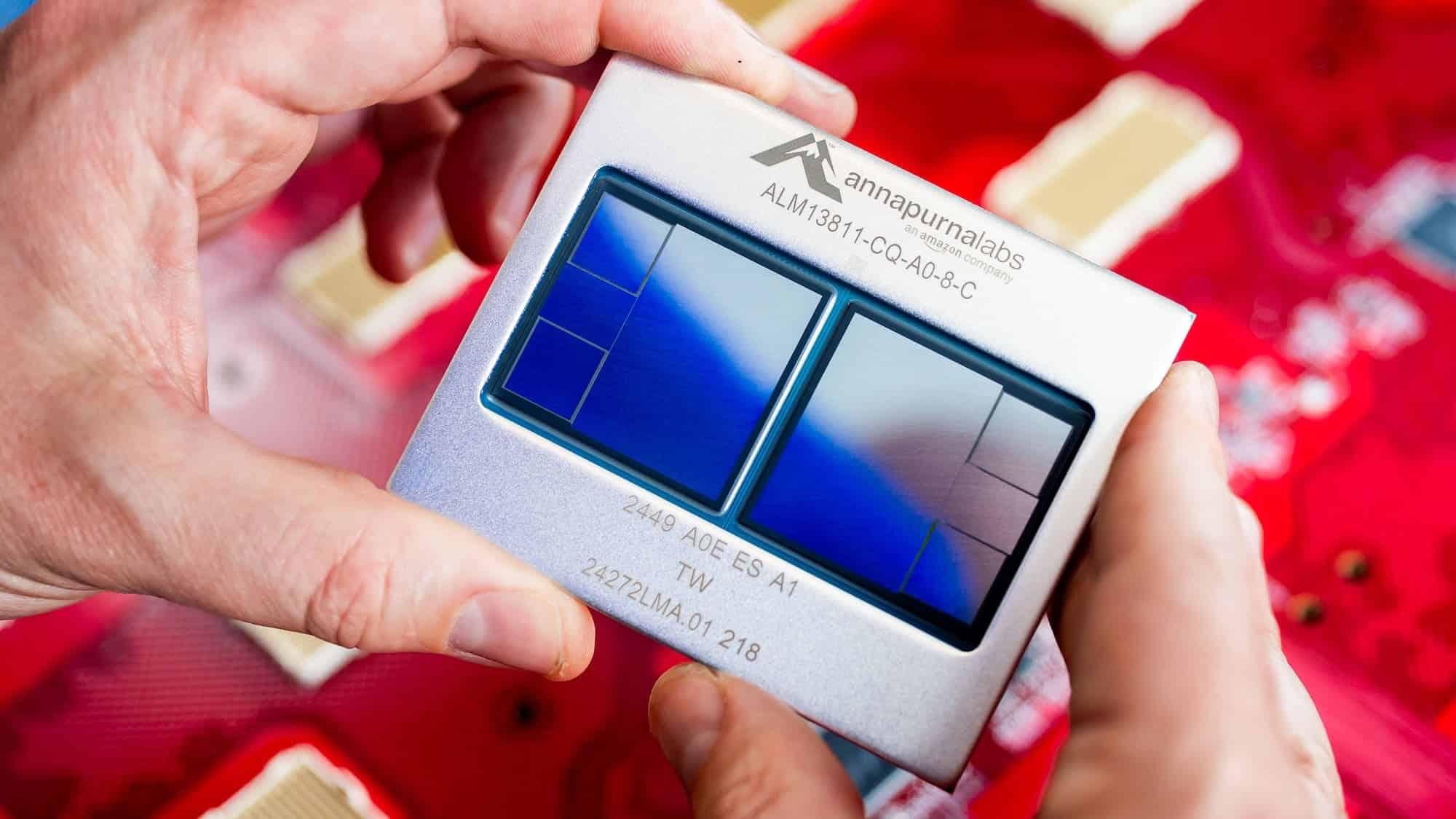
AWS is intensifying its investment in proprietary chips for artificial intelligence. According to supply chain sources cited by Asian media, Amazon Web Services has increased its target of server shipments with Trainium 3 by 20% to 30% for Q3. Industry analysts interpret this as a clear sign that the company isn’t just adjusting forecasts but proactively ordering capacity to ensure supply and capture market share in a landscape where AI infrastructure has become the main bottleneck.
This information aligns with public signals AWS has been hinting at for months. Andy Jassy, Amazon’s CEO, stated in April that Trainium 3 had begun shipping early in 2026, offering a 30-40% better price-performance ratio than Trainium 2 and that it was nearly fully booked. He also mentioned that a large portion of Trainium 4, which is still about 18 months away from broad release, was already reserved.
The move comes at a time when major cloud providers are no longer willing to rely solely on general-purpose GPUs, regardless of their power. NVIDIA continues to dominate the AI accelerator market, but AWS, Google, Microsoft, and Meta are pushing their own ASICs to cut costs, ensure supply, and tailor hardware to their internal workloads.
Trainium Becomes a Prime Option
Originally, Trainium was AWS’s bet on building custom silicon for AI training and inference. For years, these chips were seen as cost-efficient options mainly for highly integrated AWS customers, without challenging the broader GPU ecosystem directly. That perception is shifting.
Amazon now presents Trainium as an accelerator designed to improve the economics of large-scale AI workloads, not just as an isolated chip. The company emphasizes that its advantage lies in the integrated design of the chip, server, network, software, and cloud services, including Neuron SDK, EFA, Nitro, Graviton, and SageMaker HyperPod, all functioning as part of a cohesive system.
The Trainium 3 generation reinforces this narrative. AWS announced Trn3 UltraServers equipped with up to 144 Trainium 3 chips, delivering up to 362 FP8 PFLOPS—4.4 times more computational power, four times greater energy efficiency, and nearly four times more memory bandwidth compared to Trainium 2 UltraServers. Additionally, they highlighted that Bedrock is now supporting production workloads on Trainium 3.
From a business perspective, the significance is as critical as the technical details. With Trainium 2 nearing depletion, Trainium 3 almost fully booked, and demand for Trainium 4 already emerging ahead of its market release, AWS is no longer merely promising; it is actively building a supply chain capable of supporting clients needing billions of tokens, continuous training, and large-scale inference.
Anthropic, OpenAI, and Uber Drive Demand
A key driver behind this rising demand is Anthropic. In April, Anthropic and AWS announced an expanded partnership involving over $100 billion in AWS technology over ten years and up to 5 GW of new capacity for training and running Claude. This commitment covers current and future generations of Graviton and Trainium—from Trainium 2 to Trainium 4.
AWS views this as a validation of its proprietary silicon. Jassy explained that Anthropic’s commitment to run its large models on AWS Trainium over the next decade reflects a mutual advancement in custom AI chips.
OpenAI also features prominently. In February, the organization announced an eight-year, $100 billion expansion of its agreement with AWS, including a commitment to consume approximately 2 GW of Trainium capacity via AWS infrastructure, incorporating Trainium 3 and Trainium 4.
Uber adds another important customer profile. The company is expanding its use of AWS with Graviton 4 for low-latency workloads and Trainium 3 for training AI models powering its applications.
This mix is significant because it covers a broad spectrum of workloads—from frontier models and mass capacity applications to operational tasks, real-time prediction, and personalization. Bedrock, with over 125,000 clients according to Amazon, further extends the enterprise inference layer.
Taiwan Enters Production Ramp Phase
AWS’s increased targets are also seen as positive news for Taiwan’s supply chain. According to data from Futunn sourced from suppliers, server motherboard components for Trainium 3 started shipping in May and are increasing monthly. Orders for cabinet-level systems and rail components are expected to enter mass production in July, with a more substantial uptick forecasted for Q3.
Potential beneficiaries include thermal management providers such as Dynatron, Maxco, and Sunon; chassis manufacturers like Chenbro; and Level 6 assembly houses like Accton Technology. Suppliers of rails and mechanical components such as Chuang Hu and Nan Jyun are also involved.
This is critical because AI infrastructure now goes beyond just the chip. Each generation of accelerated servers demands more advanced circuit boards, better materials, thermal integration, liquid or hybrid cooling, tailored chassis, reinforced rails, cabling, power supplies, rack-level assembly, and system validation.
When AWS accelerates or increases orders, the impact propagates throughout this entire supply chain. A 20-30% increase in shipments means more than just ASICs; it entails more mechanical components, higher assembly capacity, increased cooling demands, and additional work for ODMs integrating full systems.
The ASIC vs. GPU Race Accelerates
The surge in Trainium 3 orders coincides with broader market shifts. DIGITIMES Research expects ASIC server shipments to grow 64.2% year-over-year in 2026, compared to 43.8% for GPU servers. While GPUs will still dominate in value and software maturity, the relative growth of ASICs will be higher as hyperscalers bring their own designs into production.
Google has demonstrated for years the value of TPUs for internal workloads and cloud customers. AWS aims for Trainium to play an equivalent role within its ecosystem. Microsoft has its Maia line, and Meta is accelerating its MTIA project. The underlying rationale is clear: control of the cloud, workloads, and part of the software stack enables designing chips better tailored to specific needs, rather than relying solely on general-purpose solutions.
This doesn’t spell the immediate end for NVIDIA. AWS will continue to buy and sell NVIDIA GPU infrastructure since many clients depend on CUDA, its ecosystem, and available models and libraries. However, the dynamics are shifting. If Trainium can increasingly handle inference and training at a lower cost per token, AWS reduces reliance on external vendors, improves margins, and offers a new capacity option to its customers.
Competition will no longer be solely about raw performance. Cost per token, availability, energy efficiency, migration ease, framework support, Neuron software stability, network scaling, reservation wait times, and final service price will weigh heavily, especially in enterprise AI where these variables can outweigh benchmark scores.
Key Market Watch Points
The primary indicator will be the actual ramp-up in the second half of the year. Persistent increases in Taiwan-sourced Level 6 and Level 11 components will signal that Trainium 3 is entering volume production, not just targeted deployments.
Another will be adoption beyond anchor clients. While Anthropic, OpenAI, and Uber lend credibility, AWS needs broader industry adoption of Trainium within Bedrock, SageMaker, and its proprietary workloads. The main barrier will be software: the easier it is to shift from GPU to Trainium seamlessly, the more likely the economic promise will translate into actual consumption.
The third indicator is Trainium 4. If a significant portion of its capacity is already reserved before broad release, AWS may be tempted to accelerate its timetable. While this would further strain the supply chain, it would also strengthen its stance against Google TPU and upcoming NVIDIA and AMD generations.
AI has turned hardware into a capacity race. Models demand more compute, clients want lower prices, and cloud providers aim to control more layers of the infrastructure. Trainium 3 is a direct response to these trends. If order growth continues, it signals that the AI ASIC market is entering a far more serious phase.
Frequently Asked Questions
What is AWS Trainium 3?
It is the third-generation AI chip designed by AWS for training and inference of models, integrated into its own servers and cloud services.
Why would AWS have increased orders for Trainium 3 servers?
According to supply chain sources, due to higher-than-expected demand and the need to accelerate capacity for clients like Anthropic, OpenAI, Uber, and enterprise users of Bedrock.
Which companies in Taiwan could benefit?
Thermal management suppliers such as Dynatron, Maxco, and Sunon; chassis makers like Chenbro; and Level 6 assembly providers such as Accton, as well as rail and mechanical component vendors like Chuang Hu and Nan Jyun.
Will Trainium replace NVIDIA GPUs?
Not immediately. NVIDIA remains dominant, but Trainium enables AWS to cover part of its AI workloads with custom silicon, reducing dependence in certain scenarios.
Why is the growth of AI ASICs happening?
Because large cloud providers can design chips tailored to their own workloads, improve costs, secure supply, and differentiate their services from competitors.
