
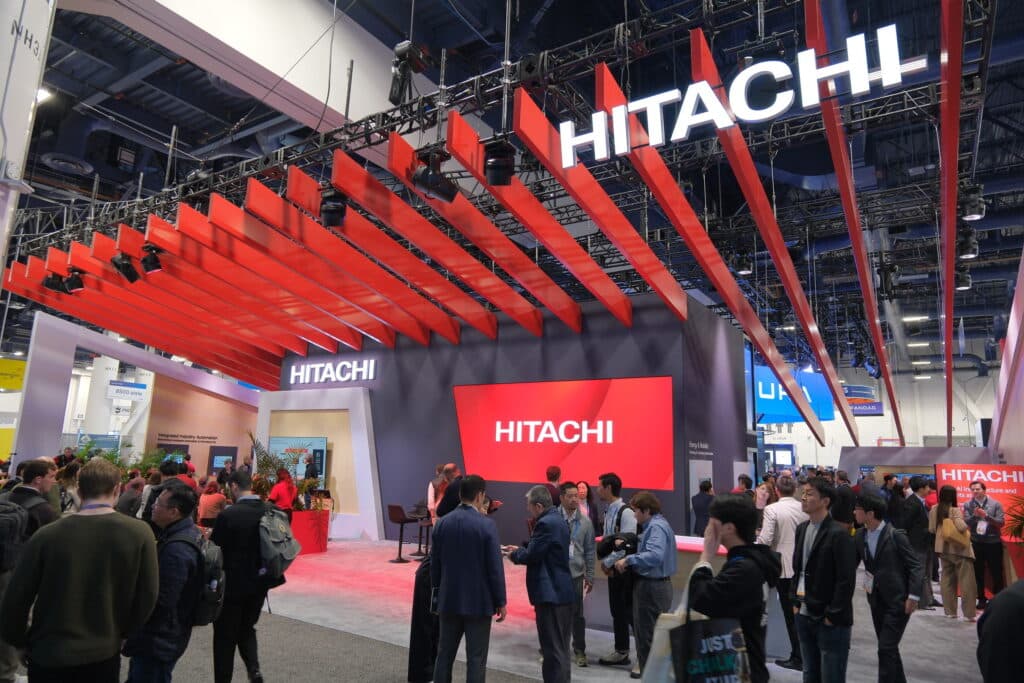
Hitachi has unveiled HMAX Data Fabric, HMAX AI Operations, and Physical AI FDE Service, three new solutions aimed at moving artificial intelligence beyond digital assistants and into factories, power grids, railways, robots, and other infrastructure where a software decision can end up triggering an action in the physical world. The company wants to turn operational data and the knowledge held by skilled workers into information that AI models can interpret, while keeping oversight over safety, performance, and operations.
HMAX and Hitachi’s bet on physical AI, in 30 seconds
- HMAX Data Fabric combines IT and operational technology (OT) data and structures it using ontologies and knowledge graphs so AI systems can use it.
- Physical AI FDE Service brings Hitachi specialist teams into projects to extract and digitize knowledge that normally resides with experienced workers.
- HMAX AI Operations monitors performance, security, governance, costs, and AI-specific risks.
- The platform can feed models used to control robots and equipment, as well as agentic AI applications.
- All three offerings have been available since September 3, 2026, with pricing available on request.
This push addresses a problem that shows up when companies try to take generative AI and agents beyond the desktop. A company can connect a language model to its corporate documents relatively quickly. Getting an AI to participate in operating a factory, a rail system, or energy infrastructure requires knowledge of physical constraints, relationships between equipment, procedures, and safety rules that often aren’t even documented.
Hitachi wants to use its operational technology experience as precisely that differentiator. The company says it has been involved, together with customers and partners, in roughly 15,000 mission-critical core systems, on top of more than a century of industrial experience.
Its bet with HMAX is to try to turn part of that operational knowledge into a structured layer that AI can use.
HMAX Data Fabric Tries to Teach AI What the Data Means
A factory can generate millions of data points and still struggle to put them to work with artificial intelligence.
The problem isn’t always having the information — it’s understanding it.
A reading of 82 degrees could come from a motor, a boiler, a cooling system, or an ambient sensor. The number alone says little. Interpreting it requires knowing what it represents, which piece of equipment it comes from, which other components depend on it, and what its normal operating limits are.
HMAX Data Fabric tries to provide that context.
The platform integrates data from IT and OT systems and uses ontologies to describe its meaning and the relationships between assets, processes, and variables.
It then organizes that information using knowledge graphs, structures that represent entities and the relationships between them.
The goal is for an AI model to find not just a collection of records, but information paired with enough context to reason about it.
Hitachi uses rail as an example.
If signs of a problem appear on a train or in rail infrastructure, HMAX Data Fabric can link information about the current state of different components to the historical behavior of those assets.
From there, AI could help identify the cause of the anomaly and provide information so operators and maintenance teams can decide whether operations need to change or a preventive intervention is required.
Hitachi’s premise is that this analysis could happen before the problem ends up causing a service disruption or a breakdown. This is a capability that will naturally depend on data quality, the models used, and the specific conditions of each deployment.
Digitizing the Knowledge That Walks Out the Door With Workers
There’s a less technological problem behind HMAX: the retirement of skilled workers.
A considerable share of industrial knowledge never ends up in a database.
An experienced technician can tell a machine is behaving strangely from a combination of noise, vibration, temperature, and behavior learned over decades.
The manual can explain the equipment’s technical limits. The worker also knows which small warning signs tend to precede a breakdown.
When that person leaves the company, part of that knowledge can disappear with them.
The Physical AI FDE Service tries to turn it into reusable information.
FDE stands for Forward Deployed Engineer. Under this model, technical specialists work directly with the customer instead of simply handing over a technology platform.
Hitachi has put together teams that combine IT, OT, product, AI, and various industrial specialists. Their work starts by identifying specific problems and continues through data preparation, model development, and ongoing operations.
One of the techniques the company describes stands out in particular: using AI to interview skilled workers.
The system asks questions interactively to try to extract troubleshooting procedures, the criteria used to make decisions, and knowledge that had never been documented before.
That information can then be turned into ontologies and knowledge graphs that other AI systems can query.
The idea is interesting beyond automation. It allows operational knowledge to be treated as a digital asset that can be preserved and reused as human teams change.
But turning a human explanation into a structured representation doesn’t guarantee that the resulting knowledge is correct or complete, either. Validation by specialists will remain especially important once that data starts feeding into decisions about critical infrastructure.
From the Agent That Recommends to the System That Acts
HMAX Data Fabric is built to connect both to agentic AI development environments and to systems used to train models capable of controlling robots and other equipment.
This is where what’s known as Physical AI comes in.
A chatbot generates information. An agent can also use tools and carry out digital actions. Physical AI takes that capability a step further because it interacts with real machines and processes.
The consequences of a mistake change, too.
A hallucination in a corporate assistant can produce an incorrect answer. In physical infrastructure, a mistaken interpretation could affect a machine, a production process, or a service.
That’s why Hitachi is connecting HMAX Data Fabric to IWIM (Integrated World Infrastructure Model), its foundation model for social infrastructure intelligence unveiled in November 2025.
IWIM incorporates operational technology knowledge and representations of physical phenomena to help AI systems interpret the constraints present in their environment.
The ultimate goal is fairly ambitious: getting different models to coordinate operations while simultaneously accounting for variables such as equipment utilization, power consumption, relationships between systems, and operational limits.
Hitachi also announced a collaboration with NVIDIA in July 2026 to develop multi-agent orchestration technology for HMAX, echoing how other industrial players like Fujitsu have paired up with NVIDIA on agent-driven infrastructure.
That points to an architecture in which different specialized agents could act on specific parts of an operation and coordinate their decisions within previously established constraints.
HMAX AI Operations Will Keep Watch on the Agents Themselves, Too
The more autonomy AI is given, the more important it becomes to keep its behavior under control after deployment.
That’s the job of HMAX AI Operations.
Hitachi is proposing an operations layer that continuously monitors model performance, security, costs, data quality, access control, auditing, and governance.
It also aims to detect problems caused by missing or noisy data and reduce AI-specific risks, including hallucinations.
The platform draws on technologies such as HARC for AI (Hitachi Application Reliability Centers for AI), a service that applies site reliability engineering (SRE) practices to artificial intelligence systems.
HMAX AI Operations also includes a system for managing agents centrally, similar in spirit to how Broadcom’s AgentMinder polices what AI agents are allowed to do. Hitachi envisions capabilities such as observability, performance evaluation, cost visualization, diagnostics, and security risk analysis.
The company also includes an agent built for IT operations that can draw on information from different tools to help analyze incidents and investigate their possible causes.
It’s a logical evolution of systems administration.
If companies start deploying dozens or hundreds of agents, they’ll need to know which agents exist, what permissions they have, how much they cost, what actions they carry out, and how they behave when data or environmental conditions change.
Industrial AI Will Need Far More Than Models
Hitachi’s announcement highlights an important difference between consumer generative AI and the kind that could end up running critical infrastructure.
In these environments, the model is just one piece of the architecture.
Clean data, operational context, specialized knowledge, permissions, physical rules, observability, security, and mechanisms to stop or correct incorrect behavior are also needed.
The very existence of HMAX AI Operations shows that autonomy doesn’t remove the need for operations. It can increase it.
Hitachi has made all three solutions available to customers since September 3, 2026, with pricing provided on request. It’s also showcasing them at Hitachi Social Innovation Forum 2026 Japan, held September 3-4 in Tokyo.
What makes HMAX Data Fabric interesting is precisely an issue that’s starting to matter more as agents move beyond office applications: having an advanced model doesn’t do much good if it doesn’t know what the data it receives represents, or which rules it can’t break.
The next stage of enterprise AI may depend less on simply scaling up model size and more on getting models to understand the specific context of the organizations they have to work in.
In a factory, a power grid, or a railway, that context also includes something a language model can’t learn just by reading documents: the constraints of the physical world.
Frequently Asked Questions
What is HMAX Data Fabric?
It’s a Hitachi platform that integrates information from IT and OT systems and structures it using ontologies and knowledge graphs. Its goal is to provide contextualized data that AI models and agents can use.
What does Physical AI mean?
Physical AI covers artificial intelligence systems that interact with real-world processes, machines, robots, or other infrastructure. Hitachi envisions using it in sectors such as manufacturing, energy, and rail.
What is HMAX AI Operations for?
It monitors aspects such as model performance, security, governance, access, costs, and data quality. It also aims to reduce risks specific to AI systems and manage agents centrally.
When are the new HMAX solutions available?
Hitachi says HMAX Data Fabric, HMAX AI Operations, and Physical AI FDE Service have been available since September 3, 2026. Pricing is provided on request.
