
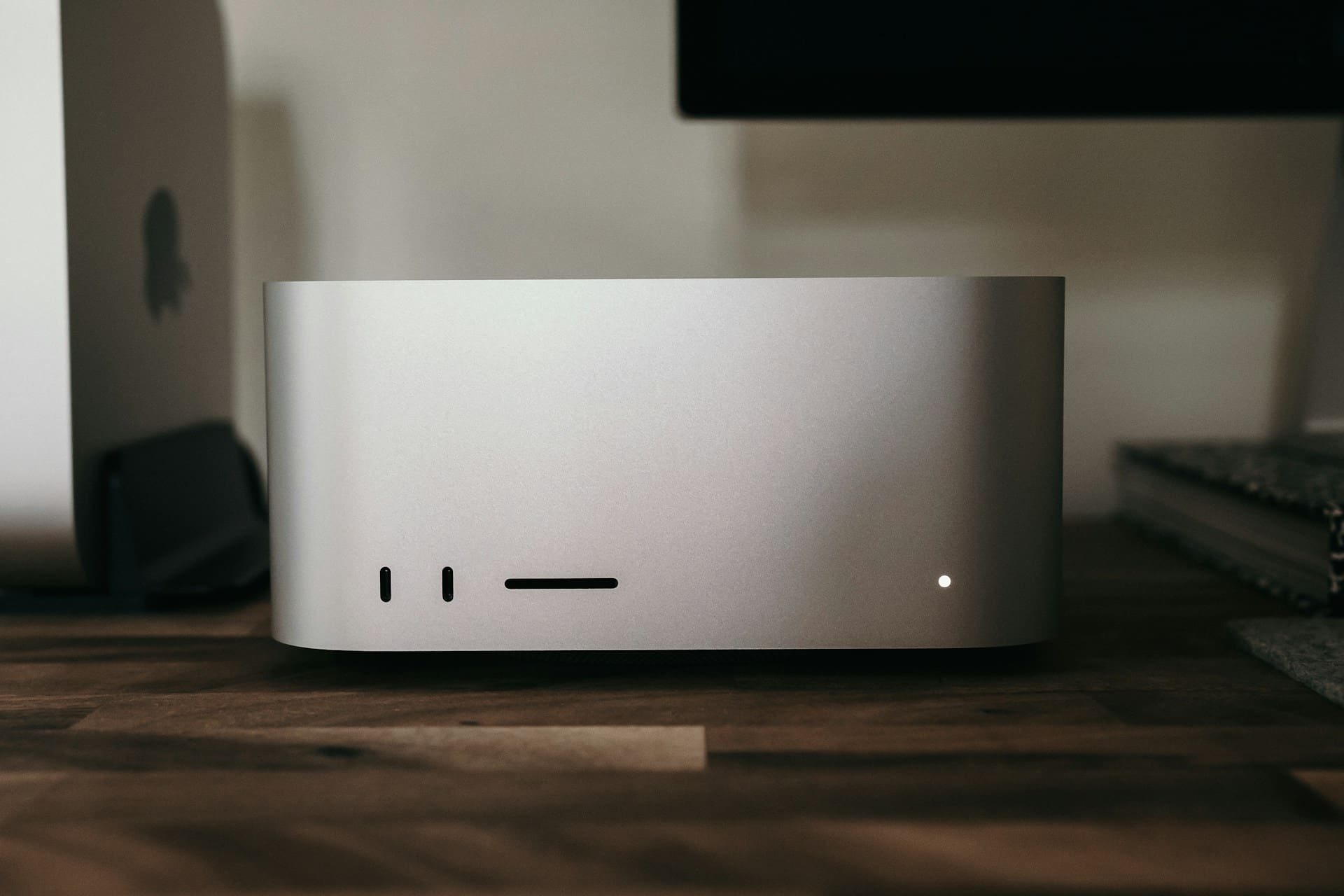
Mac mini and Mac Studio computers have become an unexpected piece of the infrastructure used by some of the biggest AI labs. OpenAI has reportedly bought tens of thousands of Apple computers for work tied to reinforcement learning and computer-use agents, while Anthropic is reportedly renting Mac mini units through Amazon Web Services (AWS). At the same time, demand is also reaching compact NVIDIA-based systems, pointing to a growing market for running AI outside the traditional large GPU clusters.
Macs as AI infrastructure in 30 seconds
- OpenAI has reportedly bought tens of thousands of Mac mini and Mac Studio units for reinforcement learning and agent development.
- Anthropic is also reportedly using Mac mini units rented through AWS.
- Unified memory lets the CPU and GPU share one large memory pool, which is appealing for running models locally.
- Apple just refreshed the Mac mini and Mac Studio with the M6, M5 Max, and M5 Ultra chips.
- The demand shows that some AI workloads can run efficiently on hardware other than large data center accelerators.
The report comes from The Information, which cites people familiar with OpenAI’s and Anthropic’s operations. There’s no public confirmation from OpenAI so far on the exact number of machines purchased or the value of these deals, so the figures should be treated as reporting rather than data the company has officially disclosed.
The trend is especially interesting because these computers aren’t meant to replace the large GPU clusters used to train the biggest foundation models.
Their appeal shows up elsewhere in the pipeline: agents, reinforcement learning, local inference, development, and workloads that need a lot of memory but not necessarily the power of a high-end data center accelerator.
Why an AI lab might want thousands of Macs
Apple Silicon’s main technical advantage for certain AI workloads lies in its unified memory architecture.
On a conventional computer with a dedicated GPU, the CPU uses its own main memory and the GPU typically has its own separate VRAM. Data has to move between the two whenever an application needs to use it on one processor or the other.
Apple uses a different architecture.
The CPU, GPU, and other accelerators on the SoC can all access a shared pool of memory. For certain workloads, that means the GPU can reach an amount of memory that’s hard to find in a conventional workstation with a single graphics card.
The new Mac Studio Apple unveiled on August 25 pushes that idea considerably further. Its M5 Ultra configuration can reach 512 GB of unified memory and 1.2 TB/s of bandwidth, along with up to 36 CPU cores and 80 GPU cores.
That doesn’t make the Mac Studio equivalent to a server loaded with data center NVIDIA accelerators.
They’re different platforms.
Professional AI GPUs offer CUDA, specialized numeric formats, interconnects built for large clusters, and a software ecosystem built up over years around accelerated training and inference.
But there’s another, increasingly important problem: getting the model to fit in memory in the first place.
A large enough model can need tens or hundreds of gigabytes just to load its weights. Quantization can shrink that footprint, but memory remains one of the main limits on running large models locally.
That’s where a compact system with hundreds of gigabytes of unified memory can become appealing.
| Feature | Apple Silicon Mac | Conventional dedicated GPU | Data center accelerator |
|---|---|---|---|
| Memory | Unified between CPU and GPU | Separate RAM + VRAM | Dedicated HBM |
| Memory reachable by GPU | Can be very high | Limited by card VRAM | High, depending on accelerator |
| Power draw | Relatively modest | Variable | Generally high |
| CUDA | No | Yes, with NVIDIA | Yes, with NVIDIA |
| Local use | Very straightforward | Easy to moderate | Uncommon |
| Large clusters | Limited | Possible at small scale | Built for it |
| Large local models | Especially appealing with lots of memory | Limited by VRAM | Excellent, at higher cost |
| Agents on macOS | Advantage for testing the Apple environment | Not applicable | Not its main purpose |
That last row may help explain OpenAI’s interest.
According to The Information, the machines are being used for reinforcement learning and training agents capable of interacting with computers.
An agent like that needs to observe interfaces, open applications, manipulate files, browse web pages, and learn to complete real tasks.
Physically having the environment the agent is being trained or evaluated on can be useful.
OpenAI isn’t likely the only one interested
The trend also doesn’t appear limited to OpenAI.
The Information reports that Anthropic is using Mac mini units through infrastructure rented on AWS. That detail stands out because AWS is one of the world’s largest cloud infrastructure providers and has its own AI accelerators.
But AWS also offers Mac-hardware-based instances for certain workloads.
Anthropic’s interest reinforces the idea that these systems aren’t simply being bought as a cheaper stand-in for NVIDIA GPUs.
There’s a specific workload they happen to suit well.
The US publication also notes that companies are emerging that build cloud infrastructure using Apple hardware exclusively, anticipating growing demand for data-center-hosted Macs.
There’s a quirk to that idea.
Apple exited its Xserve server business years ago and currently doesn’t sell anything equivalent to the traditional servers used in data centers.
Mac mini and Mac Studio are desktop computers.
That forces operators looking to deploy them at scale to solve physical and operational problems a conventional server already handles out of the box: mounting, power, networking, remote management, cooling, and swapping out hardware.
Even so, the market is finding ways to use them.
Apple just handed out even more memory
The timing also lines up with a major Apple Silicon refresh.
Apple unveiled the M6 on August 25, its first processor built on 2-nanometer technology, alongside the new M5 Ultra.
The M6 powers the new Mac mini and packs a 12-core CPU, a 12-core GPU with Neural Accelerators, two 16-core Neural Engines, and up to 170 GB/s of unified memory bandwidth.
For local AI, the Mac Studio’s M5 Ultra is even more interesting.
Apple used a new generation of UltraFusion to build one of its Ultra processors on a four-die architecture for the first time. The result can reach 36 CPU cores and 80 GPU cores, with the aforementioned 512 GB of unified memory and 1.2 TB/s of bandwidth.
Apple is explicitly positioning this machine for professional and AI workloads.
By Apple’s own testing, the new Mac Studio can deliver up to 4.3x more performance on certain AI workloads compared with earlier generations. As with any manufacturer benchmark, those figures depend heavily on the applications and configurations used and shouldn’t be read as a universal improvement.
The amount of memory is probably more important for this market than most of those percentages.
A compact workstation with half a terabyte of memory the GPU can reach lets people experiment with models that previously required much less conventional setups.
NVIDIA wants that market too
Interest in Macs coincides with NVIDIA’s own push to bring its AI architecture to much smaller machines.
DGX Spark and its rivals from Dell and ASUS were an early, clear demonstration of that.
Rather than thinking purely in terms of servers packed with multiple power-hungry GPUs, NVIDIA built a desktop platform based on the GB10 Grace Blackwell superchip, with unified memory and the ability to run AI models locally.
The conceptual overlap with some of Apple Silicon’s advantages is obvious: lots of memory reachable by both CPU and GPU, inside a compact system with reasonable power draw.
The Information reports that NVIDIA sees Apple as one of its main competitors in this emerging local AI market.
That doesn’t mean Apple is threatening NVIDIA’s data center accelerator business.
They’re different orders of magnitude and different markets.
NVIDIA still dominates large-model training and has a CUDA ecosystem that’s hard to replicate. Its Blackwell systems and their successors are also built to scale through very high-speed interconnects across huge numbers of accelerators.
The competition shows up further down the stack.
Workstations, small servers, developers, local agents, private inference, and models that need plenty of memory but not a full rack of accelerators.
That’s where Apple Silicon can compete, using an architecture originally designed for personal computers.
The memory shortage is complicating things
There’s a paradox behind this new demand.
Just as Macs with large amounts of memory are becoming attractive for AI, AI’s own expansion is straining the global memory market.
Large data centers are soaking up enormous amounts of HBM and DRAM. Manufacturers are prioritizing high-margin products built for accelerators and servers, while the biggest buyers sign supply agreements years in advance.
The effect is spilling over into the computer market too.
The Information notes that some higher-end Mac mini and Mac Studio configurations have faced availability problems over recent months, and that some companies are already looking at alternatives because of those constraints.
Apple has just responded with new generations of both products, though demand will determine whether it can supply them at the pace professional buyers need.
Sales trends offer a clue.
In the June quarter, revenue from Apple’s Mac division reached $10.4 billion, up around 29% year over year, making it Apple’s fastest-growing product area for that period.
Not all of that growth comes from AI, naturally.
But demand from developers and businesses is becoming significant enough that Apple is now promoting its computers’ local AI capabilities much more explicitly.
From buying GPUs to buying whatever compute is useful
The trend points to a broader reading of the tech market.
During the early years of the generative AI boom, virtually any infrastructure conversation ended up being about NVIDIA GPUs.
That’s starting to change.
Large companies still need huge accelerator clusters to train frontier models. But around those models, many other workloads are showing up: inference, agents, reinforcement learning, evaluation, synthetic data generation, development, and experimentation.
Not all of them need exactly the same hardware.
A data center can use NVIDIA accelerators for training, its own chips for inference, and Apple Silicon-based systems for certain agent-related tasks.
Even open models increasingly let developers choose where to run inference based on cost, privacy, available memory, and required performance.
That explains why tens of thousands of Macs can make sense for OpenAI without the company scaling back its massive, simultaneous investment in GPU infrastructure.
Mac mini and Mac Studio are finding a use Apple probably didn’t picture when it began moving away from Intel toward its own processors.
The unified memory that originally helped improve efficiency and performance on a personal computer now turns out to be especially well suited to an industry where one of the biggest problems is moving and holding gigantic quantities of parameters.
Macs aren’t going to replace large AI clusters.
But OpenAI buying them by the tens of thousands points to something perhaps more interesting: AI infrastructure is starting to diversify, and not all useful compute has to look like a traditional server packed with GPUs anymore.
Frequently asked questions
How many Macs has OpenAI reportedly bought?
The Information reports that OpenAI has acquired tens of thousands of Mac mini and Mac Studio units. OpenAI hasn’t publicly confirmed an exact figure.
What is OpenAI using the Mac mini and Mac Studio for?
According to the reporting, the systems are being used for reinforcement learning and for developing or training agents capable of interacting with computers.
Why are Macs appealing for running AI models?
Apple Silicon uses unified memory that both the CPU and GPU can access. High-memory configurations make it possible to run models locally that would otherwise exceed the VRAM available on many conventional GPUs.
Can Macs replace NVIDIA GPUs for training large models?
They aren’t equivalent platforms. NVIDIA keeps major advantages for large clusters thanks to its accelerators, CUDA, and specialized interconnects, while Macs are especially appealing for certain local workloads, agents, development, and inference.
Source: wccftech
