
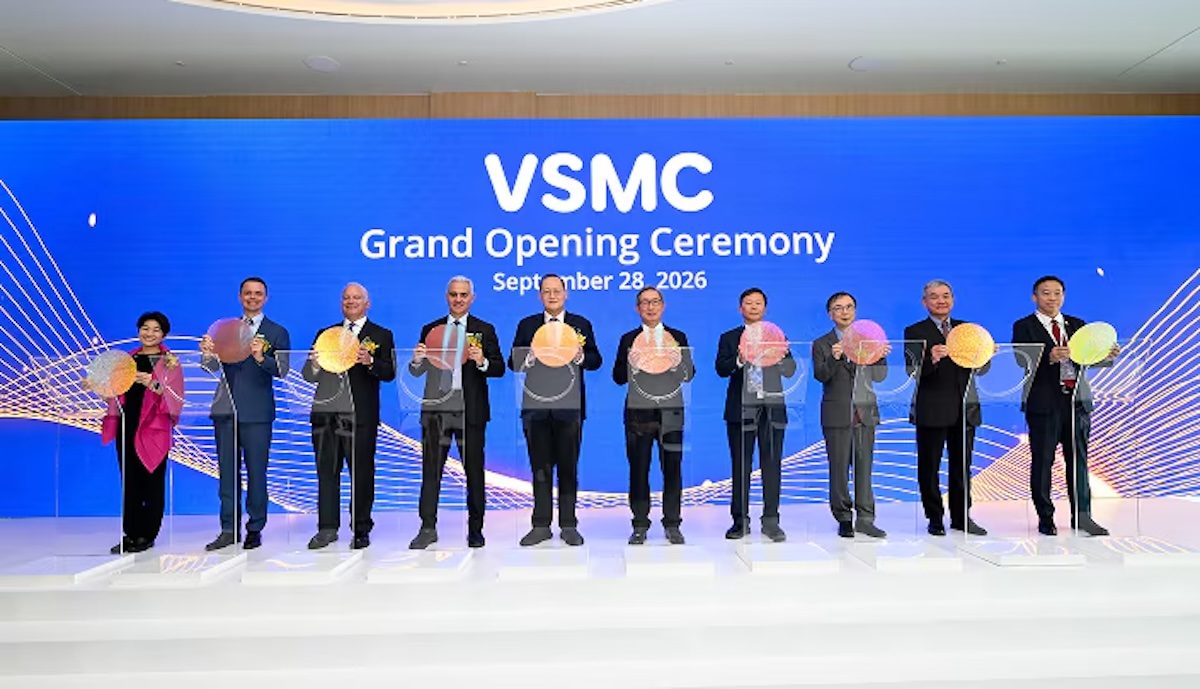
VisionPower Semiconductor Manufacturing Company (VSMC), the joint venture created by Vanguard International Semiconductor (VIS) and NXP Semiconductors, has opened its first 300mm wafer fab in Singapore. The plant, located in Tampines, has already entered risk production and is expected to start volume manufacturing in the first quarter of 2027, with capacity reaching about 44,000 300mm wafers a month by 2029.
VSMC in Singapore in 30 seconds
- VSMC’s new fab uses 300mm wafers and is already in risk production.
- Volume manufacturing will start in the first quarter of 2027.
- Planned capacity will reach about 44,000 300mm wafers a month by 2029.
- It will manufacture 130nm to 40nm processes for analog, power, mixed-signal chips, and interposers.
- The project is expected to create about 1,600 jobs and strengthens NXP and VIS’s manufacturing capacity in Asia.
The new facility is owned by VSMC, a joint venture created in September 2024 by VIS and NXP. Construction officially began in December of that year and was completed after 22 months. According to NXP, the fab has already processed its first batch of samples, with yields above 99%, and remains on schedule to begin commercial production in 2027.
The project expands both companies’ industrial presence in Singapore and adds new specialized manufacturing capacity on 12-inch wafers. The facility isn’t aimed at the smaller process nodes used in cutting-edge processors, but at mature, specialized technologies that remain necessary in automotive, industrial, consumer electronics, mobile devices, and high-performance computing.
A 300mm fab for specialized chips
VSMC will manufacture technologies ranging from 130nm to 40nm. The planned portfolio includes mixed-signal circuits, power management, analog components, and interposers for high-performance electronic systems.
The company is targeting several markets, including high-performance computing (HPC), mobile phones, automotive, industrial, and consumer electronics. This combination lets VSMC serve different types of components without relying exclusively on a single segment.
Wafer size also matters here. The move to 300mm allows more chips to be produced per wafer compared with 200mm platforms, which can improve production efficiency for processes compatible with that format. In VSMC’s case, that capacity is combined with specialized technologies that continue to see strong demand across many electronic products.
The company expects to reach about 44,000 300mm wafers a month by 2029 once the plant is running at full capacity. NXP also notes that the project will create around 1,600 jobs.
The fab incorporates automation and digital tools to manage production. VSMC says the facility will use artificial intelligence and digital management technologies as part of its automated manufacturing model.
The announcement doesn’t break down which part of those tools corresponds to specific manufacturing systems, nor does it specify which AI processes will be used at each stage of production. So the announcement positions AI as part of the manufacturing model, but it doesn’t allow its impact on plant performance to be quantified.
NXP gains its own capacity in Asia
For NXP, the opening of VSMC expands its manufacturing network and diversifies its capacity geographically. Rafael Sotomayor, president and CEO of NXP, said during the opening that the fab strengthens its manufacturing base and its ability to meet customer demand over the long term.
NXP already has an established industrial presence in Singapore. The new joint venture now adds a facility dedicated to specialized 300mm manufacturing and lets the company combine its own production with an external manufacturing network and technology partners. The move follows a similar logic to NXP’s recent expansion elsewhere in Asia, where the company has also grown its chip assembly and testing capacity in Malaysia to avoid future bottlenecks.
The company also ties the project to its hybrid manufacturing strategy. According to NXP, the capacity planned for VSMC remains unchanged from the plans announced previously.
The project began with an announced investment of $7.8 billion for the fab. Under the terms previously communicated by the companies, VIS owns 60% of VSMC and NXP owns 40%. The structure lets both companies take part in a facility aimed at specialized technologies and growing markets.
The Singapore location also fits the country’s industrial policy to attract advanced semiconductor manufacturing, part of a broader push that has also drawn GlobalFoundries to expand its own chip capacity with Singapore as a key hub. The opening was attended by representatives of the Singapore government, the Singapore Economic Development Board (EDB), JTC Corporation, TSMC, customers, suppliers, and industry associations.
Risk production comes before volume
Entering risk production marks a phase that precedes large-scale commercial manufacturing. At this stage, batches are produced to validate processes, equipment, and yield before progressively ramping up volume.
VSMC says its first batch of samples achieved a yield above 99%. The company’s target remains to start volume production in the first quarter of 2027.
From there, capacity should increase progressively up to the 44,000 monthly wafers planned for 2029. The announcement doesn’t specify how long the plant will need to reach each intermediate step, or what percentage of that capacity will be allocated to each technology.
The project also includes sustainability-related measures. The fab was designed and built to LEED (Leadership in Energy and Environmental Design) and Singapore’s Green Mark standards. VSMC says it incorporates renewable energy solutions, energy efficiency measures, and water recycling systems.
The company has also signed collaboration agreements with Singapore universities to develop specialized talent. The programs include internships and professional training aimed at building a pipeline of workers for the semiconductor industry.
The opening comes as chipmakers and governments keep expanding and diversifying production networks. For VSMC, the immediate goal is to complete the transition from construction to volume manufacturing. For VIS and NXP, the new fab adds 300mm capacity for specialized processes and expands their industrial presence in Singapore.
Frequently Asked Questions
Which companies are behind VSMC?
VSMC is a joint venture created by Vanguard International Semiconductor (VIS) and NXP Semiconductors in September 2024. VIS owns 60% and NXP owns 40%.
When will the new fab start producing chips in volume?
The plant has already entered risk production, and VSMC expects to begin volume manufacturing in the first quarter of 2027.
What processes will VSMC manufacture?
The fab will work with 130nm to 40nm technologies for analog, mixed-signal, power management, and interposer applications, aimed at sectors such as automotive, industrial, mobile, and high-performance computing.
What capacity will the fab have?
VSMC expects to reach about 44,000 300mm wafers a month once the plant runs at full capacity in 2029. It also expects to create around 1,600 jobs.
via: nxp
