
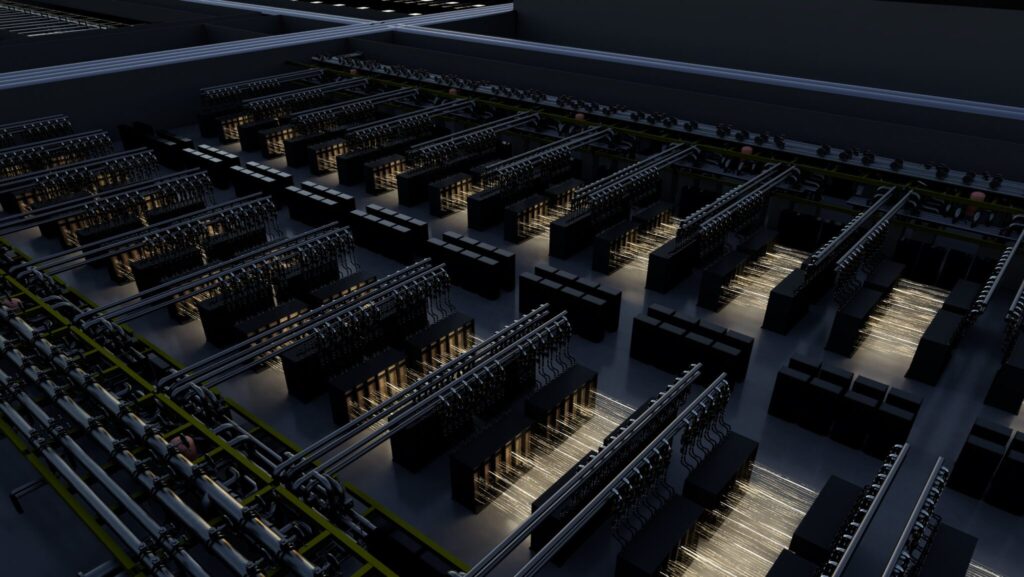
NVIDIA and MediaTek have expanded their collaboration to jointly develop new artificial intelligence platforms spanning data centers, personal computers, and automotive. The deal also has a sizeable financial side: NVIDIA has invested $3.5 billion in convertible bonds issued by MediaTek, while the Taiwanese manufacturer will add NVLink Fusion to its custom silicon lineup for AI infrastructure.
The NVIDIA-MediaTek alliance in 30 seconds
- NVIDIA has invested $3.5 billion in MediaTek convertible bonds.
- MediaTek will adopt NVLink Fusion to develop custom XPUs that can be integrated into NVIDIA’s rack-scale systems.
- The collaboration will also continue across several generations of RTX Spark and DGX Spark chips.
- Both companies will expand their joint work on software-defined vehicle platforms.
- The deal brings MediaTek’s custom silicon business closer to NVIDIA’s AI infrastructure.
The investment does not by itself amount to an acquisition, nor does it mean NVIDIA has bought a specific ordinary stake in MediaTek. The instrument announced is convertible bonds — debt that, under certain conditions, can convert into shares. The companies have not detailed the conversion terms, maturity, or price attached to those notes in their announcement.
The move also expands a technology relationship that already existed. MediaTek collaborated on the GB10 Grace Blackwell Superchip used in DGX Spark and takes part in RTX Spark, in addition to working with NVIDIA’s automotive and data center technologies. That cooperation is now going deeper into one of the businesses generating the most interest around AI infrastructure: custom accelerators.
MediaTek Moves Fully Into NVIDIA’s Custom Accelerator Model
The most relevant element for data centers is NVLink Fusion.
NVIDIA introduced this platform to let third parties build custom CPUs and XPUs that can plug into its infrastructure architecture. Rather than requiring every major system component to be an NVIDIA-designed processor, the company provides technologies to connect other manufacturers’ silicon to its NVLink network and the rest of its platform.
MediaTek will now use NVLink Fusion as the basis for offering custom accelerators to hyperscalers, cloud providers, and large AI model developers.
A customer will be able to bring its XPU design to MediaTek and adapt aspects such as memory, connectivity, packaging, power, and performance to its specific workloads. MediaTek brings its ASIC and system-on-chip (SoC) expertise, while NVIDIA provides part of the infrastructure that lets those processors be incorporated into rack-scale AI systems.
The proposal includes three especially relevant components.
The first is the NVLink Fusion chiplet, responsible for connecting the custom XPU to the NVLink network through electrical or photonic interconnects.
The second is NVLink-C2C, aimed at high-bandwidth communication between processors within the system, including future NVIDIA Rosa CPUs and other compatible components.
The third is NVHBM, NVIDIA’s proposal for customizing high-bandwidth memory around the accelerator’s needs.
The combination aims to cover something that often gets left out when people simply talk about designing an AI ASIC: turning that chip into a product that can be manufactured, packaged, connected, and deployed inside a full rack.
Designing the XPU Is Only Part of the Problem
Major cloud providers have spent years increasing their investments in in-house processors.
The appeal is obvious. A general-purpose GPU has to run very different workloads, while a custom accelerator can be designed around a specific set of operations and performance, power, or cost targets.
But designing the math units is only part of the job.
A modern accelerator needs HBM, high-speed interfaces, SerDes, advanced packaging, chip-to-chip communication, networking to scale across nodes, and a manufacturing chain capable of producing the entire system at volume.
MediaTek wants to position itself right at that layer.
Its data center division already offers custom ASIC development and presents the rack as the new unit around which AI infrastructure should be designed. The company works with both open interconnects such as UALink and UEC and proprietary technologies, including NVLink.
With the new agreement, MediaTek will be able to offer a more direct route into NVIDIA’s infrastructure.
| Area | Main contribution |
|---|---|
| Custom XPU | MediaTek design and adaptation |
| Interconnect | NVLink Fusion and NVLink-C2C |
| Memory | Integration with NVHBM |
| Packaging | Multi-die design and advanced technologies |
| Scaling | NVLink infrastructure and MGX architecture |
| Target | Rack-scale AI systems |
There’s also a strategic advantage for NVIDIA: allowing custom processors without necessarily losing its technology’s presence around them.
A company may want to build its own XPU instead of only buying NVIDIA GPUs, but keep using NVLink, memory components, CPUs, switches, and rack architecture from the American company.
NVLink Fusion thus turns silicon customization into a possible extension of the NVIDIA environment rather than framing it solely as an alternative to its GPUs.
From DGX Spark to Several Generations of RTX Spark
The second part of the deal brings the collaboration to personal computers and workstations.
MediaTek already took part in developing DGX Spark’s GB10 Grace Blackwell Superchip. This system combines Grace CPUs and Blackwell GPUs through NVLink-C2C and targets developers who need to run AI models locally.
The collaboration later expanded with RTX Spark, introduced in June 2026 for a new generation of Windows 11 computers aimed at local AI, agents, content creation, and gaming.
Both companies now confirm the work will continue across multiple generations.
This detail matters because it turns the collaboration into something broader than a single processor.
MediaTek brings expertise in low-power CPUs, connectivity, and SoCs, an area it has worked in for years for smartphones and other devices. NVIDIA brings its GPUs, RTX technologies, and AI software platform.
The combination lets NVIDIA enter categories where energy efficiency, integration, and battery life matter as much as peak performance.
It also reinforces MediaTek’s expansion beyond its traditional mobile processor business.
NVIDIA and MediaTek Will Also Keep Working Together in Automotive
The third front is automotive.
MediaTek integrates NVIDIA technologies within its Dimensity Auto family, aimed at software-defined vehicles and intelligent cabin systems.
These platforms can also be combined with NVIDIA DRIVE AGX to distribute the vehicle’s various computing functions.
The companies have confirmed they will jointly develop several future generations, though they have not provided specifications, dates, or associated automakers for upcoming products in this announcement.
MediaTek already announced a collaboration with Foxtron in June to use its Dimensity AX C-X1 platform, which incorporates NVIDIA GPU and AI technologies, in automotive solutions.
Both companies’ interest goes beyond the traditional infotainment system. Modern vehicles increasingly incorporate local processing for assistants, voice recognition, graphical interfaces, vision, and other AI-based functions.
The $3.5 Billion Changes the Scale of the Relationship
NVIDIA’s investment is probably the element that most distinguishes this announcement from the companies’ previous deals.
$3.5 billion in convertible bonds represents a considerable financial commitment.
Still, it’s worth separating that fact from its possible future consequences.
NVIDIA and MediaTek have not announced an acquisition, nor have they specified what percentage NVIDIA could end up controlling if the bonds were converted. They also haven’t made the full financial terms needed for that calculation public in this announcement.
What’s confirmed is the investment and the simultaneous expansion of technology cooperation.
For MediaTek, the deal strengthens its move into a higher-value market than traditional consumer chips: custom silicon design for AI data centers.
For NVIDIA, it means deepening its relationship with a company that can develop CPUs, SoCs, and XPUs tailored to customers who don’t want to rely exclusively on standard components.
There’s also a broader technology reading here.
The AI data center is no longer being designed as a collection of independent servers. The full rack is becoming an engineering unit where processors, memory, networking, cooling, and power consumption must be planned together.
NVLink Fusion responds to that shift.
NVIDIA allows certain components to be customized by its customers but tries to keep a common architecture for interconnect, memory, and scaling around them.
MediaTek brings the ability to turn those needs into specific silicon.
The alliance also covers the opposite extreme: from massive AI facilities down to small computers capable of running models locally, and through vehicles as well.
That explains the scope of the deal better than the financial investment alone. NVIDIA and MediaTek are trying to build a relationship spanning everything from a data center’s custom chip to a PC’s or a car’s processor, with several generations of products planned in each segment.
Frequently Asked Questions
How much has NVIDIA invested in MediaTek?
NVIDIA has invested $3.5 billion in convertible bonds issued by MediaTek. The companies have not published the full conversion terms for those notes in the announcement.
Has NVIDIA bought MediaTek?
No. The announcement covers an investment through convertible bonds and an expansion of their technology collaboration. No acquisition of MediaTek has been announced.
What is NVIDIA NVLink Fusion?
NVLink Fusion is a platform that lets third parties integrate custom CPUs and XPUs into AI systems connected through NVLink technologies. MediaTek will use it as the basis for developing custom accelerators for its customers.
What products are NVIDIA and MediaTek working on together?
The collaboration covers AI infrastructure and custom XPUs, several generations of RTX Spark and DGX Spark, and Dimensity Auto platforms for software-defined vehicles.
Source: nvidianews.nvidia
