
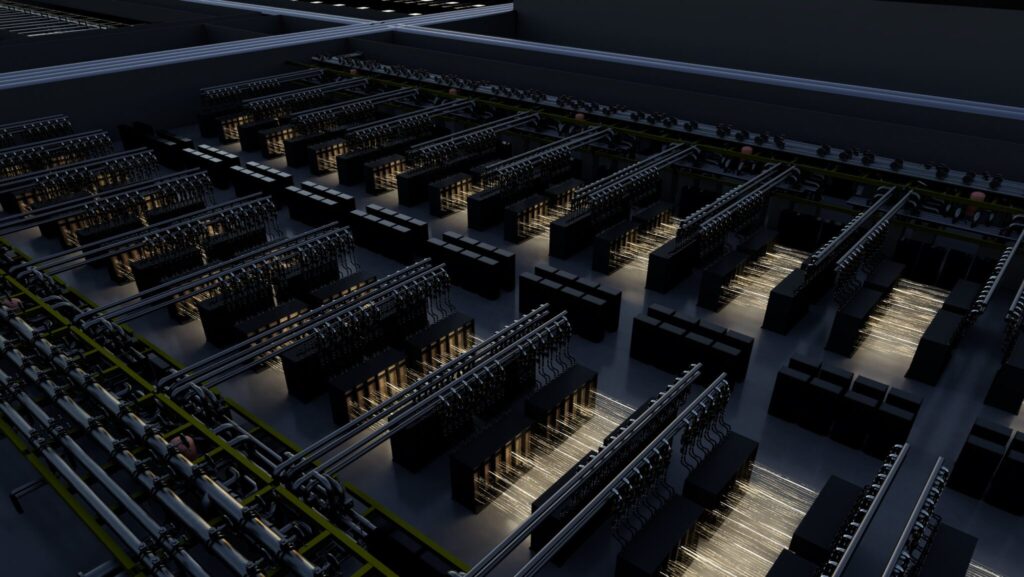
NVIDIA is widening the reach of NVLink Fusion, its plan for slotting custom accelerators, or XPUs, into AI infrastructure built around its technology. The company wants hyperscalers and in-house chip designers to keep their own processors while adopting NVIDIA’s parts for interconnect, CPUs, rack systems, cooling, power, and managing large AI data centers.
NVIDIA NVLink Fusion in 20 seconds
- NVLink Fusion lets custom XPUs integrate into NVIDIA’s NVLink infrastructure.
- The sixth generation of NVLink supports domains of 72 accelerators, with future configurations up to 1,152.
- NVIDIA says XPU-to-XPU latency is three times lower than conventional Ethernet alternatives.
- Manufacturers can reuse the MGX architecture, cooling, power, networking, and suppliers.
- Partners NVIDIA names include Intel, MediaTek, GUC, Quanta, and Annapurna Labs.
The move fits where the market is heading. The big cloud providers keep investing in their own accelerators to cut costs, tune hardware for specific workloads, and depend less on general-purpose GPUs.
Google has built its TPUs for years, AWS offers Trainium and Inferentia, and Microsoft has Maia. Meta is working on its MTIA family. At the same time, chip companies like Broadcom and Marvell see more opportunity in designing custom ASICs for large infrastructure operators.
NVIDIA seems to expect that market to keep growing. Its answer with NVLink Fusion is to make a third-party accelerator still lean heavily on NVIDIA’s infrastructure.
NVLink opens up to accelerators that aren’t NVIDIA GPUs
The approach speaks to a well-known problem in large AI systems: building a good accelerator is only part of deploying it at scale.
A hyperscaler also has to solve communication between accelerators, CPU integration, scale-out networks, rack design, power distribution, liquid cooling, storage, security, management software, and a supply chain that can build thousands of systems.
NVLink Fusion aims to hand over some of that as a platform for adding custom processors.
The core is still NVLink, NVIDIA’s high-speed interconnect that lets many accelerators act as one larger computational domain.
Per the company’s data, sixth-generation NVLink offers high-speed, low-latency communication within a domain of 72 XPUs. NVIDIA says transfers between XPUs can run at three times lower end-to-end latency and ten times higher packet rates than conventional Ethernet-based solutions.
Those are NVIDIA’s numbers, and they should be read against the configurations it compared, not as a blanket advantage over all Ethernet architectures.
The company also sketches a big future. Its roadmap includes NVLink configurations supporting up to 1,152 accelerators and adding integrated optics.
Scaling matters a lot for models like Mixture of Experts (MoE), systems with trillions of parameters, and agent-based applications. When accelerators need to swap large amounts of data constantly, the interconnect can become the limit on how well the silicon is used.
NVIDIA also wants into data centers with its own XPUs
NVLink Fusion carries a business view that goes past the technical specs.
For years, NVIDIA’s AI growth has been tied directly to selling its GPUs. Reaching into custom chips changes that: a hyperscaler might use an ASIC built for specific workloads instead of buying another NVIDIA accelerator.
NVLink Fusion lets NVIDIA still take part in that infrastructure even when another company designed the main processor.
The company offers several options. A custom XPU can connect to the NVLink domain and also use NVLink-C2C to talk to NVIDIA’s Vera CPUs or other compatible processors in the ecosystem.
NVIDIA estimates NVLink-C2C can be up to six times more energy-efficient than PCIe for processor-to-processor communication, though that’s based on its own test conditions.
The list of companies NVIDIA names around NVLink Fusion shows how wide it wants to reach.
Intel takes part as a CPU architecture and technology provider. MediaTek and GUC work on custom ASICs. Quanta helps with manufacturing and integration, and Annapurna Labs, owned by Amazon, publicly backs the approach.
Amazon’s involvement stands out, since AWS is one of the leading builders of its own AI silicon.
So NVLink Fusion offers a middle ground: use a proprietary accelerator without building the whole surrounding infrastructure from scratch.
The rack becomes a shared platform
The strategy reaches beyond NVLink itself. NVIDIA wants to standardize at the rack level and, later, across the data center.
XPU-based systems can use the NVIDIA MGX architecture and the supply chain behind platforms like Vera Rubin NVL72, including racks, cooling, power distribution, and future 800V DC power designs.
NVIDIA argues that this compatibility would let operators build facilities before the final accelerator configurations are even set.
That matters because data center timelines are very different from silicon development cycles. Securing power, designing cooling, or constructing a facility can take years, while accelerator generations move much faster.
With a common architecture, NVIDIA says GPUs and XPUs can share the physical traits of the rack, cooling, power, networking, and management. Operators could then adjust the mix based on workloads or hardware availability.
The approach also includes digital modeling of whole data centers through NVIDIA DSX and its Omniverse-based blueprints, so operators can test gigawatt-scale AI installations virtually before building them.
Reference racks will favor liquid cooling and modular trays for maintenance without shutting down the whole system.
Software rounds it out: NCCL handles distributed workloads inside NVIDIA environments, while Dynamo and NIXL target disaggregated architectures. Mission Control manages clusters, telemetry, and diagnostics.
That places NVIDIA differently from the usual playbook. If hyperscalers keep leaning on their own processors, NVIDIA can still supply the full infrastructure that connects, powers, cools, and manages those chips.
It also explains why NVLink Fusion could be central to how the company’s business evolves. NVIDIA no longer only competes over which accelerator does the math; it also wants to keep its architecture at the center around chips designed by other companies.
Frequently Asked Questions
What is NVIDIA NVLink Fusion?
NVLink Fusion is a platform that lets custom accelerators, or XPUs, integrate into NVIDIA’s interconnect and infrastructure environment. Manufacturers can keep their own silicon while using components like NVLink, compatible CPUs, MGX, and other rack design elements.
Does NVLink Fusion require NVIDIA GPUs?
Not necessarily. One of its goals is to let third-party XPUs integrate into NVIDIA-based infrastructure.
How many accelerators can NVLink connect?
The sixth generation supports domains of 72 XPUs. NVIDIA’s roadmap includes future configurations supporting up to 1,152 accelerators and the use of integrated optics.
Why does NVLink Fusion matter for NVIDIA?
Because it lets NVIDIA take part in data centers where large cloud providers increasingly use custom chips. Even when the accelerator isn’t an NVIDIA GPU, other parts of the infrastructure can still use NVIDIA’s technology.
via: blogs.nvidia
