
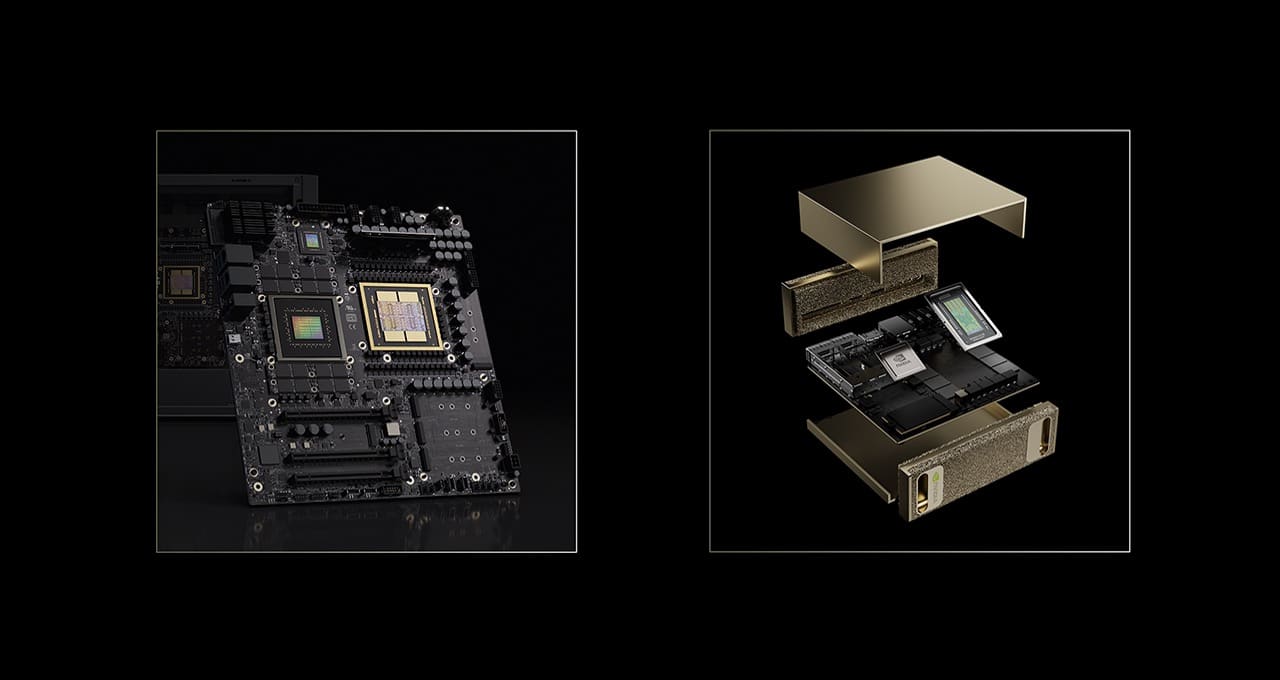
MSI has begun selling the XpertStation WS300, an AI workstation based on the NVIDIA DGX Station architecture and equipped with the NVIDIA GB300 Grace Blackwell Ultra superchip. The system offers up to 748 GB of coherent memory and is designed to run large language models (LLMs), inference, fine-tuning, and AI agents locally without necessarily depending on cloud GPU infrastructure.
The MSI XpertStation WS300 in 20 seconds
- The XpertStation WS300 uses the NVIDIA GB300 Grace Blackwell Ultra Desktop Superchip, combining a Grace CPU and a Blackwell Ultra GPU.
- It offers up to 748 GB of coherent memory shared between CPU and GPU.
- It integrates two 400 GbE connections via NVIDIA ConnectX-8.
- Two units can be linked together to expand available capacity.
- MSI positions it for inference, model fine-tuning, multimodal AI, and locally run agents.
The machine belongs to a new category of systems trying to bring capabilities once reserved for GPU servers to the desk. NVIDIA rates its DGX Station architecture at up to 20 petaFLOPS of FP4 AI compute and says it can work with models of up to a trillion parameters, depending on workload and configuration.
MSI isn’t developing its own acceleration architecture for this machine. The XpertStation is built on the platform NVIDIA designed and packages it into a commercial product that has already started shipping in the US market.
748 GB of Memory to Run Large Models Locally
One of the most interesting features of this generation of workstations isn’t just GPU power, but the amount of memory available.
The GB300 Grace Blackwell Ultra Desktop Superchip connects an NVIDIA Blackwell Ultra GPU to a 72-core Grace CPU via NVLink-C2C. NVIDIA’s reference architecture pairs 252 GB of HBM3e memory for the GPU and 496 GB of LPDDR5X for the CPU, reaching up to 748 GB of coherent memory.
NVLink-C2C also delivers up to 900 GB/s of bandwidth between CPU and GPU. The goal is to reduce one of the usual headaches when running very large models: the constant movement of data between separate memory pools.
For certain AI projects, this can matter more than simply adding more compute power.
Large language models need to store weights, context, and various intermediate structures while running. If a model doesn’t fit in available memory, it has to be split across multiple GPUs, part of it offloaded to system memory, or other techniques used that can hurt performance.
The 748 GB available lets you work locally with models considerably larger than what a conventional single-GPU workstation can handle.
NVIDIA says DGX Station can run models with up to a trillion parameters, though that figure represents the maximum capacity stated by the manufacturer and doesn’t mean any model of that size will run with identical performance or precision. Memory consumption also depends on quantization, model architecture, context length, and workload.
That’s why MSI is positioning the XpertStation WS300 for tasks such as AI development, fine-tuning, local inference, multimodal models, and continuously running agents.
Two 400 GbE Connections to Link Workstations Together
The other element that brings this kind of equipment closer to data center infrastructure is networking.
The XpertStation WS300 includes an NVIDIA ConnectX-8 SuperNIC, with two QSFP112 ports each capable of 400 Gb/s. NVIDIA’s reference DGX Station platform reaches up to 800 Gb/s of aggregate Ethernet connectivity that way.
It’s not a feature meant simply for faster file transfers.
MSI raises the possibility of connecting two XpertStation WS300 units to distribute workloads and increase the capacity available for certain models. NVIDIA also envisions this possibility for DGX Station via ConnectX-8.
That puts the product somewhere between a traditional workstation and a small AI cluster.
A single DGX Station uses one Blackwell Ultra GPU and one Grace CPU. At the other end of the spectrum, NVIDIA’s DGX GB300 infrastructure for data centers can pack in dozens of GPUs and Grace CPUs inside full systems built for large-scale workloads.
MSI’s pitch lets you start with one machine next to your development team and connect a second one once the workload justifies it, although this is still a long way from replacing a data-center GPU infrastructure when tens or hundreds of accelerators are needed.
Local AI Is Gaining Ground in Businesses Again
The launch comes as part of the industry tries to move certain AI workloads from the cloud to infrastructure installed inside organizations themselves.
The cloud still offers a clear advantage for projects that need variable capacity or temporary access to large numbers of GPUs. Buying your own infrastructure to use for just a few hours a day can be hard to justify.
But the math changes when workloads are continuous.
Round-the-clock inference, model development, agents that run all day, or recurring processes can rack up steep costs when all the compute is billed by usage.
Running locally also brings up another argument: data can stay inside the company’s own infrastructure.
That can matter when working with source code, internal documentation, customer information, or proprietary models. It doesn’t eliminate security and compliance requirements on its own, but it does let you control where data is stored and processed.
That’s precisely one of the markets MSI is targeting with the XpertStation WS300.
The company also points to compatibility with NVIDIA NemoClaw and OpenShell, technologies designed to run AI agents under defined policies within enterprise environments. The idea is that these systems aren’t used just to chat with a model, but to keep agents running and connected to internal applications and processes.
NVIDIA is following the same path with DGX Station. The company presents the platform as a system for developing, fine-tuning, and running models and agents locally before moving them, when needed, to the data center or the cloud.
There’s also a detail that helps put the XpertStation in context.
The reference platform has a total power draw of up to 1,600 watts. This isn’t a conventional high-performance PC — it’s specialized infrastructure that comes in a format that can be installed outside a traditional rack.
MSI hasn’t detailed a general price for all markets in its announcement, nor a specific availability date for Spain. The company does confirm the system is already available through distributors such as ASI, D&H, and Newegg in the markets where it’s sold.
The arrival of machines like the XpertStation WS300 expands the options for deploying enterprise AI. Between a GPU installed in a traditional workstation and a cluster of accelerators in a data center, an intermediate category is emerging: desktop systems built with architectures pulled directly from the AI server market.
Its usefulness will depend less on hitting peak performance numbers than on finding workloads that can continuously make use of hundreds of gigabytes of memory and a Blackwell Ultra GPU.
For companies that need that level of capacity every single day, running models a few meters from their developers is starting to become a technical alternative worth comparing against the recurring cost of keeping those same workloads in the cloud.
Frequently Asked Questions
What processor does the MSI XpertStation WS300 use?
It uses the NVIDIA GB300 Grace Blackwell Ultra Desktop Superchip, which combines a 72-core NVIDIA Grace CPU with a Blackwell Ultra GPU via the NVLink-C2C interconnect.
How much memory does the XpertStation WS300 have?
The platform offers up to 748 GB of coherent memory, combining 252 GB of HBM3e tied to the GPU with 496 GB of system LPDDR5X.
Can multiple XpertStation WS300 units be connected together?
Yes. MSI supports connecting two systems via NVIDIA ConnectX-8. Each workstation has two 400 Gb/s Ethernet ports, for up to 800 Gb/s of aggregate bandwidth.
Can it run AI models without using the cloud?
Yes. Running inference, fine-tuning, multimodal models, and AI agents locally is precisely one of its main uses. NVIDIA says the DGX Station architecture can support models with up to a trillion parameters, depending on the characteristics of the workload.
