
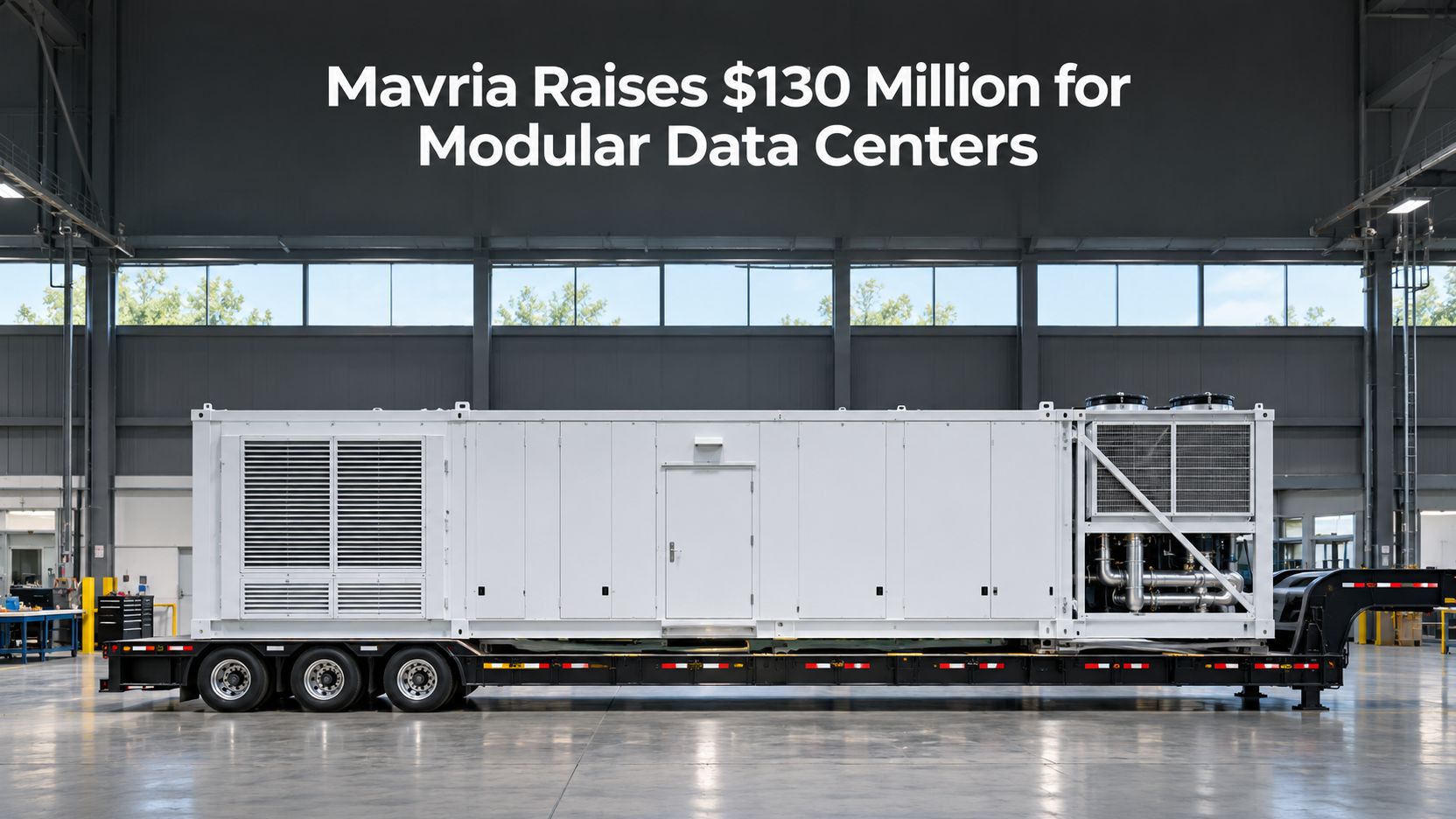
Mavria, a startup based in The Woodlands, Texas, came out of stealth on November 9, 2026, saying it has raised $130 million across its pre-seed and seed rounds, at a $1 billion valuation. Its pitch is to manufacture AI data centers in a factory, as standardized blocks shipped by truck, instead of building each facility as a custom project.
Mavria’s funding round in 20 seconds
- Mavria says it has raised $130 million, at a $1 billion valuation.
- The latest round is led by Paradigm.
- Its product, Terrain, bundles power, cooling, controls, and IT modules into 5 MW blocks.
- It has no announced customers, and testing is planned for 2027.
The company was founded by Adam Blake, its CEO, Seth Cohen, and Nick Poradek, who overlapped at the US Department of Energy during the current Trump administration. According to the US press, Blake and Cohen led the team that carried out the president’s executive orders on nuclear energy, and Cohen was chief legal counsel on nuclear policy. Before that, Blake had built a commercial solar energy company and sold a software business to Vista Equity Partners, while Poradek sold an industrial company to Liberty Energy, according to the company itself.
Terrain: A Data Center as an Industrial Product
Mavria’s first product is called Terrain. It’s a standardized system that bundles power supply, cooling, control systems, and server modules (IT pods), designed and tested together in the factory before being shipped to the site. Blake describes each unit as a five-megawatt block. The company sums it up in a line from its pitch: Terrain “replaces custom data center construction with repeatable industrial manufacturing.”
The idea, as the founders told The Wall Street Journal, is that these relatively small units can connect to local distribution lines and tap spare electrical capacity, without waiting for the long transmission-grid interconnection process that holds back large campuses, and that they can be coupled to larger facilities to add compute power. Mavria is targeting leading AI labs, cloud providers, and data center developers. It doesn’t run a cloud service or sell compute capacity: it manufactures the physical infrastructure.
The first unit, Terrain 01, is in production in Houston and serves as a demonstrator. According to DCD, the company told the WSJ that unit testing is planned for early 2027 and that it expects to ramp up production on its assembly lines by mid-year. These are company targets, not committed deliveries: Mavria hasn’t announced customers, pricing, manufacturing capacity, or delivery timelines.
The Round’s Numbers Don’t Quite Add Up
The $130 million is the cumulative total the company announces. According to statements from Blake reported by TokenPost, the latest round was $100 million, led by Paradigm, an investor known for its activity in cryptocurrencies, with participation from AMP PBC, Liquid 2, Critical Frontier, and Dream Ventures; the remaining $30 million would come from a pre-seed round in June. FourWeekMBA, for its part, found a Form D filed with the US Securities and Exchange Commission (SEC) on October 21, 2026, showing a $100 million offering of which $75 million had been sold as of that date. The difference could be due to the disbursement schedule, but the company hasn’t clarified it.
Dealroom places the deal among the top 1% of largest early-stage rounds for US energy startups in the past 48 months. A $1 billion valuation with no announced customers or deployments assumes very fast execution, in a market where established manufacturers are already competing.
A Market With Big Competitors
Mass-producing data centers isn’t a new idea, but AI demand has brought it back into fashion. NVIDIA is pushing its DSX POD, pre-integrated systems built by its partners, as we explained when covering Dell and NVIDIA’s proposal, and Schneider Electric has unveiled its own modular design for AI. The pressure comes from energy: transformer lead times are stretching into years, according to Reuters, and large projects are competing for megawatts, as shown by the 3.6 GW SpaceX has under construction, according to SemiAnalysis.
Building in a factory shortens construction time, but it doesn’t by itself solve power availability or site permitting. Mavria will have to prove that its 5 MW blocks deploy faster and with the reliability that high-density AI workloads demand, against providers with years of installations behind them. For those managing infrastructure, the appeal of predictable, uniform, repeatable capacity is real; the question is whether a startup with no deployments yet can deliver it at scale.
Frequently Asked Questions
What is Mavria?
A startup in The Woodlands, Texas, founded by Adam Blake, Seth Cohen, and Nick Poradek, former US Department of Energy officials, that manufactures AI data centers in a factory.
What is Terrain?
It’s Mavria’s first product: a standardized 5 MW system that bundles power, cooling, controls, and server modules, manufactured and tested before being shipped by truck to the site.
How much money has Mavria raised?
The company announces $130 million across pre-seed and seed rounds, at a $1 billion valuation. An SEC Form D from October showed $75 million sold out of a $100 million offering at that time.
Does it have customers yet?
It hasn’t announced any. It also hasn’t published pricing or delivery timelines, and unit testing is planned for early 2027.
Sources:
This article is also available in Spanish: «Mavria levanta 130 millones para fabricar centros de datos en serie», on revistacloud.com.
