
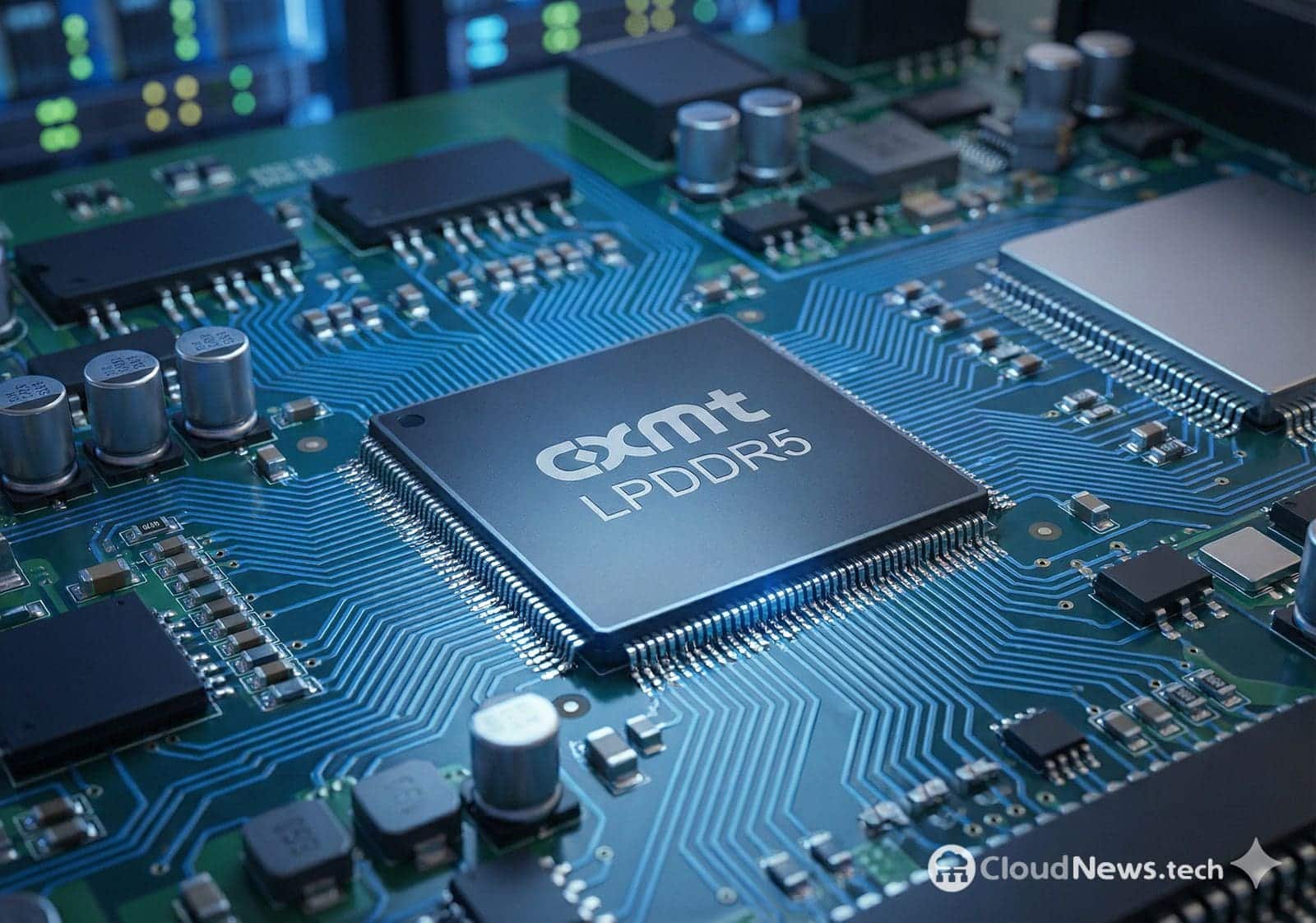
Chinese manufacturer CXMT (ChangXin Memory Technologies) has reportedly introduced High-k Metal Gate (HKMG) technology into its G4 DRAM process and its LPDDR5X products, a meaningful step toward curbing the electrical leakage that shows up as transistors keep shrinking. The company continues closing the gap on Samsung, SK hynix, and Micron while it develops its next process, G5, at roughly 15 nanometers.
CXMT’s progress in 30 seconds
- CXMT has reportedly added HKMG to its 16nm G4 process and LPDDR5X, a technology leading manufacturers have used for years.
- HKMG uses high-k dielectric materials and metal gates to better control electrical leakage.
- The company is already developing its next generation, G5, at around 15nm.
- CXMT is also working on HBM, though it still trails Samsung, SK hynix, and Micron.
- Its production capacity is growing fast, but estimates of its future volume vary considerably depending on the source.
The advance is especially interesting because it isn’t simply about producing more memory. CXMT is adopting manufacturing techniques needed to keep shrinking DRAM transistors, precisely one of the areas where its technological gap with the three big international manufacturers remains significant.
CXMT already sells DDR5 running up to 8,000 Mbps and LPDDR5X reaching 10,667 Mbps. The latter family partially entered mass production in May 2025, while the faster variants later moved into the customer-sampling stage.
Why swapping materials inside the transistor matters so much
DRAM miniaturization has run into a physical problem for years. As certain conventional insulating layers get extremely thin, leakage current rises due to effects such as quantum tunneling.
HKMG aims to ease that problem using materials with a high dielectric constant (high-k) and a metal gate.
One material commonly used in these structures is hafnium oxide (HfO₂). Its higher dielectric constant lets manufacturers keep certain electrical properties using a physically thicker layer than with conventional silicon dioxide, reducing leakage as a result.
The second part of HKMG is just as important: it replaces the traditional polysilicon electrode with a metal gate.
CXMT isn’t discovering this technology. More advanced manufacturers have worked with it for years. SK hynix, for instance, announced its use of HKMG in mobile DRAM back in 2022 and later explained that the technology had been one of the building blocks behind its faster, lower-power LPDDR5X and LPDDR5T.
The news here is that CXMT would have reached enough maturity to bring HKMG into production within its own DRAM technology.
ZDNet Korea places its G4 in the 16nm class and notes the company is developing G5, at roughly 15nm. According to the same report, CXMT would still be around two generations behind the leading manufacturers.
So it would be premature to read HKMG as proof that CXMT has technologically caught up with Samsung, SK hynix, or Micron.
From DDR5 to HBM: CXMT widens its ambitions
The next front is High Bandwidth Memory (HBM), the high-bandwidth memory paired with GPUs and AI accelerators.
According to information out of Korea, CXMT would have entered risk production of HBM2E using its roughly 18nm G3 process and would be sampling HBM3 made on G4.
It’s worth separating those stages from large-scale commercial production. CXMT’s current public catalog still centers on DDR5, LPDDR5/5X, DDR4, and LPDDR4X, without presenting HBM as an equivalent commercial family yet.
That puts the Chinese manufacturer in a very different position from SK hynix, Samsung, and Micron, which are currently competing in far more advanced generations of HBM for AI accelerators.
It also explains why news about CXMT’s progress needs to be read on two different levels. In conventional DRAM, the company already has competitive products and is ramping production quickly. In the more advanced memory used for AI, it still has to prove manufacturing capability, performance, packaging, and large-scale customer qualification.
Even so, its progress has implications for the industry, because China is trying to reduce one of its biggest technology dependencies in semiconductors: advanced memory.
CXMT ramps up production, closing in on Micron’s industrial scale
The other side of the equation is manufacturing capacity.
Available figures don’t support stating as fact that CXMT will produce exactly 800,000 wafers per month by 2031. Published estimates differ significantly. It’s a similar story to CXMT’s broader race to close the wafer-capacity gap with Micron, where the numbers alone don’t tell the whole story either.
Counterpoint Research estimates CXMT currently has around 320,000 wafers per month of capacity and could reach about 420,000 by 2027. The firm believes the company aims to double capacity by 2030 and triple it by 2035.
Other models are even more aggressive. Estimates attributed to SemiAnalysis put capacity at around 350,000 wafers per month by the end of 2026 and roughly 420,000 by the end of 2027.
New fab projects add to that picture. CXMT operates DRAM facilities in Hefei and Beijing and keeps expanding its industrial footprint, with new projects that could significantly raise output over the next few years.
That’s why wafer counts shouldn’t be confused directly with market share, either.
Two manufacturers can process similar numbers of wafers and still produce very different volumes of usable memory, depending on the process node, per-chip density, or manufacturing yield.
That’s still one of the advantages Samsung, SK hynix, and Micron hold.
CXMT may close the gap in physical manufacturing capacity before it does so in bits produced, cost per bit, or high-end products. Public figures also don’t allow for a clean, apples-to-apples comparison of manufacturing yield against its competitors.
Competitive pressure, though, is rising.
For years, the global DRAM industry has been extraordinarily concentrated around Samsung Electronics, SK hynix, and Micron. CXMT is building the scale needed to become a fourth player that’s much harder to ignore.
HKMG’s adoption matters precisely for that reason. Building fabs adds capacity, but mastering materials, transistor structures, and smaller process nodes determines what kind of memory those fabs can actually produce.
The Chinese manufacturer still has technological ground to make up, especially in HBM and the most advanced DRAM generations — a gap that also shows up in the ongoing HBM4 talent race between Samsung and SK hynix, where the leaders are pulling further ahead on the memory used for AI accelerators. But the jump from conventional memory to DDR5, LPDDR5X, HKMG-equipped G4 processes, and G5 development shows the competition is no longer limited to older-generation products.
Frequently Asked Questions
What has CXMT achieved with HKMG technology?
According to reports out of Korea, CXMT has added High-k Metal Gate to its roughly 16nm G4 DRAM process and to its LPDDR5X products. The technology helps control electrical leakage as transistors get smaller.
Is CXMT already on par with Samsung, SK hynix, and Micron?
No. The sources cited still place CXMT roughly two generations behind the leading manufacturers on certain processes, though the gap is narrowing and its production capacity is growing.
Does CXMT make HBM memory for artificial intelligence?
CXMT is reportedly working on HBM2E and sampling HBM3, but those stages don’t equate to commercial-scale production of advanced HBM on par with the leading manufacturers.
Will CXMT reach 800,000 wafers per month?
Some forecasts point to strong capacity growth over the next few years, but 800,000 wafers per month by 2031 should be treated as an estimate, not a capacity confirmed by CXMT. Other forecasts put its trajectory at different figures.
