
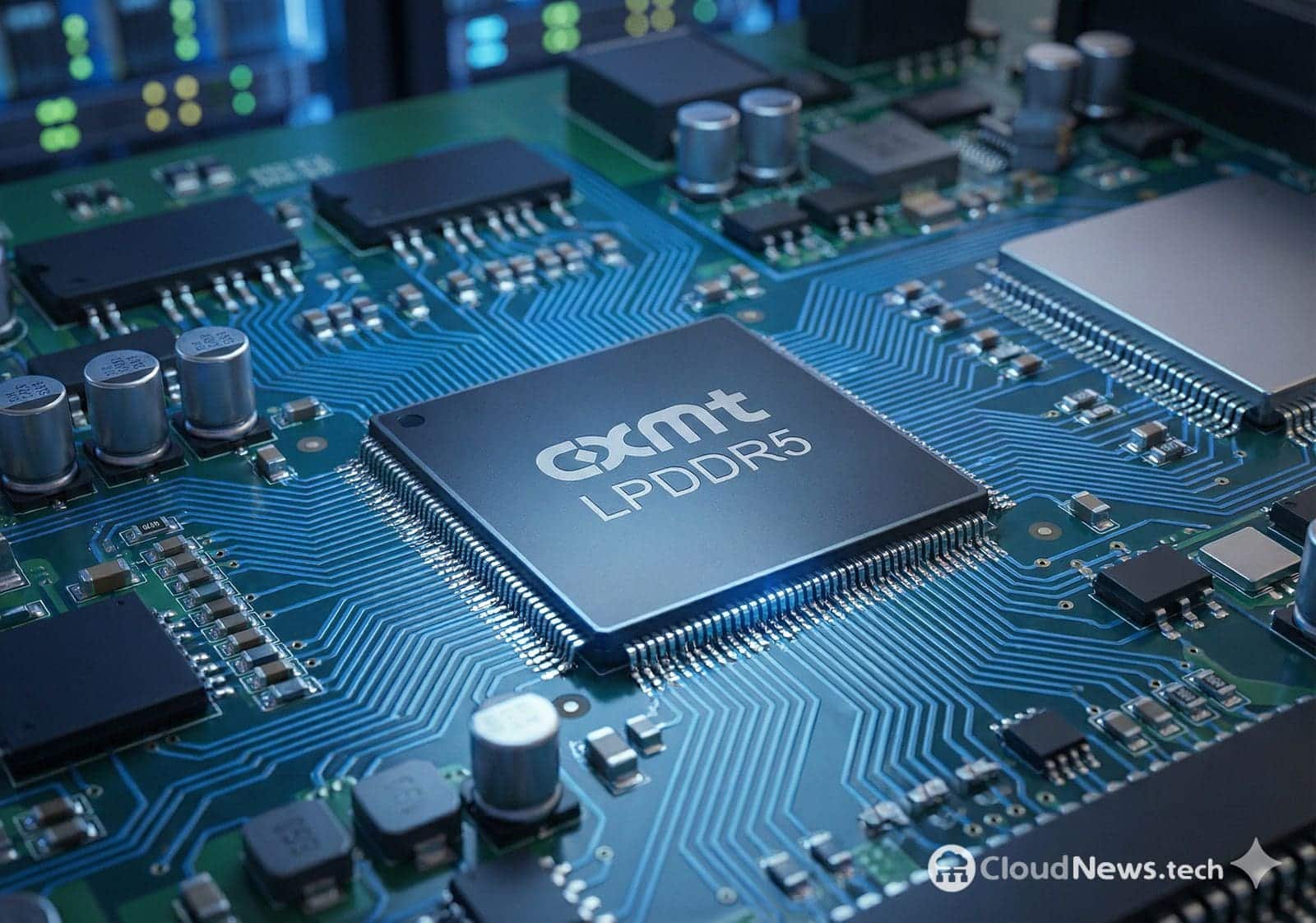
China is about to reach a goal that just a few years ago seemed distant. ChangXin Memory Technologies, better known as CXMT, could close 2026 with a DRAM manufacturing capacity very close to that of Micron, the only major American producer still competing directly with Samsung and SK Hynix in this market.
Estimates handled by SemiAnalysis place CXMT at around 350,000 wafers per month before year’s end, compared to approximately 385,000 for Micron. This narrows the gap to about 35,000 wafers per month. It’s a significant industrial advance, although this comparison does not mean that both companies can produce the same amount of usable memory, achieve equivalent yields, or compete on equal footing in the profitable AI market.
Key factors in CXMT’s growth in 20 seconds
- CXMT could reach around 350,000 DRAM wafers per month in 2026.
- Micron would be around 385,000, according to published estimates.
- Samsung and SK Hynix would maintain a much larger capacity.
- The number of wafers alone does not measure the number of bits produced or sales value.
- The technological process, performance, and size of each chip influence the actual outcome.
- CXMT is gaining ground in DDR4, DDR5, and consumer device memory.
- The company remains behind in HBM, the most demanded product for AI accelerators.
- Its initial HBM capacity could be around 30,000 wafers per month.
- SemiAnalysis estimates that CXMT could account for 17% of the global DRAM supply by late 2028.
- The company is preparing for an IPO in Shanghai to fund new factories and technological improvements.
Samsung maintains an approximate capacity of 720,000 wafers per month, and SK Hynix around 595,000. CXMT still does not threaten this leadership but is moving past the phase where it was considered merely a low-cost Chinese supplier for basic products.
Reuters positions the company as the fourth-largest global DRAM manufacturer, with about 7.7% of the market in 2025. The firm plans to start trading on the STAR market in Shanghai on 07/27/2026 and aims to raise 29.5 billion yuan, roughly 4.35 billion dollars. The funds will be used to upgrade production lines and reduce the technological gap with competitors.
More wafers don’t necessarily mean producing the same amount of memory
Monthly capacity is a common reference for comparing semiconductor factories, but it can be misleading when used as a definitive classification.
A wafer is a silicon disc on which many chips are manufactured. Two companies can process the same number of wafers and end up with vastly different amounts of sellable memory. The outcome depends on how many chips fit on each disc, the density of each device, and the percentage that pass quality tests.
The manufacturing process has a direct impact. More advanced technology allows more memory cells to be placed on a smaller surface area. This can increase each chip’s capacity or reduce its size to produce more units per wafer.
Production yield also plays a crucial role. If a factory produces many defective chips, its theoretical capacity may seem high, but actual commercial output will be much lower. A mature line with good yields can generate more useful bits than a larger, but less stable, process.
Product mix adds another variable. A wafer dedicated to conventional DDR4 does not consume the same resources as one used for high-density DDR5, mobile LPDDR memory, or stacked components to create HBM.
Therefore, CXMT can approach Micron in installed capacity without yet matching it in production volume, revenue, or profitability. The figure of 350,000 wafers describes the size of its infrastructure, not the final value of the chips produced.
Recent public estimates reflect this gap. CXMT was responsible for about 7.7% of the global DRAM market in 2025 by sales, according to Reuters. SemiAnalysis estimates that its contribution to the supply could grow from 11% in 2025 to 17% by late 2028. These figures are compatible: one measures business share, the other the physical volume of available memory.
CXMT has made some progress in consumer-visible products. Its chips already appear in DDR5 modules sold in China, including DDR5-6000 models for desktops. This demonstrates that the company can supply sufficiently mature memory for conventional systems, though it has yet to match the frequencies, densities, and margins of Samsung, SK Hynix, or Micron’s most advanced products.
The Chinese market also offers a scale that’s hard to ignore. PC, phone, graphics card, networking equipment, and server manufacturers require large amounts of memory. Much of that demand could shift toward CXMT, even though its products do not dominate all categories yet.
For Beijing, the immediate goal is not necessarily to replace the Big Three globally. Supplying a growing share of the domestic industry would already reduce reliance on foreign suppliers and limit the impact of future trade restrictions.
HBM remains the hardest gap to close
The comparison with Micron changes when it comes to high-bandwidth memory. HBM is produced by stacking multiple DRAM layers and connecting them via vertical interconnects. It’s one of the most critical and scarce components in accelerators used for training and running AI models.
In this segment, producing large quantities of conventional DRAM alone isn’t enough. The manufacturer needs advanced processes, high yields per wafer, specialized packaging, and the capacity to stack chips with low defect rates. A failure in one layer can compromise the entire set.
CXMT aims to start volume production of HBM3 in 2026. Initial estimates indicated a capacity of about 30,000 wafers per month, less than a fifth of SK Hynix’s. TechInsights also placed its technology roughly four years behind the South Korean leader.
SemiAnalysis forecasts rapid expansion if plans proceed as expected: around 55,000 wafers per month for HBM in 2027 and 100,000 in 2028. Even with that production, analysts believe the global DRAM market could remain under significant shortage until the end of that period.
The Chinese firm also faces equipment restrictions. The US and allies have limited China’s access to advanced tools, including extreme ultraviolet lithography. CXMT can continue expanding factories with DUV equipment and domestically produced machinery, but manufacturing denser nodes without the tools used by competitors requires more steps, higher costs, and complex multi-patterning techniques.
Dependence isn’t limited to a single machine. A memory plant uses deposition, etching, inspection, metrology, ion implantation, and cleaning equipment. China is developing local alternatives across many of these categories, but full replacement will take time.
This limitation explains why CXMT could grow faster in consumer memory than in advanced HBM. DDR4, parts of DDR5, and some LPDDR products can be made with mature processes and have enormous demand within China. These markets, where competitive pricing, availability, and institutional support are key, can compensate for lower densities.
The strategy poses a risk for Samsung, SK Hynix, and Micron. All three have shifted some investments toward HBM and higher-margin products. This makes sense as AI demand grows but leaves room in conventional segments that CXMT might capture.
If Chinese PC, mobile, and server makers begin relying heavily on domestically produced DRAM, overseas suppliers could lose volume even without aggressive expansion by CXMT outside China. The impact would be most significant in price-sensitive products and contracts with government agencies.
Micron is not standing still. The company has increased its US investment plan to over $250 billion through 2035, with new facilities in New York, Idaho, and Virginia. It has also signed agreements to secure silicon wafer supplies for DRAM, NAND, and HBM manufacturing.
Samsung and SK Hynix are also preparing major expansions. Memory industry veterans understand the risks of overbuilding during high-price cycles: when new factories come online and demand softens, surplus supply can lead to steep declines.
CXMT operates with different incentives. Its expansion has a commercial component but also aligns with China’s policy of technological self-sufficiency. It can maintain investments that a private company might consider too risky if government grants, land, energy, and infrastructure are provided.
This does not mean unlimited resources or insensitivity to market cycles. An inefficient factory consumes capital, electricity, and materials even with public support. Customers also demand reliable products and won’t automatically replace proven memory with higher-failure alternatives.
The IPO will allow for a more detailed assessment of the business. The prospectus and future financial results should reveal how much CXMT invests, the utilization of its capacity, how yields evolve, and what revenues are generated per memory generation.
The proximity to Micron in wafer processing volume marks an important stage but not a technological victory. CXMT is building the scale needed to become the fourth stable player in the market and secure an increasing share of Chinese consumption.
The decisive test will come afterward: translating that capacity into more bits per wafer, advancing in DDR5 and LPDDR, producing competitive HBM yields, and doing so without full access to the most advanced tools. China has already demonstrated it can ramp capacity—now it must prove it can match the productivity and value of its rivals.
Frequently Asked Questions
Will CXMT produce more DRAM memory than Micron in 2026?
Not necessarily. It could approach Micron in wafer count, but the amount of usable memory depends on processes, chip densities, yields, and product types.
What is CXMT’s position in the global DRAM market?
It is the fourth-largest manufacturer. Reuters estimates it will hold about 7.7% of the market in 2025, behind Samsung, SK Hynix, and Micron.
Can CXMT already compete in HBM for AI?
It’s developing HBM3 and preparing for industrial capacity, but remains behind the leaders in technology, volume, packaging, and validation with major clients.
Will CXMT’s expansion lower RAM prices?
It could increase supply of DDR4 and DDR5, especially in China, but global prices will also depend on AI demand, HBM capacity, and investment decisions by Samsung, SK Hynix, and Micron.
