
Demand for AI storage is reshaping memory market forecasts. TrendForce says U.S. cloud service providers have raised their purchasing forecasts for enterprise SSDs, and that fourth-quarter 2026 orders could exceed the already high levels seen in the third quarter. At the same time, a forecast from Jeff Pu at GF Securities has raised the expected quarter-on-quarter growth in NAND prices for the fourth quarter from 2% to 17%.
NAND for SSDs: the key points in 20 seconds
- Major cloud providers are increasing their orders for enterprise SSDs to support AI infrastructure.
- TrendForce expects fourth-quarter orders to exceed third-quarter levels.
- Jeff Pu has revised his NAND price forecast upward: from 2% to 17% in Q4 2026.
- The forecast also points to 21% growth in Q3 2026 and 15% in Q1 2027.
- QLC is gaining ground in vector databases and cache storage for AI workloads.
The 17% figure needs an important caveat. It doesn’t mean every SSD will get 17% more expensive on store shelves, nor that a consumer SSD will automatically cost that much more. This is a forecast for the blended price of NAND memory relative to the previous quarter. The final price of an SSD also depends on the controller, assembly, margins, contracts, and the specific state of the consumer market.
What is changing is where memory makers place their priorities. AI-driven enterprise demand is gaining weight, giving suppliers more incentive to allocate capacity to data-center SSDs, while the consumer market faces a different situation. For 2027, TrendForce describes an increasingly sharp divide between an AI-driven enterprise SSD market and a consumer NAND market under greater price pressure.
Data center orders are shifting the balance again
TrendForce says U.S. cloud service providers, known as CSPs, have revised their demand forecasts upward over the past few weeks. The reason is linked to faster deployments and the expanding use of enterprise SSDs across more applications.
The firm expects fourth-quarter orders for enterprise SSDs to exceed third-quarter levels. For NAND makers, that shift has a direct consequence: greater bargaining power over production allocation and pricing in the enterprise segment. It’s a dynamic cloudnews.tech has tracked before, as memory maker Phison has warned that NAND supply stays tight even as new fabs come online.
The difference from previous cycles also lies in the type of applications driving demand. AI storage is no longer limited to holding the large datasets used to train models.
TrendForce identifies growth in workloads tied to agentic AI, which need to retrieve information and handle large volumes of data in real time. It also points to growth in vector databases, where capacity and cost per gigabyte make QLC NAND a particularly attractive option for certain deployments.
In China, another use case is emerging: KV cache offloading. Some AI architectures move part of the cache used during inference from memory to high-capacity SSDs. The goal is to free up memory resources and maintain infrastructure with greater storage capacity at a lower cost than expanding certain tiers of high-performance memory.
QLC gains ground inside enterprise SSDs
The evolution of QLC memory is one of the data points that best explains where this market is heading.
QLC stores four bits per cell, compared with three bits per cell for TLC. That higher density makes it possible to build high-capacity drives with a potentially lower cost per gigabyte, though with different trade-offs in performance and endurance depending on each drive’s design.
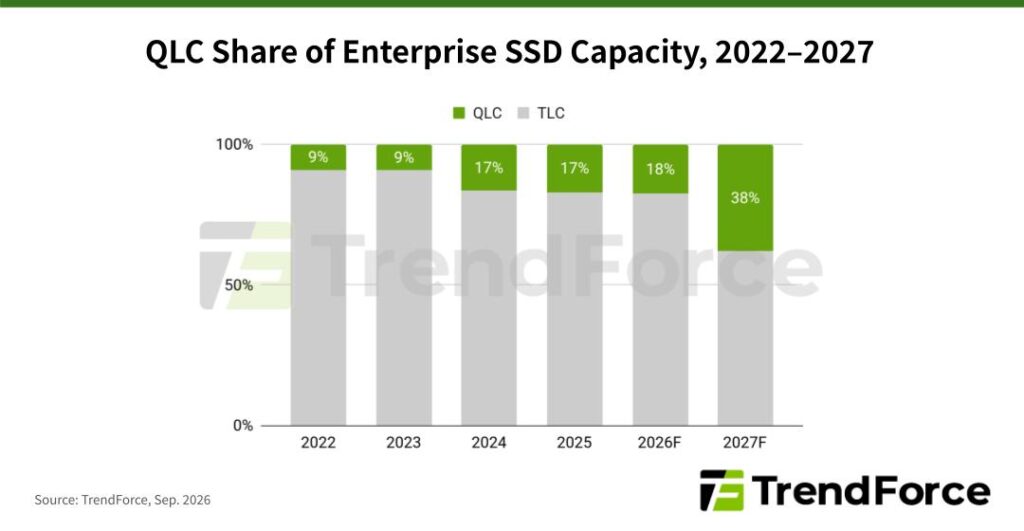
TrendForce’s chart shows QLC’s share of enterprise SSD capacity rising from 9% in 2022 and 2023 to 17% in 2024 and 2025. The estimate for 2026 stands at 18%, while the forecast for 2027 reaches 38%.
That jump doesn’t mean 38% of all units sold will use QLC. The metric TrendForce shows is QLC’s share of enterprise SSD capacity, an important distinction because a high-capacity drive carries much more weight in that calculation than a lower-capacity one.
TrendForce itself identifies QLC as one of the drivers of enterprise SSD growth, particularly because of its balance between capacity and cost.
From 2% to 17%: what Jeff Pu’s forecast actually says
Jeff Pu’s revision adds pressure to the outlook for the coming months. Information released on September 21 now puts expected quarter-on-quarter NAND price growth at 21% for the third quarter of 2026, up from 18% previously.
For the fourth quarter, the estimate moves from 2% to 17%, while the first quarter of 2027 goes from a forecast of flat prices to an increase of 15%. These are changes relative to the immediately preceding quarter and reflect a market forecast, not prices already locked in for consumers.
The revision also aligns with the shift TrendForce is tracking in enterprise SSDs. The firm had previously warned that CSP demand for AI applications was rising, and in its latest analysis argues that the pressure is spreading from traditional training workloads to inference, agentic applications, and the storage of large volumes of information.
For anyone buying an SSD for a PC, the consequence is less direct than a figure like 17% might suggest. The enterprise and consumer markets don’t share the same priorities or necessarily the same contracts. TrendForce also notes signs of weakness in certain parts of the consumer market, which could limit how much of the NAND price increases carry over to all products — though, as cloudnews.tech has reported, AI-driven demand has already pushed some retail SSD prices sharply higher this year.
The pressure, then, is especially concentrated in enterprise storage. AI is pushing data centers to need more capacity to store data, vector databases, information retrieved by agents, and certain model states during inference. And the faster that demand grows, the greater the competition for NAND manufacturing capacity that can’t be expanded from one quarter to the next.
That doesn’t mean a PC SSD will cost 17% more by year-end. It does point to a NAND market increasingly shaped by data centers and artificial intelligence, with a growing gap between how enterprise SSDs and consumer products behave.
Frequently Asked Questions
Will all SSDs get 17% more expensive?
No. The 17% figure is Jeff Pu’s forecast for the price of NAND in the fourth quarter compared with the third. The price of any specific SSD depends on many other components and commercial factors.
Why does AI need so many enterprise SSDs?
AI infrastructure needs to store large volumes of data and is increasingly using storage for information retrieval, vector databases, and certain cache offloading techniques during inference.
What is QLC and why is it growing in data centers?
QLC is a type of NAND memory that stores four bits per cell. Its high density can lower cost per gigabyte and suits certain enterprise workloads that prioritize capacity.
What is TrendForce’s forecast for enterprise SSDs?
TrendForce expects orders for enterprise SSDs from U.S. cloud providers to rise in the fourth quarter of 2026 and potentially exceed third-quarter levels. The firm links part of this growth to new AI workloads.
