
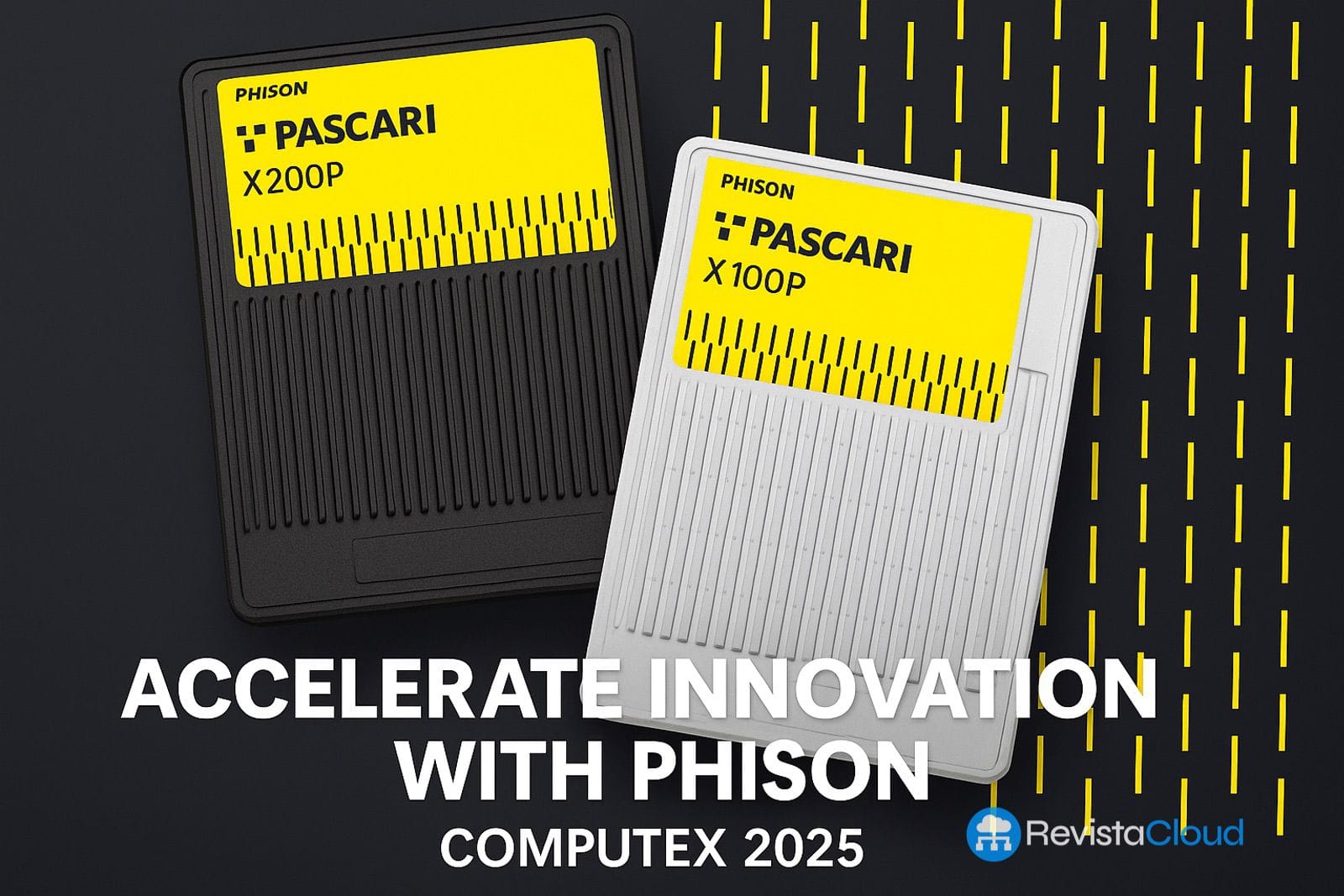
AI’s pressure on the memory industry is pushing back the prospect of a quick return to the abundance cycles that have traditionally driven down NAND and DRAM prices. Khein-Seng Pua, CEO of Phison, argues that even a sharp expansion in the number of fabs might not be enough if AI demand keeps up its current trajectory, while SEMI’s investment forecasts confirm that manufacturers are already committing record amounts to expanding and upgrading memory production.
Memory shortage key points in 20 seconds
- Phison expects NAND supply to remain very tight through 2027 and questions a quick return to overcapacity.
- Pua suggests that even an expansion equivalent to dozens of fabs might not necessarily solve the problem if AI keeps growing.
- SEMI forecasts $52 billion in investment in 300mm memory equipment for 2026.
- DRAM, HBM, and NAND are all under simultaneous pressure from data centers and AI systems.
- More capacity doesn’t automatically mean an immediate drop in prices.
This isn’t the first time Phison has sounded this alarm. Its CEO said last year that NAND shortages could last a decade and push the market toward a memory supercycle, a warning that keeps looking more accurate as 2026 progresses.
Phison’s statements should be read as a warning about how fast demand is growing, not as an industry estimate that exactly 20 new fabs are needed. Pua considers forecasts that expect current expansions to push the NAND market back into oversupply within a year or two to be too optimistic. Two suppliers reportedly told Phison recently that it is still difficult to quantify the shortfall that could occur in 2027.
SEMI’s data provides context for these statements. The organization calculates that global investment in equipment for 300-millimeter memory fabs will exceed $50 billion for the first time in 2026, reaching about $52 billion. For 2027 it expects another $57 billion. The industry is building more capacity, but a growing share of it is aimed precisely at the memory that AI infrastructure needs.
NAND no longer depends only on PCs and smartphones
Phison’s argument starts from a shift in what flash memory is used for. For years, NAND demand was closely tied to smartphones, computers, consumer electronics, and enterprise storage. AI data centers are now adding another source of consumption that can reach very high volumes.
Pua notes that cloud AI is already growing fast while the rollout of AI systems inside companies themselves still has room to run. His comparison takes the long view: PCs and smartphones each took around two decades to build out their respective markets, while the current generative AI phase is barely a few years old. On that basis, he considers it possible that AI could keep absorbing semiconductor capacity for another 20 to 30 years.
That is not the same as forecasting 20 to 30 straight years of NAND shortages. The statement refers to the period during which AI could keep increasing its demand for manufacturing capacity.
The distinction matters because fabs will keep expanding during that time.
SEMI estimates that global memory capacity at 300mm fabs will reach roughly 4.1 million wafers per month in 2026 and 4.2 million in 2027. At the same time, investment in equipment specifically for 3D NAND would grow 28% in 2026, to about $14 billion.
| Memory market | 2026 | 2027 |
|---|---|---|
| Total 300mm memory equipment investment | $52 billion | $57 billion |
| Annual investment growth | +29% | +11% |
| Global 300mm memory capacity | 4.1M wafers/month | 4.2M wafers/month |
| 3D NAND equipment | $14 billion | — |
| 2026 3D NAND investment growth | +28% | — |
Source: SEMI 300mm Fab Outlook, June 2026.
There is also a technical hurdle that keeps investment from translating directly into available wafers. The shift toward more advanced DRAM, high-bandwidth memory (HBM), and NAND with a higher number of layers involves more complex processes. SEMI points out that these transitions are precisely what moderates the effective growth in capacity.
Phison is also taking steps to protect its own supply. Pua says the company is buying up available NAND inventory at more favorable prices and trying to keep enough memory on hand to serve its customers. The company expects AI-related products to exceed 40% of its revenue by the end of 2026, up from around 38% currently, provided it can secure the components it needs.
DRAM and HBM are competing for another slice of capacity
The problem isn’t limited to NAND storage. AI is simultaneously reshaping investment priorities in DRAM and HBM, the high-bandwidth memory used alongside AI accelerators.
SEMI expects investment in DRAM equipment to grow 29% during 2026, to roughly $37 billion, driven precisely by demand for HBM and DDR5 for GPUs and other accelerators.
| 2026 memory investment | Amount | Growth |
|---|---|---|
| DRAM equipment | $37 billion | +29% |
| 3D NAND equipment | $14 billion | +28% |
| Total 300mm memory | $52 billion | +29% |
Samsung, SK hynix, Micron, and Chinese manufacturers all have plans to add capacity over the coming years. The question is whether those additions will arrive before demand grows again.
A Samsung Securities analysis from June specifically outlines a scenario of high memory profitability followed by capacity expansions. Its estimates for SK hynix still projected bit growth in both DRAM and NAND through 2027 and 2028, while assuming a gradual moderation in average price increases.
Samsung Securities has also noted that the pace of capacity construction in South Korea is picking up. In a later analysis, its team estimated that pulling forward certain equipment-installation schedules by roughly 50% still wouldn’t be enough to fully meet AI-related demand, with tight conditions likely to persist at least through 2027.
That doesn’t mean NAND and DRAM share exactly the same market, either. NAND stores data non-volatilely; DRAM and HBM provide high-speed working memory. But all three components are being hit at the same time by the buildout of AI infrastructure.
Why building more fabs doesn’t immediately make an SSD cheaper
Phison’s warning helps explain an apparent contradiction: the industry has never invested this much in manufacturing memory, and yet it’s still talking about supply constraints.
A new fab needs construction, equipment installation, ramp-up, and qualification before it reaches meaningful output. On top of that, some of the announced investment isn’t creating capacity from scratch — it’s upgrading existing lines to produce more advanced generations.
Meanwhile, demand keeps rising.
Phison says NAND prices have roughly multiplied tenfold from the cycle’s previous lows. Pua sees the recent slowdown in the pace of price increases as a positive, since overly sharp hikes end up hurting consumer electronics makers. But a slower rise isn’t the same as a drop: his forecast is that prices will hold on a plateau and keep climbing moderately through 2027.
The impact doesn’t have to be the same for every product, either. An AI server, an enterprise SSD, and an SSD for a home PC all use NAND, but their specs, margins, and ability to absorb higher prices differ.
That could make the relevant question over the coming months not just how much memory the industry can produce, but which customers it decides to allocate it to.
Manufacturers are responding. China, South Korea, Japan, and the United States all have capacity expansions underway, while SEMI expects global investment in memory equipment to keep growing toward nearly $80 billion by 2029.
But Phison’s statements show why there is still no reliable date for turning that investment into cheaper SSDs and RAM for consumers.
Capacity is growing. The open question is whether it can grow faster than demand from data centers, AI servers, and enterprise systems.
Frequently asked questions
Did Phison say exactly 20 new NAND fabs are needed?
The reference to 20 fabs should be read as a warning about the potential scale of demand if AI keeps expanding, not as a technical calculation determining that this is precisely the capacity required.
Will NAND memory still be in short supply in 2027?
Phison’s CEO expects supply to stay very tight through 2027 and considers it too optimistic to expect an immediate return to oversupply. However, there is no guaranteed date for when the tight conditions will end.
How much is the industry investing in building more memory?
SEMI forecasts about $52 billion in 300mm memory equipment during 2026 and $57 billion in 2027. Within 2026, it estimates roughly $37 billion for DRAM and $14 billion for 3D NAND.
When could RAM and SSD prices come down?
Available data doesn’t allow for a specific date. The industry is expanding capacity, but AI-linked demand is also growing, so building new fabs doesn’t guarantee an immediate price cut.
