

The rising cost of memory is producing comparisons that would have seemed unthinkable just three years ago. One user showed they bought a Samsung 870 EVO SATA 4TB for $169.99 in October 2023, while a comparable model recently showed up on Amazon for $1,099.90. That single price doesn’t describe the whole market, but the trend behind it is real: SSDs have gotten a lot more expensive through 2026 as NAND manufacturers prioritize the growing demand for server storage and AI.
The SSD price surge in 30 seconds
- A Samsung 870 EVO 4TB bought for $169.99 in 2023 was listed at $1,099.90 in 2026 on the same Amazon listing.
- In Spain, the same model runs around 1,000 euros, though there are much cheaper SATA 4TB SSDs available.
- NAND is still under pressure from data center and AI demand.
- Manufacturers are steering more capacity to enterprise SSDs, where margins are higher.
- TrendForce forecasts contractual NAND prices rising another 10-15% in Q3 2026.
The Samsung 870 EVO comparison went viral because it puts a face on something market statistics show far less dramatically.
In October 2023, you could find 4TB SSDs on sale for under $200. Three years later, capacities that looked set to keep getting cheaper have turned the other way.
And it’s especially odd that it’s happening with a SATA SSD, a mature technology limited by an interface PC users have known for years.
A 2021 SSD that can now cost far more than when it was new
Samsung introduced the 870 EVO family in early 2021. The 4TB model uses V-NAND memory and hits official sequential speeds of up to 560 MB/s read and 530 MB/s write.
Those numbers are well behind today’s PCIe 4.0 and 5.0 NVMe SSDs, but they’re plenty for many uses.
SATA also keeps an advantage: millions of computers can use 2.5-inch drives even without enough M.2 slots.
That made large-capacity SATA SSDs an attractive way to expand storage for years.
The current pricing has broken part of that logic.
| Samsung 870 EVO 4 TB | Observed price |
|---|---|
| Purchase shown by user, 10/11/2023 | $169.99 |
| Amazon listing in 2026 | $1,099.90 |
| Recent lowest price recorded by Idealo Spain | from 991.17 euros |
| Samsung USA | $1,759.99, out of stock |
Samsung also still lists the 4TB model with its original specs.
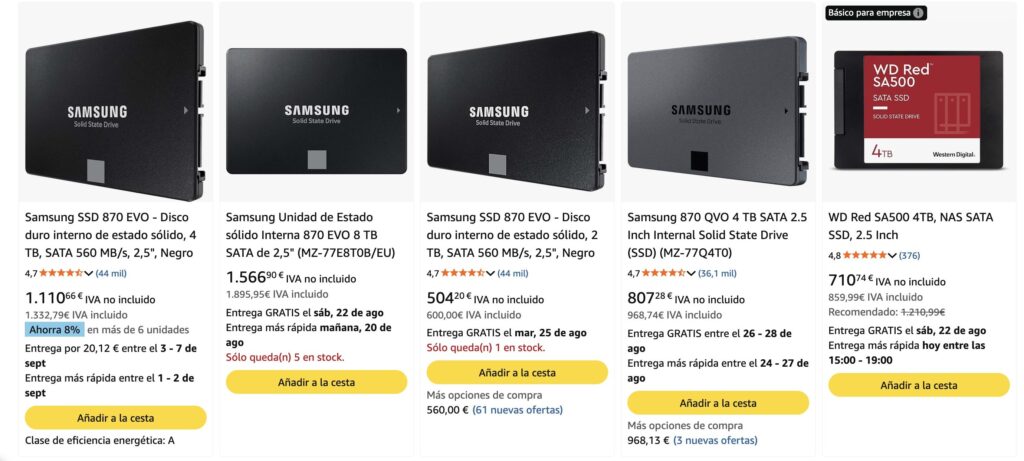
But these figures need an important caveat.
A specific listing showing $1,099 or $1,759 doesn’t mean every 4TB SATA SSD costs that.
Prices for older products can get badly distorted when normal stock runs out and only external sellers, imported units, or references with limited availability remain. You can find 4TB SATA SSDs from other brands well below those prices.
So it would be wrong to conclude SSD prices have universally multiplied sixfold.
What matters is that even current alternatives cost considerably more than those very aggressive 2023 deals.
The reason is NAND, not the SATA interface
A SATA SSD and an NVMe can perform very differently, but both need NAND Flash memory to store data.
And that’s where the real issue is.
AI infrastructure is quickly raising demand for enterprise storage. Large data centers need enormous amounts of NAND to fill SSDs whose capacities can dwarf consumer products.
TrendForce expects contractual NAND Flash prices to rise between 10% and 15% quarter over quarter in Q3 2026.
The firm names AI inference and large data center deployments as the main reasons demand stays high.
There’s also a number that helps grasp the scale of the shift.
According to Counterpoint Research, enterprise SSDs absorbed about 48% of global NAND bits shipped in Q2 2026, up from 26% a year earlier.
Almost half of production, measured by capacity, is going into enterprise storage.
Manufacturers would rather sell server storage
The problem for consumers isn’t only that more buyers are chasing the same memory.
It’s also about what kind of memory manufacturers choose to make.
Samsung, SK hynix, Micron, Kioxia/SanDisk, and others have limited capacity. If enterprise demand rises and pays better margins, there’s a strong pull to devote more resources to those products.
TrendForce confirms suppliers are steering more capacity toward enterprise SSDs while keeping NAND wafer supply tight in the open market.
That helps explain a paradox in 2026.
Demand for PCs and other consumer devices isn’t especially strong. Normally weak demand would push storage prices down.
But the industry’s focus has moved.
Data centers are soaking up enough capacity to keep the supply chain tight even as consumer buying slips.
AI is also changing how much storage a server needs
There’s another difference from past memory cycles.
An AI-focused server doesn’t just need GPUs and HBM memory.
It also creates and moves huge datasets. Training means storing datasets, checkpoints, and results, and large-scale inference brings new storage and cache needs.
The NAND market is responding to that demand.
TrendForce describes a clear split right now: strong cloud and enterprise demand against a consumer market weakened by high prices.
That makes home SSDs an indirect casualty of AI’s rise.
Not because anyone is literally putting a Samsung 870 EVO inside an AI server, but because enterprise products and consumer SSDs end up competing for manufacturing capacity and raw materials in the same NAND industry.
The Samsung 870 EVO case is also about its age
The 870 EVO’s remarkable price jump can’t be pinned on the memory crunch alone.
It’s a product launched more than five years ago.
When a model ages and its availability shrinks, prices can behave oddly. Sellers holding units may set prices well above the product’s reasonable value.
Paying around 1,000 euros for a 4TB 870 EVO is hard to justify when there are cheaper modern SATA or NVMe options.
This example is better seen as a market snapshot than a buying guide.
Samsung USA currently shows the 4TB model at $1,759.99, but out of stock for delivery or pickup. That shows why listed prices and actual market prices don’t always line up.
When might SSD prices fall again?
The forecasts here aren’t fully uniform.
TrendForce thinks NAND supply could outpace demand faster in 2027, thanks to the move to more advanced processes and more bits per wafer.
Its current forecast suggests supply constraints could start easing in the second half of 2027.
That doesn’t necessarily mean prices return to 2023 levels.
The market has changed. Manufacturers are putting more resources into enterprise products, and AI infrastructure is becoming a major structural consumer of storage.
Some specialized segments face even more extreme situations. TrendForce predicts contractual prices for SLC NAND memory could rise between 120% and 170% in H2 2026, due to scarcity and demand from industrial, networking, data center, and edge AI uses.
The old Samsung 870 EVO stands for a much bigger shift.
For years the outlook seemed inevitable: each NAND generation would bring more terabytes for less money. Memory manufacturing has always been cyclical, but AI has added a buyer willing to absorb huge capacities and pay higher margins.
For someone who bought that 4TB SSD for $169.99 in 2023, the result is striking: three years later, upgrading a computer with the same capacity can cost a lot more, even though the technology is exactly the same.
Frequently Asked Questions
Does a Samsung 870 EVO 4TB really now cost six times what it did in 2023?
A comparison shared by a user shows a purchase at $169.99 in 2023 and a listing at $1,099.90 later. But these are specific prices and don’t mean the whole SSD market has multiplied sixfold.
Why are SSD prices rising?
NAND supply stays tight while demand from data centers and AI keeps growing. Manufacturers are also prioritizing enterprise SSDs and higher-margin products.
Is it worth paying 1,000 euros for a Samsung 870 EVO 4TB?
The high price of this model is also driven by its availability. There are alternative 4TB SATA and NVMe SSDs, so it’s wise to compare before paying a premium for one particular model.
Will SSD prices fall in 2027?
TrendForce expects the growth in NAND supply could gradually ease the shortage during 2027, especially in the second half. The real trend will also depend on how much AI storage demand keeps growing.
via: Reddit
