
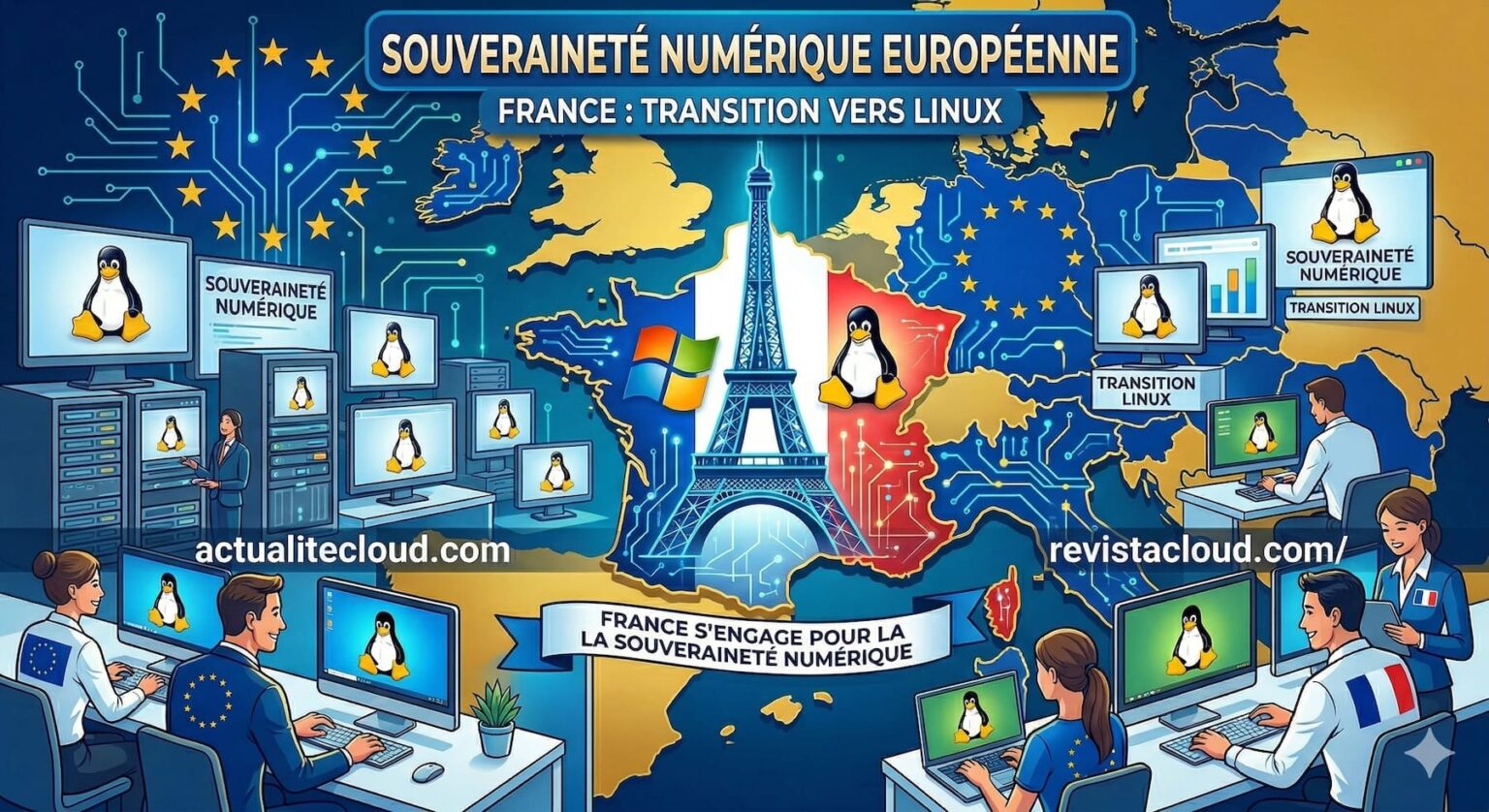
China’s decision to speed up the removal of Windows from certain state bodies raises an uncomfortable question for Europe too: does it make sense for European administrations, sensitive infrastructure, and public services to keep a structural dependence on operating systems and platforms controlled by companies outside the European Union? The answer isn’t to throw Windows out of every public body, but some European governments are already showing that Linux and open software can work across thousands of public-sector desktops, cut licensing costs, and increase technological control.
Linux and European digital sovereignty in 30 seconds
- Europe doesn’t need to ban Windows, but it does need to identify the public-sector roles where depending on a U.S. vendor adds little value.
- Schleswig-Holstein is replacing Office, Outlook, Exchange, and, gradually, Windows itself with open technologies for around 30,000 employees.
- The German state says it has already saved more than €15 million in licensing costs.
- France has used Linux across tens of thousands of Gendarmerie workstations for years.
- The European Commission itself placed open source among the pillars of its new technological sovereignty strategy in June 2026.
Nor should this turn into an ideological battle between Windows and Linux. Microsoft offers a mature, widely supported product that many professional applications still need. Migrating purely because Linux has no license cost can end up being more expensive if applications then need to be rebuilt, employees retrained, or complex compatibility layers maintained.
But the argument also works the other way. Continuing to pay proprietary licenses indefinitely simply because the same vendor has always been used isn’t a technology strategy either.
Europe is starting to acknowledge this officially.
Schleswig-Holstein Shows the Migration Can Move Past the Experimental Stage
The most interesting European example right now is in Germany.
The German state of Schleswig-Holstein is running a program to build a digitally sovereign public workplace for around 30,000 employees.
It isn’t simply a matter of installing Linux.
Its strategy involves gradually replacing much of the Microsoft infrastructure with different open components.
| Traditional technology | Adopted or planned alternative |
|---|---|
| Microsoft Windows | Linux |
| Microsoft Office | LibreOffice |
| Exchange | Open-Xchange |
| Outlook | Thunderbird |
| SharePoint | Nextcloud |
| Active Directory | Nubus / open infrastructure |
| Microsoft Access | Alternative platform for applications |
| Proprietary telephony | Open OSKAR architecture |
The project already offers real results to analyze.
In October 2025, Schleswig-Holstein completed the migration of more than 40,000 mailboxes, containing more than 100 million emails and calendar entries, from Microsoft Exchange and Outlook to Open-Xchange and Thunderbird.
By the end of that same year, LibreOffice was deployed on close to 80% of administrative workstations, initially excluding certain areas of the tax administration.
The regional government also published a figure that’s especially interesting for the economic debate: it says it has achieved more than €15 million in savings on licensing costs, against a planned extraordinary investment of €9 million during 2026 to continue the migration and develop the open solutions.
That doesn’t mean Linux will always turn out cheaper.
But it does show that the savings aren’t just a hypothesis.
In August 2026, Schleswig-Holstein took another step and awarded the transformation of its telephone infrastructure to OSKAR, an architecture built on open technologies.
And the regional government confirms that it has also begun the operating-system transition to Linux.
The project is interesting precisely because it doesn’t hide the main problem.
Part of the administration’s specialized applications still depend on Windows. That’s why the change is being carried out gradually rather than through an order to uninstall Microsoft from every computer overnight.
That approach could prove far more applicable across the rest of Europe.
France Has Spent Years Showing Linux Can Work in Critical Bodies
France offers another, even older precedent.
The French National Gendarmerie began a transition to open software years ago that ended up including its own Ubuntu-based distribution, known as GendBuntu.
This isn’t a small town hall using Linux to cut costs.
The Gendarmerie runs infrastructure spread across the country and handles sensitive information. Its experience shows that a Linux desktop can be centrally managed and used in environments where security, operational continuity, and control are important requirements. That same shift away from Windows has been building elsewhere in France too, part of a broader push to accelerate the country’s digital sovereignty efforts well beyond the Gendarmerie alone.
The French model doesn’t involve building every piece from scratch, either.
That’s probably one of the ideas Europe should avoid if it wants to move toward technological sovereignty: sovereignty doesn’t mean building a different national alternative for every American product.
Twenty-seven mutually incompatible government Linux distributions wouldn’t necessarily make Europe more independent.
A European approach would make far more sense.
Linux already provides an open kernel used globally. LibreOffice, Nextcloud, Open-Xchange, Thunderbird, and numerous other projects offer components administrations can build controllable workstations on top of.
There are also European companies capable of providing support, integration, security, and maintenance.
The money wouldn’t disappear. Instead of putting the entire budget into licenses from foreign vendors, part of it could go to European companies handling integration, development, and support.
That’s where an important economic difference appears.
Open source doesn’t mean zero cost.
It means changing vendors doesn’t necessarily mean changing technology.
An administration can hire one company to maintain Linux or an open application and later award that service to a different company without having to replace the whole platform.
That room to negotiate also carries economic value.
The EU Itself Already Admits It Has a Dependency Problem
This debate has stopped being a position defended solely by free-software communities.
On June 3, 2026, the European Commission unveiled its new open source strategy as part of the European technological sovereignty package.
The Commission acknowledges that Europe maintains a high dependence on non-EU vendors for software, cloud, artificial intelligence, and digital infrastructure.
Document COM(2026) 503 is even more explicit: it states that the Union depends on non-European vendors for more than 80% of its digital products, services, infrastructure, and intellectual property.
The Commission identifies open source as a tool for reducing those dependencies.
Among the priority areas are precisely operating systems, cloud and edge, artificial intelligence, cybersecurity, and software development infrastructure.
It also wants public administrations to become users and participants in the open ecosystem, to improve public-procurement conditions for these solutions, and to reuse developments across bodies.
There’s also a sizeable economic figure behind the plan. The Commission estimates that Europe spends more than €260 billion a year on digital technologies from third countries. It’s a pattern the sector keeps running into: some of the foundations underpinning Europe’s sovereignty push turn out to be surprisingly narrow, as a hidden PHP dependency inside one of Germany’s own government platforms recently showed.
Not all of that money goes to Microsoft, nor could it all be replaced by Linux. The figure covers a much larger technology market.
But it helps put the scale of the dependency in perspective.
Denmark has also formally started studying the problem. Its Digitalization Agency published a specific analysis in 2026 on digital sovereignty in the public sector, produced together with the Ministry of Digitalization, municipalities, and regions, examining national and international experiences and possible mechanisms for giving administrations more freedom of choice.
Austria offers another example in collaboration tools. Its Federal Ministry of Economic Affairs deployed Nextcloud on infrastructure located in Austria to gain more control over its data and reduce its dependence on non-EU cloud services.
Not everyone is replacing Windows. And that distinction matters.
Europe Doesn’t Need to Eliminate Windows, It Needs to Be Able to Do Without It
A sensible European policy would hardly consist of ordering every civil servant to use Linux.
There are roles where Windows can remain the technically and economically better option.
Industrial applications, specialized tools, certain medical devices, legacy administrative programs, or business applications built specifically for Microsoft technologies can make a migration unjustifiably costly.
Real sovereignty would mean knowing where that dependency exists and having the ability to remove it when necessary.
A relatively simple first step would be to classify public-sector roles.
An employee who mainly uses a browser, email, videoconferencing, web apps, documents, spreadsheets, and browser-based administrative tools probably has very different needs from a technician who depends on specialized Win32 software.
For the first group, Linux should at least be able to compete on equal footing in public tenders.
Another principle should also apply: new public applications should avoid creating unnecessary dependencies on the user’s operating system.
An administrative application built in 2026 that only works properly on Windows is potentially creating a problem that can last twenty years.
Open standards, web applications, documented APIs, interoperable formats, and vendor-independent authentication let the operating system go back to being a choice rather than an obligation.
That has implications that go well beyond licensing savings.
A public body that controls its code, its document formats, its users’ identities, and the infrastructure where it stores data has a much greater ability to switch vendors.
And that ability is precisely one of the foundations of technological sovereignty.
China is following a far more interventionist model, progressively replacing foreign technology with domestic alternatives. Europe doesn’t need to copy it.
It also has an advantage: Linux and much of the open software it needs already exist.
The question is whether it wants to use them strategically.
Schleswig-Holstein’s case shows this can be done at a scale large enough to stop calling it an experiment. It also shows that not everything can be migrated immediately, and that legacy applications are one of the biggest obstacles.
Maybe that’s the framing Europe needs: not asking whether it should abandon Microsoft, but in which public bodies, roles, and services it still makes sense to depend exclusively on Microsoft, and in which it no longer does.
If the answer, across thousands of administrative desktops, is that a browser, an office suite, email, and a handful of web applications cover practically all of the daily work, Linux stops being an ideological question.
It becomes an economic and strategic option that administrations should, at the very least, run the numbers on.
Frequently Asked Questions
Could Europe replace Windows with Linux across public administration?
Technically, it could do so for a considerable share of positions, but a complete replacement would be far more complicated. Specialized applications, peripherals, and legacy systems can keep Windows dependencies in place for years.
Are any European administrations already moving away from Microsoft?
Yes. Schleswig-Holstein is gradually replacing Office, Exchange, Outlook, and other components, and has begun shifting from Windows to Linux. The French Gendarmerie has used Linux desktops for years, while other European bodies are replacing certain proprietary tools with open alternatives.
Would Linux save public money?
It can cut licensing costs, but a migration also involves integration, training, support, and adapting applications. Schleswig-Holstein says it has already saved more than €15 million in licensing, against a planned €9 million in extraordinary investment for migration and development during 2026.
Why can open source improve Europe’s sovereignty?
Because it allows software to be inspected and modified, lets organizations use open standards, and makes it possible to switch vendors without necessarily abandoning the technology in use. In 2026, the European Commission placed it among the tools for reducing technological dependence on non-EU vendors.