
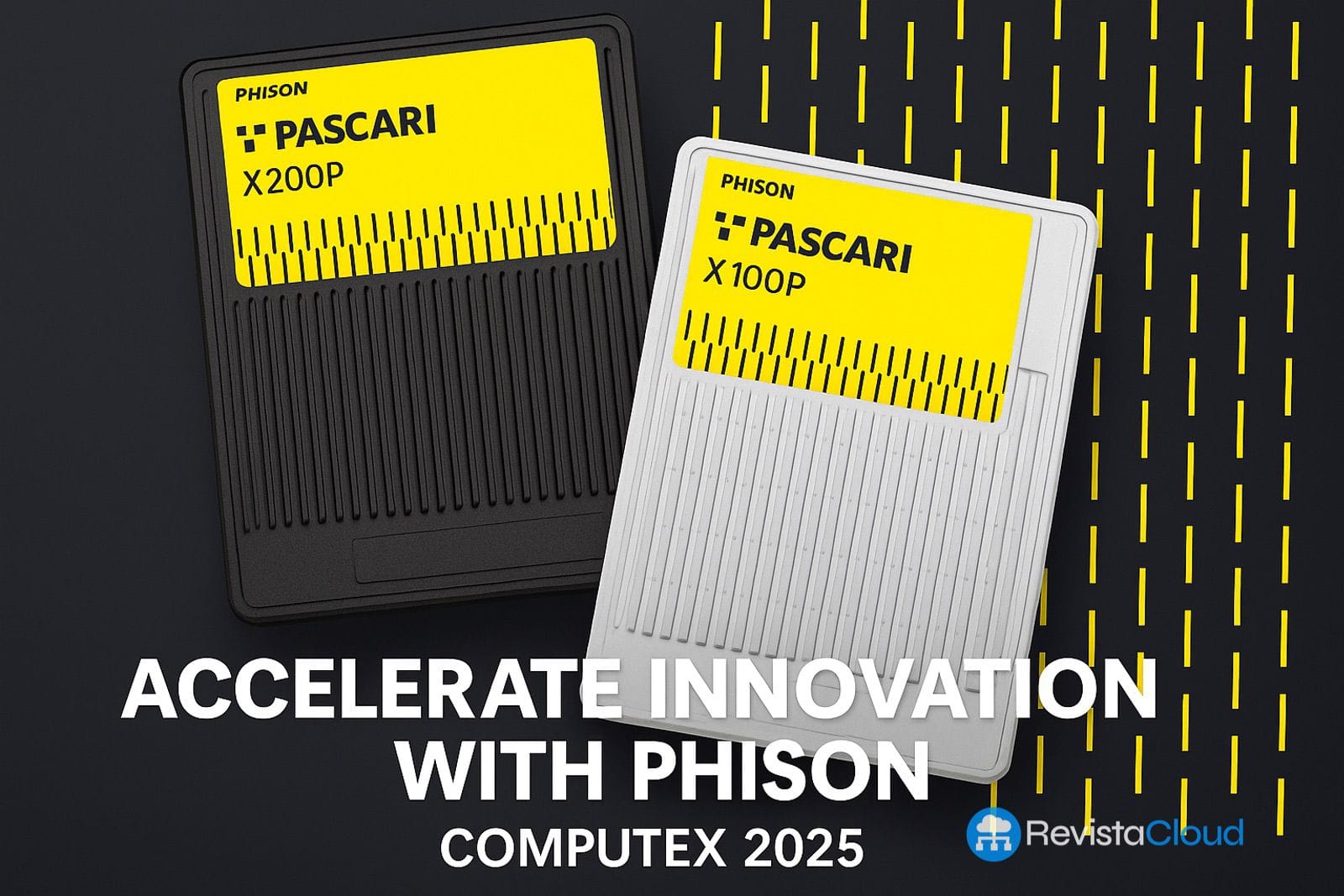
Phison Electronics has strengthened its presence in Europe by opening its first local entity in Eschborn, Germany, from where it plans to grow its enterprise storage business for artificial intelligence, data centers, high-performance computing, and cloud providers. The company has also appointed Ingvar Ersson as General Manager and President for EMEA, and Antony Zukowski as Regional Director.
Phison’s European expansion in 20 seconds
- Phison Electronics Europe GmbH will be headquartered in Eschborn, Germany.
- Ingvar Ersson will lead the EMEA region, with Antony Zukowski taking on the regional director role.
- The company wants to grow European adoption of its Pascari enterprise SSDs.
- AI, HPC, hyperscale, neoclouds, and enterprise storage will be among its priorities.
- Phison will combine direct sales with distributors, integrators, and technology partners.
The move has a commercial dimension, but it also reflects how the expansion of AI infrastructure is boosting interest in components that until recently got far less attention than GPUs. Accelerators need constant access to large volumes of data, and storage performance can shape both training and inference.
Phison wants to capitalize on that demand to build a bigger presence in an enterprise market where it’s known mainly as a developer of NAND controllers and technologies used by numerous SSD manufacturers.
The new European structure is meant to bring customers closer to its Pascari family, through which the company is trying to carry its flash storage expertise into data centers and high-performance professional workloads.
Phison Is Chasing More Business in AI, HPC, Neoclouds, and Data Centers
The opening of Phison Electronics Europe GmbH means the company will have its own regional entity in Europe for the first time.
From Germany it will coordinate a strategy for Europe, the Middle East, and Africa (EMEA) that combines direct relationships with large enterprises and a network of distributors, systems integrators, and partners.
The company identifies four major priority areas: artificial intelligence, hyperscale, high-performance computing (HPC), and enterprise storage.
Ingvar Ersson has been named GM & President of EMEA and will report directly to Phison’s founder and CEO, KS Pua. The executive brings more than 25 years of international experience and has held roles at companies including JOLT Energy and Verbatim EUMEA. According to Phison, he has worked with the company’s technologies for close to two decades.
Antony Zukowski joins his team as Regional Director for EMEA. His background includes roles at Actebis, Bell Microproducts, Esys Distribution, Thomson Computing, TD SYNNEX, and Arrow ECS France, working with vendors such as Lenovo, Nutanix, Pure Storage, and Rubrik.
One of the team’s priorities will be growing the presence of Phison’s Pascari enterprise SSDs.
Phison also points to specific sectors where it expects to find demand: media and entertainment, HPC, neocloud providers, local governments, and education. The company links these opportunities to real-time data processing, artificial intelligence and machine learning, big data, and the adoption of PCIe Gen5 drives.
The mention of neocloud providers is especially interesting. The term is used for infrastructure companies that specialize in offering accelerated capacity for AI, usually built around large GPU deployments. These are operators that need not just compute capacity, but also networking and storage capable of feeding the accelerators fast enough.
Storage Is Starting to Take Center Stage in AI Infrastructure
Phison’s European expansion arrives at a time when much of the investment tied to artificial intelligence is still concentrated on data centers.
Although GPUs are the most visible component, a platform’s ultimate performance depends on more than that. Models need to read huge datasets, store checkpoints, move information between different memory tiers, and serve data during inference.
That’s putting more pressure on networking and storage.
Enterprise SSDs also have different requirements from consumer products. Sustained performance, write endurance, latency, capacity, power consumption, and behavior under heavy workloads can all be decisive in a data center. That same tension between raw drive speed and real-world performance is what has put NVMe deployments under scrutiny elsewhere, as a recent look at how RAID configurations can quietly cap a storage investment showed.
Pascari is precisely the brand Phison is using to grow its presence in this segment.
The company also has aiDAPTIV, a technology aimed at running and training large language models (LLMs) on local infrastructure using a combination of GPU, memory, and flash storage. Phison presents it as a way to reduce GPU memory requirements in certain scenarios, though the performance and cost-effectiveness will depend on the model and configuration used.
The new European office will therefore need to compete in an enterprise storage market with established manufacturers and customers that typically evaluate platforms over long periods before deploying them in production. It’s a shift also visible in new SSD controller designs built specifically for AI workloads, such as Marvell’s Bravera SC6.
Channel strategy will carry weight in that process. Phison has named ASBIS Enterprises as one of the partners it’s strengthening its collaboration with to distribute Pascari in Europe.
Europe Gains Weight in Phison’s Plans
The company directly ties the Eschborn opening to growing European investment in artificial intelligence and enterprise infrastructure.
KS Pua sees Europe as a growth opportunity for Phison and expects a regional structure to allow it to work more directly with customers and partners. These are commercial goals stated by the company, not a quantified sales or market-share forecast.
Phison, however, starts from a sizeable presence in the storage industry.
The company says its technology is present in more than one in every five SSDs sold worldwide, a figure that mainly reflects its long-standing controller and NAND solutions business. It has more than 4,500 employees, around 70% of whom work in research and development, and it reports holding more than 2,000 patents.
The challenge now is to carry a bigger share of that scale into the enterprise market under its own Pascari brand.
Having sales and technical staff in Europe could prove important for pulling that off. Data center storage projects typically require validation, performance testing, integration with existing servers and platforms, and support during deployment.
Proximity can also help with projects where customers want custom configurations, another of the areas Phison identifies among the opportunities for its new European organization.
Choosing Germany also gives the company a central location for its continental operations. From Eschborn, near Frankfurt, the company will be able to strengthen its relationships with distributors, integrators, and customers while expanding sales of Pascari.
Phison hasn’t announced specific financial investments tied to the opening, nor revenue targets for Europe. It also hasn’t detailed the initial size of the new regional workforce.
The news matters less, then, for the announced size of the office than for the shift in commercial positioning: Phison wants a more direct relationship with the European market right as storage becomes a critical piece of the race to build AI infrastructure again.
Frequently Asked Questions
Where has Phison opened its first European entity?
Phison Electronics Europe GmbH has been established in Eschborn, Germany. From there the company will strengthen its operations across the EMEA region.
Who will lead Phison in Europe?
Ingvar Ersson has been named GM & President for EMEA and will report directly to founder and CEO KS Pua. Antony Zukowski will take on the role of Regional Director for EMEA.
What is Phison Pascari?
Pascari is Phison’s enterprise SSD storage family. The company aims it at intensive workloads in data centers, artificial intelligence, cloud, HPC, and hyperscale infrastructure.
Why does artificial intelligence need so much storage?
Training and inference work with huge amounts of data that need to be fed to compute systems fast enough. If the network or storage can’t keep up, they can become a bottleneck even when high-performance GPUs are available.
via: phison
