
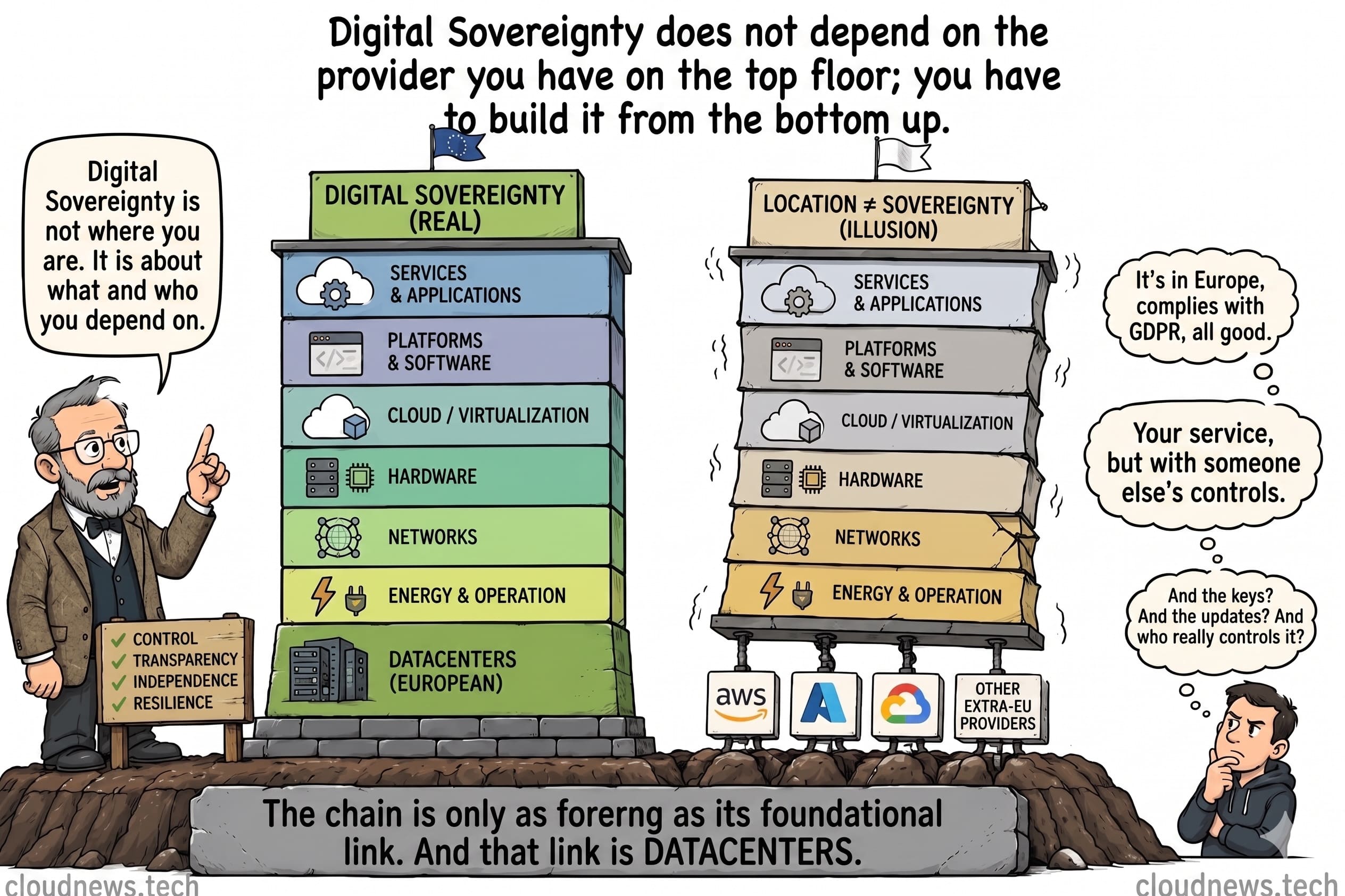
Germany is putting €108 million into the next generation of Government Site Builder, the platform its federal administration is using to migrate hundreds of websites, built on TYPO3. The European Commission runs around 770 sites on Drupal, and roughly 300,000 German federal users rely on Nextcloud services. Behind those three names sits a common thread that tends to go unnoticed whenever Europe talks about digital sovereignty: PHP still underpins a substantial share of public open-source software.
PHP and digital sovereignty in 30 seconds
- Germany has budgeted €108 million to develop, migrate, and operate Government Site Builder 11, built on TYPO3.
- The European Commission uses a shared Drupal platform for around 770 sites across 44 services.
- Nextcloud is part of Germany’s Bundescloud, used by roughly 300,000 federal users.
- TYPO3, Drupal, and Nextcloud all have PHP at the core of their applications.
- The PHP Foundation received $730,534 in contributions during 2025.
The data comes from an analysis published by Sebastian Bergmann at The PHP Foundation. His argument isn’t that governments deliberately chose PHP as a language to achieve technological sovereignty. The decisions were made around specific products, mostly open-source platforms that reduce reliance on proprietary solutions.
But when you look at which software ends up getting picked, PHP keeps showing up.
The situation also raises an economic question. Governments are putting tens of millions of euros into projects built on free software, while a much smaller share of that budget reaches the developers who maintain the languages and components sitting several layers underneath.
Germany and Europe have chosen open software for their public services
Germany’s case puts numbers to this trend.
The budget planned for Government Site Builder 11 (GSB 11) comes to €108 million spread over four years. According to data compiled by The PHP Foundation, €26.88 million goes to product development and support, €73.2 million to migrations and relaunches, and another €8 million to operations.
GSB is the standard solution used for German federal administration websites. More than 80 agencies and institutions already use the system and have built more than 250 sites with it.
Version 11 is built on TYPO3, an open-source content management system developed primarily in PHP.
The choice is notable because Germany also evaluated Drupal. In other words, both options that made the final cut ran on PHP.
The European Commission offers another example on an even larger scale.
During Drupal4Gov EU 2026, held in Brussels, the team behind the Europe Web Publishing Platform said the shared infrastructure managed 770 active sites across 44 Commission services, with about 700 million visits and 2.2 billion page views a year. Germany is following a similar path with its own broader digital sovereignty push spanning contracts, GPUs, and European software.
Consolidation began in 2019. Maintaining numerous custom platforms made it harder to apply security updates and deliver a consistent experience across services.
Some of the reusable software built around this infrastructure is published openly through the OpenEuropa and ec-europa projects.
It’s not the only European case.
The European Union Aviation Safety Agency (EASA) uses Drupal for its Sustainability Portal, tied to compliance with the ReFuelEU Aviation regulation and used by more than 350 airlines and 31 national authorities. That environment also includes Matomo for analytics and Mautic for certain email functions, both other applications tied to the PHP ecosystem.
The Netherlands has GovNL CMS, France maintains Drupal components tied to its state design system, and local governments in the UK and Ireland share LocalGov Drupal.
These are different examples, but they show that the free software used by European administrations isn’t limited to experimental projects.
Nextcloud brings PHP right onto civil servants’ desktops
PHP’s presence becomes even clearer once you move past websites and into everyday work tools.
Germany’s Bundescloud includes SIB-Box, built on Nextcloud, for roughly 300,000 federal users.
Nextcloud is also part of openDesk, the digital workplace platform promoted by Germany’s Zentrum für Digitale Souveränität (ZenDiS). Nextcloud’s own recent open-source push has been highlighted before in our coverage of Nextcloud Hub 25 Autumn as Europe’s open-source response to the digital sovereignty threat.
openDesk combines several open applications to offer an alternative to proprietary office suites. Its components include Nextcloud, Collabora, Element, Open-Xchange, OpenProject, and XWiki.
Germany has folded this goal into its policy planning: by October 2028, the federal administration should have a digitally sovereign alternative to proprietary workplace tools.
The state of Baden-Württemberg has already moved close to 60,000 teaching staff onto infrastructure tied to this model, according to sources compiled by The PHP Foundation. There are also other deployments or agreements involving federal agencies and additional institutions.
Nextcloud Server is still primarily a PHP application, though there’s an important technical nuance here.
The project has started moving some especially performance-sensitive parts to other languages. Its Files High Performance Backend is written in Rust, and the ADA architecture unveiled in 2026 combines PHP, Go, and Rust for different functions.
So simply saying “Nextcloud is written in PHP” glosses over part of its current architecture. PHP still powers the application and most of its logic, while certain input and output processes are moving toward other languages.
This hybrid model doesn’t diminish PHP’s importance either. If anything, it shows how a mature application can keep its core intact while adopting different technologies wherever they offer concrete advantages.
Millions for the projects, far less for keeping PHP running
The financial comparison Sebastian Bergmann draws is probably the most uncomfortable part of the analysis.
Against the €108 million German project, The PHP Foundation received $730,534 in contributions during 2025, from 536 organizations and individuals.
The comparison doesn’t mean that €108 million should have gone to PHP. These are budgets with completely different purposes, and much of the German funding covers migration, development, support, and operations across hundreds of sites.
What it does show is a familiar pattern in free software.
A government hires integrators to build a portal. The integrator uses TYPO3. TYPO3 depends on PHP, and PHP, in turn, needs developers to maintain the language, fix vulnerabilities, ship new versions, and adapt the project to technological change.
Public funding reaches the first links of that chain easily, but not necessarily the last ones.
The PHP Foundation says it employs 13 engineers and that in 2025 its expenses exceeded donations by around $139,000, a gap it attributes to maintaining its technical capacity.
Germany already has a precedent for narrowing that gap. The Sovereign Tech Agency has funded work directly tied to PHP, including the PHP-FPM Web Services Tool and improvements to the language’s streams layer.
So the mechanism already exists: using public funding to maintain open components that later benefit a much larger number of projects.
The PHP Foundation’s article lists three proposals raised at Drupal4Gov EU to extend this idea to public procurement: crediting verifiable open-source contributions within tenders, setting aside part of a contract from the outset for maintaining the projects a solution depends on, and promptly returning non-sensitive code developed with public funds back to the original project.
The proposal to set aside budget doesn’t name a fixed figure. As a reference point, Tiffany Farriss, currently interim CEO of the Drupal Association, suggested roughly 2% to 5%, which could rise to 10% on complex projects.
These are proposals, not current requirements in European public procurement.
But they raise a question that goes beyond PHP. If Europe wants to increase its independence through open software, it will also have to decide how to sustainably fund the maintenance of the software it depends on.
PHP offers an especially visible example, because it has spent decades running behind pages, applications, and platforms without most of its users ever needing to know it’s there.
Now it’s also showing up underneath some of the initiatives European administrations are using to reduce their dependence on proprietary technology vendors.
Frequently asked questions
Why is PHP linked to European digital sovereignty?
Because several open-source platforms used by European administrations, such as TYPO3, Drupal, and Nextcloud, have PHP as a core part of their architecture. That doesn’t mean governments chose PHP directly as a digital sovereignty policy.
Is Germany going to spend €108 million on PHP?
No. The €108 million covers the development, migration, relaunch, and operation of Government Site Builder 11 over four years. The platform is built on TYPO3, which uses PHP.
Does the European Commission use Drupal?
Yes. The Europe Web Publishing Platform runs around 770 sites for 44 European Commission services, according to data presented at Drupal4Gov EU 2026.
How much money did The PHP Foundation receive in 2025?
The PHP Foundation reported $730,534 in contributions during 2025, from 536 organizations and individuals.
