
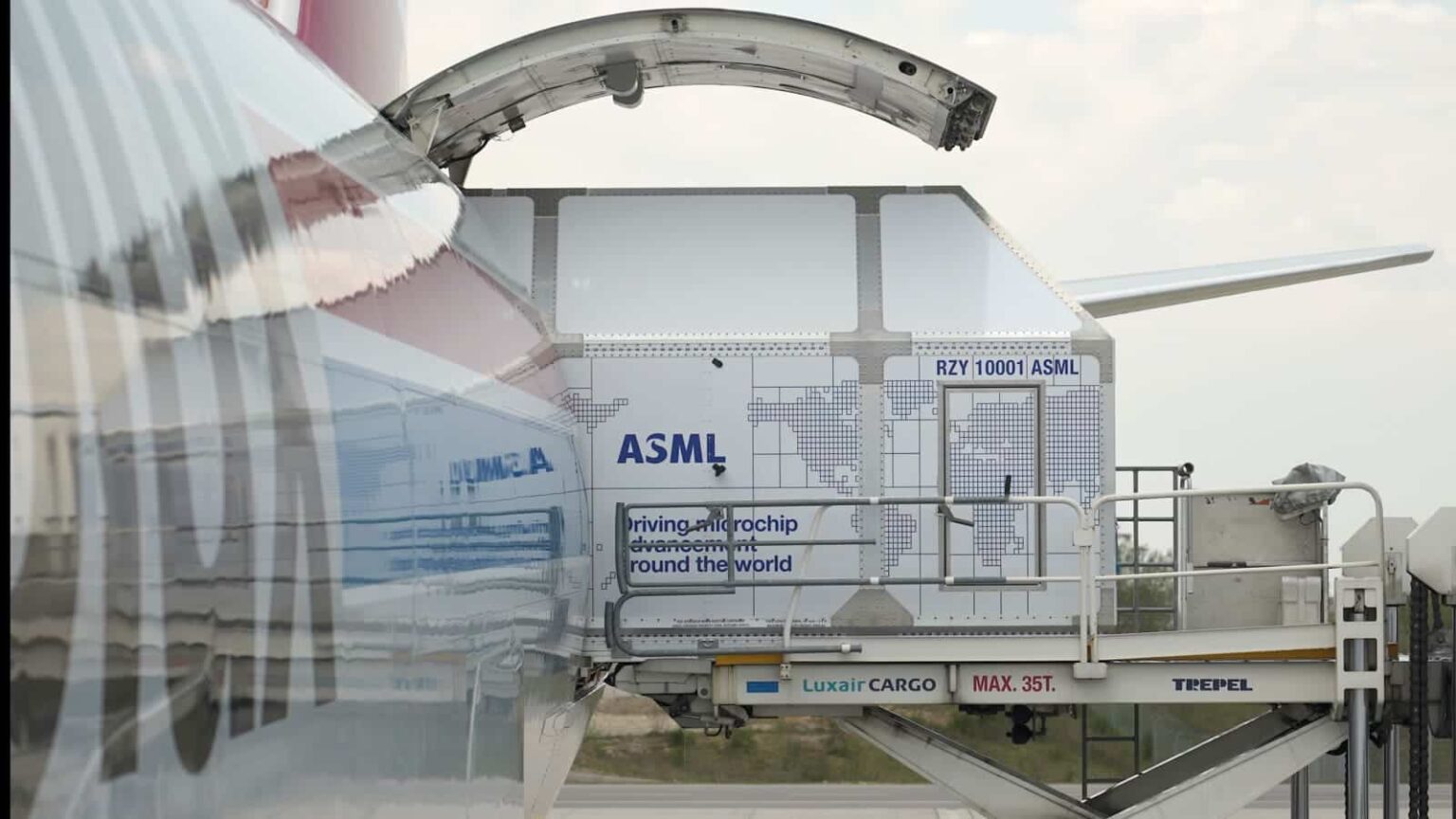
Chinese memory makers ChangXin Memory Technologies (CXMT) and Yangtze Memory Technologies (YMTC) are reported to have bought enough deep ultraviolet (DUV) lithography equipment from ASML to cover their capacity expansion plans for the next three years. The information, originally published by the Financial Times citing a person familiar with the matter, shows how China’s industry is trying to protect its growth against the risk of new Western restrictions while simultaneously accelerating the development of its own lithography machines.
Key points on China’s DUV machine stockpiling in 20 seconds
- CXMT and YMTC are reported to have secured enough ASML DUV equipment for three years of expansion.
- China cannot buy the Dutch company’s most advanced EUV systems.
- Certain immersion DUV equipment is also subject to export controls.
- CXMT and YMTC are preparing new fabs to increase their DRAM and NAND production.
- China is also developing domestic DUV machines, though a significant gap with ASML remains.
The move carries particular weight because lithography remains one of the areas where China’s semiconductor industry is most dependent on foreign suppliers. The country has managed to develop domestic alternatives in etching, deposition, and other manufacturing processes, but matching the specs of ASML’s machines remains considerably harder.
The memory makers’ strategy therefore appears to follow two parallel paths: buying up now all the foreign equipment they can still obtain while preparing domestic alternatives for when that access is no longer guaranteed.
It doesn’t mean China already has a lithography industry capable of replacing ASML. Domestic systems are beginning to enter production and testing, but various reports indicate they still lag behind in throughput, precision, reliability, and critical components.
CXMT and YMTC need DUV machines for their new fabs
The news comes as China’s two leading memory companies prepare major capacity expansions.
CXMT specializes in DRAM (Dynamic Random-Access Memory), the memory used as RAM in computers, servers, mobile devices, and accelerators.
YMTC focuses on NAND flash, used mainly for storage in SSDs, smartphones, and other devices.
Both are growing as global demand for memory stays elevated amid the expansion of AI infrastructure.
CXMT is building new facilities in Shanghai and Hefei and, according to reports published by Reuters in July, is considering a third expansion. Those projects could push its capacity above 600,000 wafers per month if all of them go ahead as planned.
YMTC is also preparing new fabs.
The problem is that building a fab isn’t worth much without the machines needed to bring it into production.
That’s where ASML comes in.
The Dutch company makes the lithography equipment used to project circuit patterns onto silicon wafers. Its machines are among the hardest technologies to replicate anywhere in the semiconductor manufacturing chain.
There are two especially relevant families: DUV (Deep Ultraviolet) and EUV (Extreme Ultraviolet).
China has been unable to access ASML’s EUV systems for years. The Dutch government began withholding export licenses to the country in 2019.
The restrictions have since expanded.
Certain immersion DUV systems also require a license to be exported outside the European Union. ASML explains in its 2025 annual report that EU rules incorporated certain Dutch controls at the end of that year, including licensing requirements for advanced DUV equipment.
That doesn’t mean all DUV machines are banned for Chinese customers.
ASML continues to do business in China with systems that aren’t blocked by the controls applicable to each customer and technology.
In fact, the company itself acknowledged that its DUV business in China during 2025 was stronger than expected.
DUV is still far more important than it looks
Calling DUV an “old” technology can lead to the wrong conclusion.
EUV machines are needed to efficiently manufacture many of the most complex layers of advanced semiconductors, but the industry still uses DUV extensively.
ASML sold 279 DUV systems during 2025, versus 48 EUV units, according to its annual report.
Even fabs producing cutting-edge chips need numerous steps performed via DUV.
For China, it matters even more.
Without access to EUV, Chinese manufacturers can turn to multipatterning techniques, where several DUV exposures are used to create smaller patterns than a single exposure could achieve.
The technique comes at a cost.
The more exposures required, the greater the number of manufacturing steps. That increases time, complexity, machine utilization, and the risk of defects.
Alignment between layers also becomes progressively more demanding.
That’s why having DUV doesn’t automatically turn a Chinese fab into the equivalent of an advanced facility using EUV.
But it does allow relatively sophisticated semiconductors to keep being manufactured despite the restrictions.
In memory, this capability is especially important.
CXMT has managed to keep shrinking its processes using DUV and has just reached another technological milestone with its new LPDDR6.
The company announced on September 7, 2026 that its LPDDR6 has entered mass production and will make its commercial debut in the Xiaomi 18 Fold.
According to CXMT, the package offers 16GB of capacity, uses individual 16Gb dies, and reaches a maximum speed of 12,800 Mbps.
The company presents it as the first commercial rollout of LPDDR6 in a flagship smartphone.
This advance also helps explain why securing machinery supply matters so much to CXMT. The company is no longer limited to producing memory generations far behind those used internationally, and it needs to expand its fabs to keep up with that growth.
China is preparing up to 12 domestic DUV machines in 2026
Stockpiling foreign machines is only part of the strategy.
China is trying to develop its own equipment.
The Financial Times has reported that Huawei is playing a significant role in that effort, backing companies working to solve some of lithography’s most complicated components.
One of the projects centers on Yuliangsheng, a Shanghai-based company working on domestic DUV systems.
The latest reports point to a target of 12 machines during 2026.
That figure is higher than the estimates published over the summer.
In late July, reports pointed to plans to produce around five systems in 2026 and roughly 20 during 2027. The most recent reports describe an accelerated program, though there are also differing accounts of exactly which companies and industrial structures are responsible for manufacturing the equipment.
The first machines are reportedly being tested by manufacturers such as SMIC, as well as on lines linked to Huawei.
But there’s still a considerable gap versus ASML.
Chinese systems show limitations in throughput and still depend on certain foreign components.
Two of the hardest problems lie in the projection optics and the high-power light sources.
Huawei is backing domestic companies trying to reduce these dependencies. Its investment vehicles have supported, for example, companies working on precision optics and laser sources.
The situation illustrates just how complicated it is to develop a lithography machine.
It’s not enough to manufacture the main tool. You need to build a supply chain capable of producing extremely precise optics, light sources, motion systems, sensors, control software, and numerous specialized components.
Even after building a working machine, it has to process enough wafers per hour, maintain precision over long periods, and reach availability levels compatible with a fab that runs continuously.
That’s still where much of ASML’s advantage lies.
The restrictions are also producing an unexpected effect
The United States has spent years using export controls to limit China’s ability to manufacture the most advanced semiconductors.
The logic is simple: if China can’t access certain Western machines, advancing toward cutting-edge processes becomes far more complicated.
In the short term, the restrictions have worked especially well on EUV.
China still doesn’t have a commercially available alternative comparable to ASML’s EUV machines.
However, the long-term effect is harder to assess.
Every new restriction increases the economic incentive to develop a domestic supplier.
Chinese fabs also have more reasons to try local equipment they might otherwise have dismissed if they could freely buy more mature Western machinery.
That process can accelerate learning.
CXMT and YMTC’s situation reflects exactly this contradiction.
Both companies still depend on ASML and, according to the reporting, have tried to buy enough machinery while they still can.
At the same time, uncertainty over future restrictions is boosting interest in domestic machines that still don’t offer the same specs.
The result will likely be a gradual transition, not an immediate replacement.
Over the coming years, Chinese fabs may combine previously acquired ASML equipment with domestic machinery initially used in less demanding processes.
As Chinese suppliers improve throughput and reliability, those machines could take on a growing share of production.
For ASML, there’s also a commercial consequence.
China accounted for 29% of its net sales during 2025, around €9.5 billion. All of that business was tied to DUV and services, since EUV can’t be exported to the country.
The company doesn’t appear to expect DUV to disappear anytime soon, either.
In its second-quarter 2026 results, it announced plans to increase its immersion DUV manufacturing capacity by roughly 30% in 2027, starting from about 130 units planned for 2026, and it’s weighing another 30% expansion for 2028.
The scenario is therefore considerably more complex than a simple race between ASML and a Chinese alternative.
CXMT and YMTC now need the Dutch machines to grow. China needs time to improve its domestic equipment. And the Western restrictions are specifically trying to limit that time and that access.
If the two Chinese manufacturers have indeed managed to stockpile enough machinery for three years of expansion, they’ll have built a significant cushion against a possible tightening of controls.
It doesn’t eliminate the technological dependence on ASML.
But it could delay by several years the point at which that dependence becomes an immediate bottleneck for China’s new memory fabs.
Frequently Asked Questions
How many ASML DUV machines have CXMT and YMTC bought?
No specific figure has been published. The Financial Times reports, citing a person familiar with the matter, that both companies have acquired enough equipment to cover their expansion plans for the next three years.
Can ASML sell lithography machines to China?
ASML cannot export its EUV systems to China, and certain advanced DUV equipment is subject to controls and licensing. Other DUV systems and services can still be sold when the applicable rules and licenses allow it.
Can China manufacture advanced chips using only DUV?
DUV can be used with techniques like multipatterning to produce smaller structures, but it increases the number of steps, cost, and complexity compared with EUV. That’s why having DUV doesn’t eliminate the disadvantage of lacking access to EUV.
Does China already manufacture its own DUV machines?
China is developing and beginning to test domestic DUV equipment. The latest reports point to limited production during 2026, but these systems are still said to lag behind ASML in areas such as throughput, maturity, and some critical components.
Related reading: CXMT’s LPDDR6 debut in the Xiaomi 18 Fold and YMTC’s push to overtake Samsung in NAND by 2027 add more context on why both companies are racing to secure fab capacity, while our earlier look at the ASML-China saga explains why matching Dutch lithography know-how is so hard.