
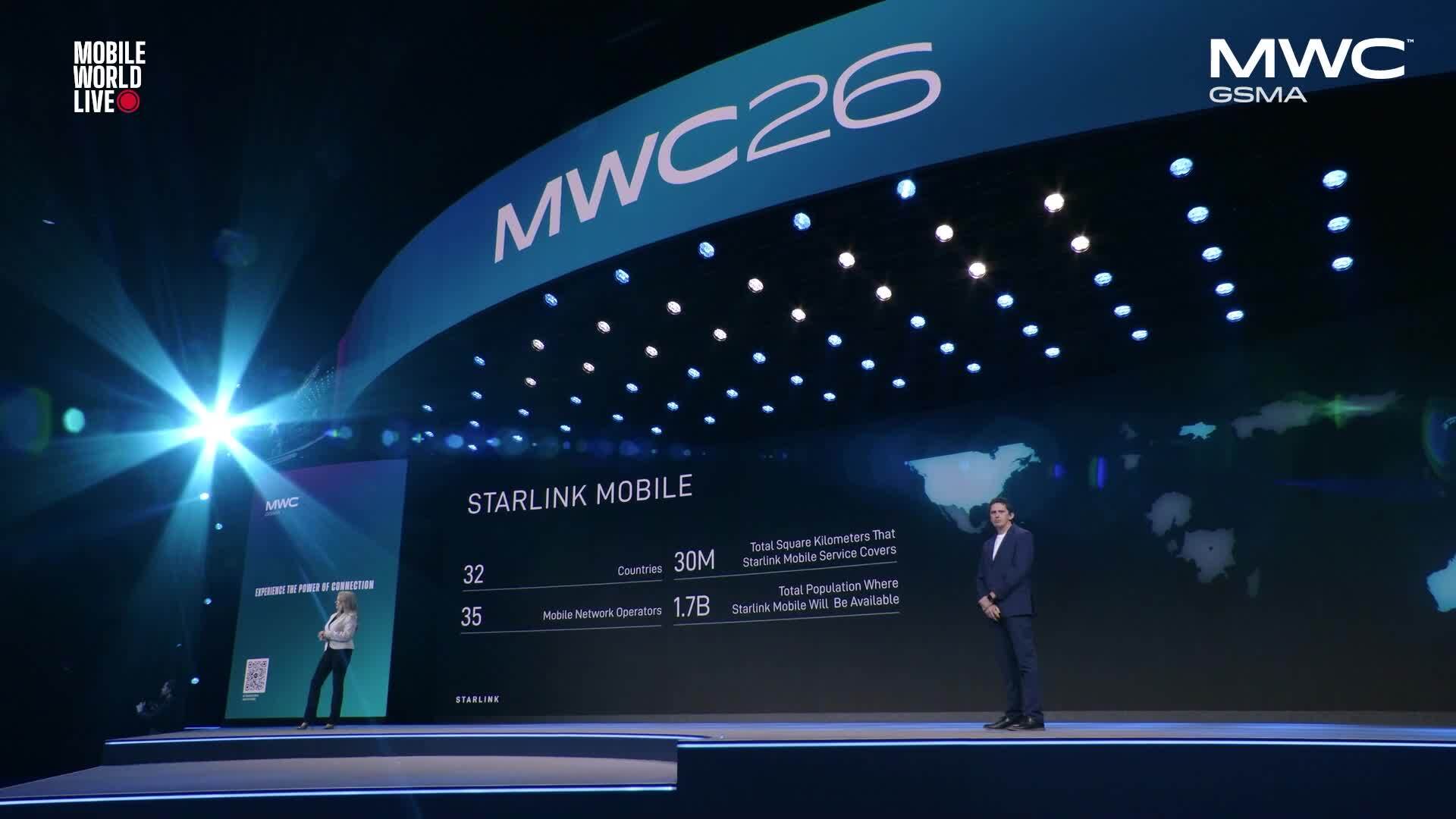
SpaceX has chosen Qualcomm’s Dragonwing platforms for the base stations of the terrestrial 5G network Starlink Mobile wants to roll out across the United States. Qualcomm Technologies announced it on November 4, 2026, in a press release dated from San Diego, which details that this is a multiyear agreement and that, according to SpaceX’s plans, the rollout will begin in 2027 and reach tens of thousands of sites. What’s being announced is the choice of a chip and software supplier for that network, not its launch: there are no Starlink Mobile base stations of this kind providing service today.
Key points of the SpaceX-Qualcomm deal for Starlink Mobile, in 30 seconds
- Qualcomm will supply its Dragonwing QRU100 and QDU100 platforms, along with Layer 1 software, for Starlink Mobile’s terrestrial base stations in the US.
- The radios will use 64-transmitter, 64-receiver Massive MIMO to gain coverage, capacity, and spectral efficiency.
- SpaceX plans to start the rollout in 2027, with tens of thousands of sites over the course of a multiyear agreement.
- The release gives no figures, names no equipment manufacturer, and sets no commercial launch date.
- The move follows the FCC’s authorization in May 2026 for SpaceX to buy spectrum from EchoStar.
Starlink Mobile is the name under which SpaceX now markets its direct-to-cell (D2C) service, the direct connection between satellites and ordinary mobile phones. Starlink’s own website presents it as a constellation of around 650 satellites that works with existing LTE phones through partner carriers, including T-Mobile in the United States and MasOrange in Spain. Qualcomm’s release adds another layer: a terrestrial network of its own. Michael Nicolls, identified in the release as Starlink’s senior vice president, states that the company is building “the first fully integrated satellite-and-terrestrial nationwide network that will keep people connected wherever they are.” He also explains that working with Qualcomm helps accelerate the development timeline for its end-to-end base station architecture.
What the Dragonwing QRU100 and QDU100 do in the network
A modern 5G base station is split into several pieces. The radio unit (RU) sits next to the antennas and processes the signal being transmitted and received. The distributed unit (DU) handles Layer 1, or the physical layer, along with other latency-sensitive functions. Qualcomm splits the work this way: the QRU100 integrates the processing for the Massive MIMO radios, and the QDU100 runs Layer 1 processing in the distributed unit. Massive MIMO (multiple input, multiple output) groups together dozens of antenna elements to steer beams toward users, and in this case the configuration chosen is 64T64R: 64 transmit paths and 64 receive paths.
According to Qualcomm, combining both platforms is designed to improve performance per watt in both the radio and the distributed unit, and that energy efficiency should translate into a more favorable deployment economics at scale. That’s a claim from the manufacturer, with no consumption figures or comparisons in the release. The company also describes the base as flexible for a multiband network that will roll out in several waves, though it doesn’t specify which bands, how many waves, or how many sites each one will have.
Durga Malladi, executive vice president and general manager of technology planning, edge solutions, and data centers at Qualcomm Technologies, says in the release that a nationwide network demands high performance and energy efficiency at every site, and that alongside SpaceX the company is pushing today’s 5G forward while potentially laying the groundwork for a later AI-native 6G. That part is a shared long-term vision: the release makes clear that this rollout is focused on terrestrial 5G. It also doesn’t clarify which company will manufacture the radios and distributed units that will carry these chips, a detail usually disclosed for this kind of network that the release doesn’t address.
From satellite to base station: what SpaceX had already signaled
The idea of complementing satellites with ground infrastructure isn’t new. During SpaceX’s second-quarter 2026 earnings call in August, company president Gwynne Shotwell confirmed to analysts that the company would deploy terrestrial infrastructure and pointed to small base stations alongside Starlink terminals as a more capital-efficient option, as reported by Telesemana and Notebookcheck. Elon Musk mentioned at the time the antennas installed on the roofs of homes and businesses. Revista Cloud already explained how Starlink planned to turn its home antennas into a 5G mobile network. Qualcomm’s release doesn’t say whether the Dragonwing-based base stations will go on those rooftops or at conventional sites.
It’s worth separating the timelines. On that call, Shotwell put the start of service with the next-generation V2 satellites at the end of 2027, while this November 4, 2026 release talks about the terrestrial rollout beginning in 2027, with no service date. Neither is available today. What does work is the current satellite service: T-Mobile has sold it in the United States as T-Satellite since 2025, and Starlink’s website says it already offers messaging, data in more than 40 apps, and app-based voice, while native calling and direct-to-phone broadband are listed as future services.
There’s also a difference in framing. The Starlink Mobile page describes the future V2 network as a complement to carriers’ terrestrial 5G networks, in partnership with them. Qualcomm’s release, on the other hand, talks about a nationwide terrestrial 5G network belonging to Starlink Mobile itself. SpaceX hasn’t detailed whether it will operate as an independent mobile carrier, combine its own network with carrier agreements, or use some other commercial model. At the time of writing, no SpaceX statement about the deal has been found, so Nicolls’s remarks reach the public through Qualcomm.
EchoStar’s spectrum and the FCC’s approval
A terrestrial network needs licensed frequencies, and that’s where the earlier move comes in. In May 2026, the US Federal Communications Commission’s (FCC) Wireless Telecommunications Bureau and Space Bureau approved the sale to SpaceX of about 65 MHz of EchoStar spectrum nationwide, in the AWS-3, AWS-4, and H-Block bands, according to Mobile World Live. The purchase was announced in 2025, and trade press put it at around $17 billion. The FCC paired the approval with a set of waivers that let SpaceX use that spectrum in terrestrial, space-based, or hybrid architectures — exactly what a project mixing satellites and base stations needs.
Qualcomm’s release doesn’t specify which bands the Dragonwing-based network will use, beyond calling it multiband. It also doesn’t include the contract’s financial value, the exact number of sites, or the year-by-year breakdown. The figure of tens of thousands of sites is presented as a SpaceX plan for the life of the agreement, not a closed commitment with dates. In August, an Evercore ISI analyst estimated that becoming the fourth mobile carrier in the United States could require more than $100 billion in investment, though that figure comes from the analyst and SpaceX hasn’t confirmed it. To understand why SpaceX can compete in this space without making handsets, Revista Cloud looked at why Starlink doesn’t need to sell a phone to compete in the mobile market.
Frequently asked questions
What has SpaceX agreed with Qualcomm?
SpaceX has selected Qualcomm’s Dragonwing QRU100 and QDU100 platforms, along with its Layer 1 software, for the base stations of Starlink Mobile’s terrestrial 5G network in the United States. It’s a multiyear agreement whose value hasn’t been disclosed.
When will Starlink Mobile’s terrestrial 5G network start operating?
SpaceX expects the rollout to begin in 2027. Qualcomm’s release gives no date for the start of commercial service.
Does Starlink Mobile already work today?
Yes, but only via satellite and through partner carriers such as T-Mobile in the United States or MasOrange in Spain, with messaging, data in certain apps, and app-based voice. The terrestrial network and direct-to-phone broadband from the V2 satellites are future plans.
What spectrum will SpaceX use?
The FCC approved in May 2026 for SpaceX to acquire about 65 MHz from EchoStar in the AWS-3, AWS-4, and H-Block bands, with permission for terrestrial, space-based, or hybrid uses. Qualcomm doesn’t detail which bands this specific network will use.
Sources:
- Qualcomm: SpaceX Selects Qualcomm to Accelerate Starlink Mobile’s Nationwide 5G Network
- Starlink: Starlink Mobile
- Mobile World Live: FCC signs off on EchoStar deals to SpaceX, AT&T
- Telesemana: SpaceX admits LEO satellites aren’t enough to compete with 4G and 5G networks
- Notebookcheck: SpaceX tips Starlink Mobile 5G carrier coverage and launch date
This article is also available in Spanish: «SpaceX elige a Qualcomm para la red 5G terrestre de Starlink Mobile en EE. UU.», on revistacloud.com.
