
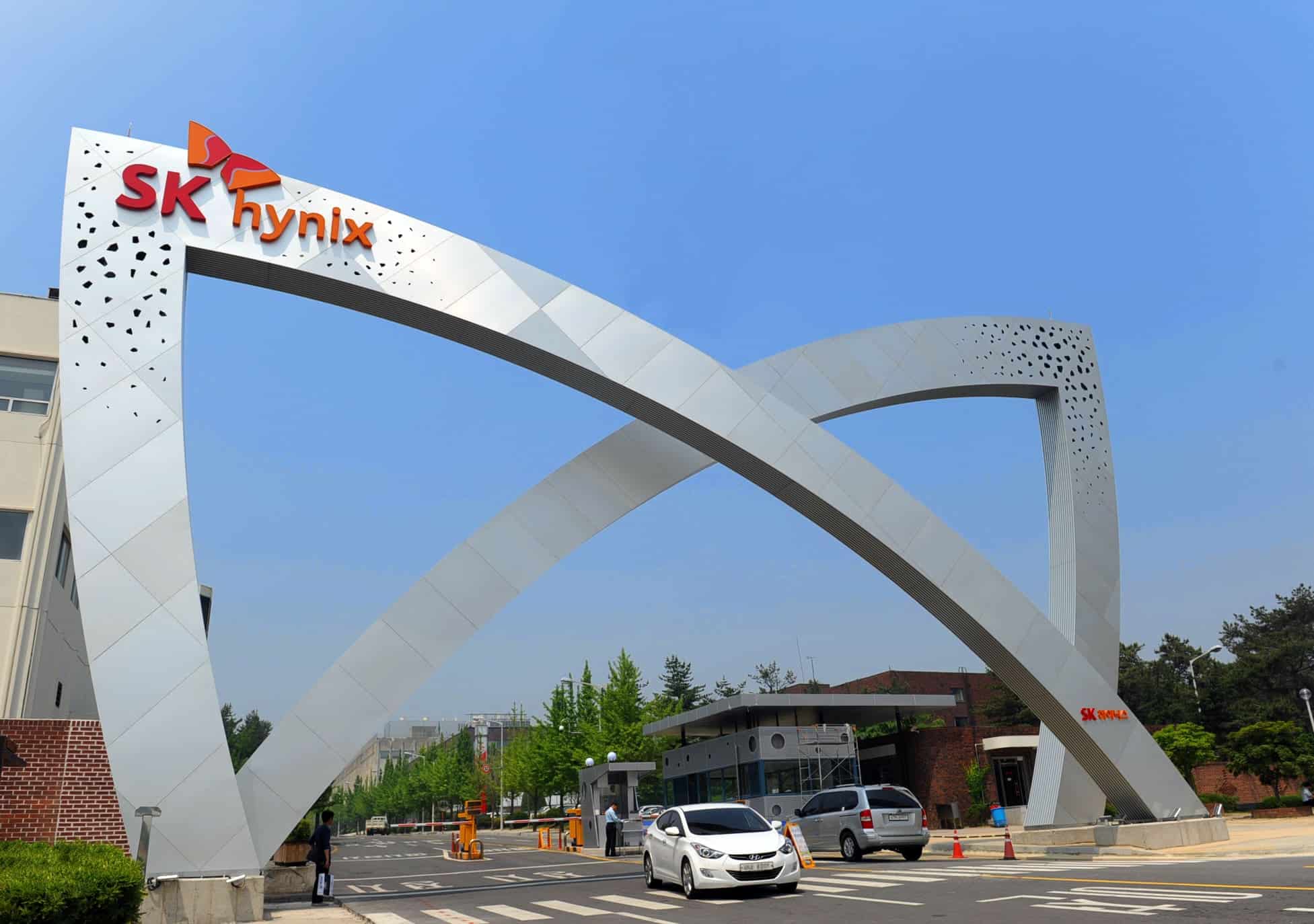
Artificial intelligence is pushing demand for memory chips at a pace that’s forcing manufacturers to expand capacity and speed up the development of new technologies. SK hynix wants to hold its position in this market and is building new facilities in South Korea and the United States, while also preparing a new generation of memory for AI systems.
SK hynix’s AI memory push in 30 seconds
- SK hynix CEO Kwak Noh-Jung frames memory as essential to AI’s expansion.
- The company is expanding capacity with new facilities in Yongin, Cheongju, and Indiana.
- SK hynix will invest 54 trillion won in new plants in Yongin and Cheongju.
- The Indiana plant will exceed $4 billion and will produce next-generation HBM starting in 2029.
- The strategy combines new memory types, advanced packaging, research, and production capacity.
Kwak Noh-Jung’s statement, made during the 2026 Global Forum held in Santa Clara, California, sums up the shift underway in the semiconductor industry. “The AI industry cannot exist without memory,” said SK hynix’s top executive, who also highlighted the role HBM, or High Bandwidth Memory, has played in the recent evolution of AI accelerators.
The company isn’t framing this expansion purely as a capacity increase. Its strategy combines factories, research, new memory technologies, and advanced packaging to try to keep pace with AI systems’ growth over the coming years.
That approach carries a direct consequence for the market: the race to build AI data centers doesn’t depend solely on manufacturing more processors. Accelerators need to move enormous amounts of data between compute and memory, and that’s where HBM has become one of the most important components in today’s systems.
Yongin and Indiana, two pieces of an international expansion
SK hynix is building new facilities in South Korea and the United States. In Yongin, the company approved an investment of roughly 54 trillion won in August, split between the Y2 fab, at 35.2 trillion won, and the M17 plant in Cheongju, at 19.1 trillion won.
The Y2 fab will be dedicated to DRAM memory and will span roughly 1.13 million square meters. SK hynix plans to open its first cleanroom there in June 2029 and use it to manufacture HBM and other next-generation DRAM.
The company is also speeding up the timeline for its large Yongin complex. Its goal is to complete the four planned fabs at the complex by 2033, twelve years ahead of the originally planned date. The first cleanroom at Y1 is targeted to begin operating in February 2027.
In the United States, the Indiana project follows a different logic. SK hynix began construction in August on an advanced packaging plant for HBM memory, with an investment exceeding $4 billion. The facility will be its first U.S. base for HBM production and is designed to supply next-generation memory to customers in the country.
The plant will combine production with a research center focused on advanced packaging. SK hynix expects to begin volume production of next-generation HBM there during the second half of 2029. The company also expects to build a collaborative environment there with universities, customers, and technology partners.
The U.S. expansion also carries a supply-chain dimension. Part of the wafers SK hynix produces in South Korea will be shipped to Indiana for advanced packaging and testing before the products are supplied to U.S. customers.
Why memory has become so important for AI
Large AI models need to process enormous volumes of data. The accelerators used to train and run them can perform calculations at high speed, but they need constant access to data stored in memory.
HBM addresses exactly this part of the problem. Compared with conventional memory, it uses a design that stacks multiple DRAM chips vertically and connects them using high-speed technologies. The goal is to deliver high bandwidth within a small footprint.
That characteristic explains its presence in accelerators built for artificial intelligence and high-performance computing.
SK hynix has built much of its recent position around HBM and continues expanding its portfolio of solutions. The company itself describes memory as a component that’s shifting from being just another part of the system to directly shaping the design and performance of AI infrastructure.
The next step doesn’t depend solely on increasing HBM capacity. Packaging, energy efficiency, manufacturing capacity, and integration with the processors and systems that use this memory all come into play as well.
That’s why the Indiana project matters. It won’t just be another chip fab, but a facility centered on HBM and advanced packaging, paired with a research and development space.
The memory race is also an industrial race
SK hynix’s expansion comes as memory makers prepare investments to meet AI-driven demand growth.
The company announced in June a medium- and long-term investment strategy of 1,100 trillion won to expand its capacity in Yongin, Cheongju, and a future industrial zone in southwestern South Korea. The plan covers DRAM, NAND, and HBM.
In August, it put part of that plan into motion with the 54 trillion won earmarked for Y2 and M17. SK hynix cited Omdia forecasts suggesting global DRAM and NAND demand could grow at a compound annual rate of 19% between 2025 and 2030. That’s a market forecast, not a consumption figure that has already been reached.
The company is also expanding its activity beyond its factories. During the 2026 Global Forum, it presented its technology strategy for the AI era and brought together leaders in DRAM design, AI interfaces, packaging, and systems. The shared message was that future improvements will depend increasingly on coordination across these areas.
Adding to this structure is a new global AI research and development center in the United States that SK hynix is folding into its international strategy. The company has also launched SK hynix Ventures to invest in and build relationships with companies across the AI ecosystem in areas such as data centers, systems software, and optical interconnects.
What this all means for the AI industry
The most immediate effect of this strategy is industrial. As AI data centers keep growing, having ever-more-powerful accelerators isn’t enough on its own. There also needs to be enough high-performance memory produced, packaged correctly, and available to supply when system makers need it.
For SK hynix, that means investing simultaneously in technology and production capacity. For accelerator and server makers, having a broader supply of HBM and other memory types can help ease one of the possible physical constraints on AI systems.
The timeline also shows that much of this expansion will take effect over the medium term. The new Yongin fabs and the Indiana facility are still under construction, and several of their production capabilities won’t arrive until 2027 and 2029. They aren’t, in other words, supply increases available immediately.
Kwak Noh-Jung’s statement reflects exactly that perspective. SK hynix wants its position in HBM to translate into a broader portfolio of memory technologies and an industrial network capable of keeping pace with AI’s growth.
The company competes in this market with other major manufacturers such as Samsung and Micron, while other producers are also trying to expand their presence. In this landscape, the advantage won’t depend solely on who develops faster memory first. It will also come down to who can manufacture it at scale, integrate it through advanced packaging, and keep up supply as AI systems demand ever-larger quantities.
FAQ
Why is memory so important for artificial intelligence?
AI accelerators need to move huge amounts of data between processing and memory. HBM delivers high bandwidth and is used in computing systems built for AI and high-performance workloads.
Where is SK hynix building new facilities?
The company is expanding capacity in Yongin and Cheongju, South Korea, and is building an HBM and advanced-packaging facility in Indiana, United States.
When will the new Indiana plant produce HBM?
SK hynix plans to begin volume production of next-generation HBM there during the second half of 2029. The facility will also have research and development capabilities in advanced packaging.
How much will SK hynix invest in its new Yongin and Cheongju plants?
The company has approved roughly 54 trillion won for the Y2 facility in Yongin and the M17 facility in Cheongju, as part of its strategy to expand capacity to meet AI-driven memory demand.
via: thelec.kr
