
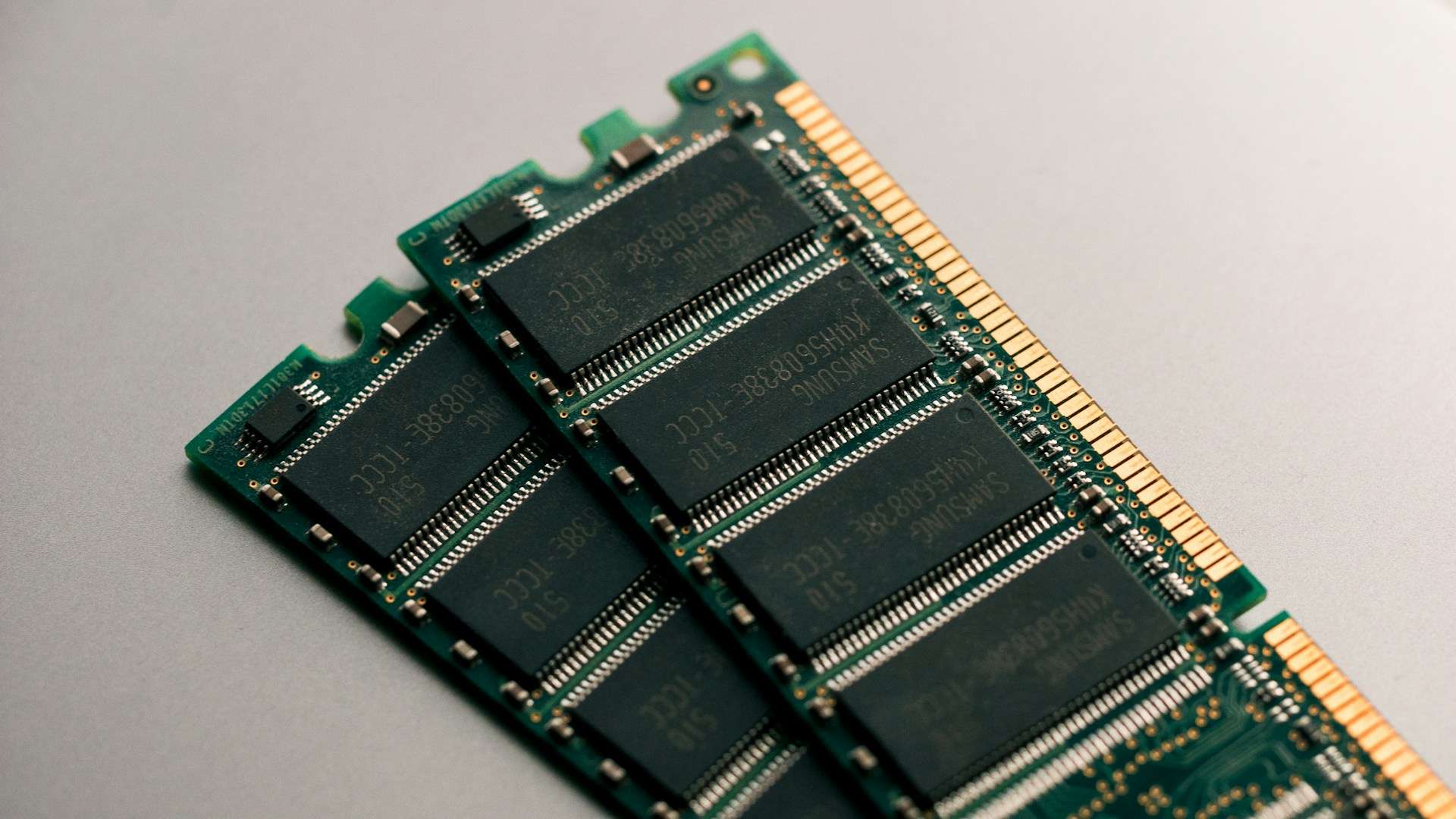
The fever for artificial intelligence is no longer measured solely in GPUs, data centers, or language models. It is also reshaping the financial expectations of major memory manufacturers. Recent tables attributed to Goldman Sachs Global Investment Research show a strong upward revision of SK hynix and Samsung Electronics’ projected operating profits for the coming years, with a clear takeaway: demand for DRAM, NAND, and high-bandwidth memory has become one of the most profitable segments in the AI value chain.
According to these estimates, Goldman Sachs has raised its operating profit forecast for SK hynix in 2026 from 261.1 trillion won to 271.1 trillion won, approximately $179.8 billion. The increase is even more significant in subsequent years: for 2027, the forecast jumps from 330 trillion to 400.7 trillion won; and for 2028, from 365.9 trillion to 453.9 trillion won. In percentage terms, this represents a 3.7% improvement for 2026, 21.4% for 2027, and 24% for 2028.
Samsung Electronics also appears as a major beneficiary. The revision points to an operating profit of 373.8 trillion won in 2026, up from the previous 354.6 trillion. For 2027, Goldman Sachs would raise the forecast from 438.2 trillion to 530.3 trillion, and for 2028 from 494.6 trillion to 609.6 trillion, around $404.7 billion. The percentage improvements would be 5.4%, 21%, and 23.3%, respectively.
The market no longer discounts a normal recovery
Memory has always been a cyclical business. For decades, Samsung, SK hynix, and Micron have experienced sharp fluctuations in prices based on the balance of supply and demand. What is changing now is the scale of demand linked to artificial intelligence. AI servers consume significant amounts of memory—not only HBM to fuel accelerators, but also DDR5 DRAM, high-capacity modules, and enterprise SSDs for training, inference, vector databases, and fast storage.
SK hynix finished 2025 with record results: 97.1 trillion won in revenue, 47.2 trillion won in operating profit, and an operating margin of 49%, according to data published by the company itself. The company attributed this performance to its advantage in high-value-added products and AI-related demand.
Samsung also confirmed in its 2025 results that its memory business achieved quarterly record highs in revenue and operating profit during the fourth quarter, supported by increased sales of HBM, conventional DRAM, DDR5 for servers, and enterprise SSDs. Additionally, the company indicated that in 2026 it expects to continue benefitting from AI and server demand, with deliveries of HBM4 and expansion into AI-related products.
| Company | Previous 2026 Operating Profit | Revised 2026 Operating Profit | Revised 2027 | Revised 2028 |
|---|---|---|---|---|
| SK hynix | 261.1 trillion won | 271.1 trillion won | 400.7 trillion won | 453.9 trillion won |
| Samsung Electronics | 354.6 trillion won | 373.8 trillion won | 530.3 trillion won | 609.6 trillion won |
These figures are striking because they suggest more than just a rebound from the previous down cycle. The market seems to be valuing a phase of exceptionally high margins driven by supply shortages, long-term contracts, prioritization of data center products, and demand that is no longer as heavily reliant on PCs or mobile devices.
Goldman Sachs had already raised its price targets for Samsung and SK hynix in March, citing increases in DRAM and NAND prices, persistent supply shortages, and high capacity absorption by AI servers. In that analysis, the bank noted that AI server demand was significantly consuming memory supply, even though other end markets like PCs and smartphones were not particularly strong.
SK hynix, the major bet on HBM
SK hynix has a clear advantage: its position in HBM, the high-bandwidth memory that accompanies the most advanced GPUs and AI accelerators. This type of memory is expensive, difficult to manufacture, requires advanced packaging, and is closely tied to large AI infrastructure clients. For this reason, the market especially rewards those who can deliver sufficient capacity, performance, and quality.
In Goldman Sachs’ projections, SK hynix’s DRAM division accounts for much of the upward revision. The projected operating profit for DRAM reaches 213.97 trillion won in 2026, 320.47 trillion in 2027, and 373.66 trillion in 2028. NAND also shows improvement, with 57.23 trillion in 2026, 80.23 trillion in 2027, and 80.29 trillion in 2028.
The estimated operating margins are almost unusually high for a historically volatile industry. Goldman Sachs estimates SK hynix’s total operating margin at 75.9% in 2026, 79% in 2027, and 77% in 2028. For DRAM, margins could exceed 79% and reach 82.8% in 2027, according to the shared tables.
The takeaway is straightforward: the more AI data centers rely on high-performance memory, the greater the pricing power of manufacturers capable of supplying these products. It’s not just about selling more chips—it’s about selling more expensive, scarcer, and strategically critical chips.
Samsung recovers ground, but with more complexity
Samsung has a more diversified structure than SK hynix. Besides memory, it operates in mobile phones, displays, consumer electronics, networking, foundry, System LSI, and Harman. This breadth provides more revenue streams but also causes the market to closely watch if its semiconductor division can regain leadership in HBM and improve foundry profitability.
In the revised estimates, the DS business—comprising semiconductors—is seen as the main driver. Goldman Sachs raises the estimated operating profit of DS for 2028 to 596.48 trillion won, from the previous 480.54 trillion. Within this division, memory accounts for the majority of profit: 369.65 trillion in 2026, 519.67 trillion in 2027, and 594.53 trillion in 2028.
Samsung also benefits from the DRAM and NAND cycles, though its investment narrative includes an additional question: whether it can close the gap with SK hynix in advanced HBM and leverage its large-scale industrial capacity to win AI customer orders. The company itself indicated in its results that it plans to deliver HBM4 and expand products like DDR5, SOCAMM2, GDDR7, and high-performance SSDs for inference.
The key difference between the two is the profile. SK hynix offers more direct exposure to the AI memory boom, while Samsung combines that exposure with a much broader conglomerate, where improvements in memory can offset weaknesses or slower growth in other divisions.
The risk: the cycle might turn again
While projections are enormous, they should be approached with caution. Memory is a cyclical business prone to excess. When prices rise, manufacturers invest more. When this capacity hits the market, the cycle can turn. Some analyses in Korea already warn that the expansion planned through 2028 could presage a normalization of margins if supply begins to meet demand.
There is also risk tied to customer concentration. Demand for HBM is closely linked to major providers of accelerators, hyperscalers, and AI server manufacturers. If investment cycles in data centers slow down, if AI model prices pressure returns, or if more efficient memory architectures emerge, these estimates could change rapidly.
Nonetheless, the core message remains clear: artificial intelligence has turned memory into a strategic infrastructure. For years, GPUs dominated the spotlight. Now, the market recognizes that without HBM, fast DDRAM, enterprise SSDs, and advanced packaging, AI systems do not scale as efficiently.
For Samsung and SK hynix, this situation presents an extraordinary window of opportunity. For the rest of the industry, it serves as a warning: the AI race is not decided solely based on models or computational chips, but also by the memory feeding those chips, available bandwidth, and the ability to produce enough components without breaking the data center economy.
Frequently Asked Questions
Why has Goldman Sachs raised its forecasts for Samsung and SK hynix?
Due to expected improvements in memory prices and margins, especially for DRAM, NAND, and server-related products.
What role does HBM play in these forecasts?
HBM is high-bandwidth memory used alongside AI accelerators. Its scarcity, complexity, and high value make it a key source of revenue and profit margins.
Who is better positioned, Samsung or SK hynix?
SK hynix has a more direct and strong exposure to HBM, while Samsung combines memory with a much broader business portfolio and large-scale industrial capacity.
Can this profit cycle change?
Yes. Memory remains cyclical. If supply outpaces demand or investments in AI data centers cool down, prices and margins could normalize.
