
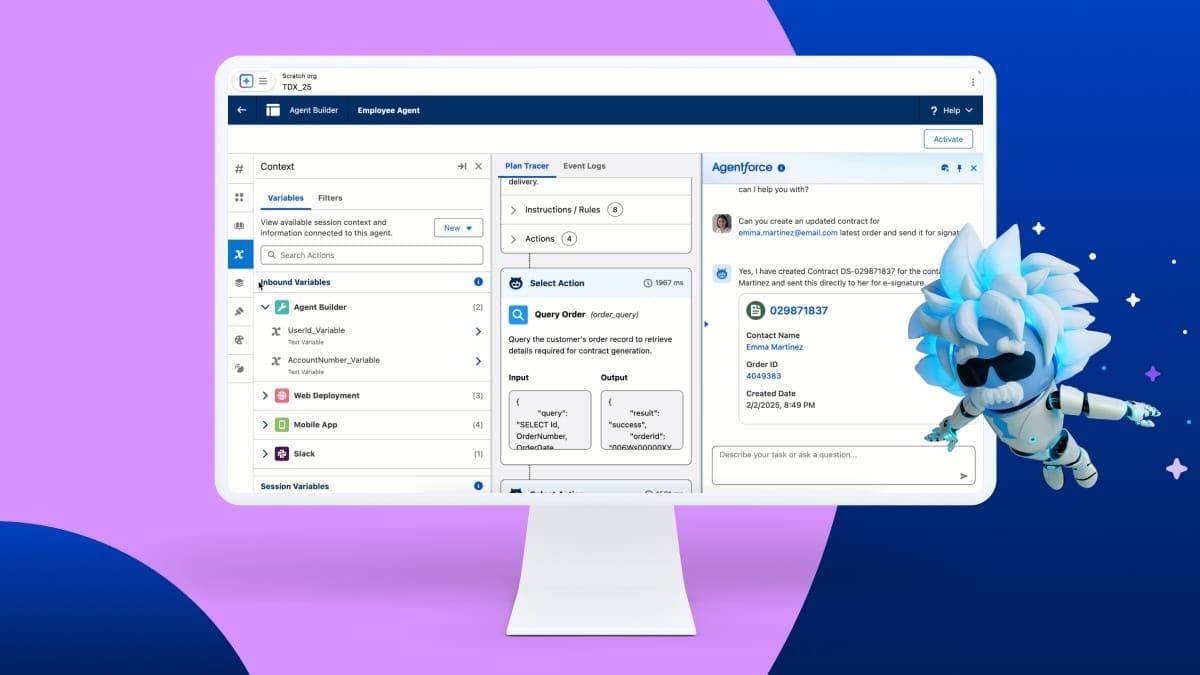
Salesforce has unveiled Koa, its first reasoning model designed specifically for customer relationship management (CRM) tasks and built on NVIDIA Nemotron 3 Super. The company says Koa was trained on synthetic scenarios inspired by 27 years of accumulated knowledge from Salesforce deployments, and is meant to let Agentforce agents handle multi-step business processes and use the tools needed to complete them.
Koa, Salesforce’s reasoning model, in 30 seconds
- Koa is Salesforce’s first reasoning model built specifically for CRM.
- It’s based on NVIDIA Nemotron 3 Super and uses synthetic scenarios spanning more than 14 industries.
- Salesforce says it matches or beats other leading models on CRM actions, with three times fewer errors.
- No customer data was used to train it, and Salesforce keeps control of the model’s weights.
- NVIDIA models are also coming to Missionforce for government and regulated environments, including internet-isolated systems.
The difference Salesforce is pitching isn’t just about generating responses. Koa was designed so agents can reason about a goal, decide which steps to take, and use tools to carry them out. The company gives examples such as updating a sales opportunity, assigning a support case, or scheduling a follow-up.
The model was developed through a post-training process on top of NVIDIA Nemotron 3 Super. Salesforce says it uses a synthetic dataset built from business scenarios that represent the processes, policies, and knowledge accumulated over nearly three decades of use of its CRM platforms.
The company also states that the model’s weights remain under its control, and that both post-training and inference happen within its own trust boundary.
A model trained to act, not just answer
Salesforce built Koa’s training around scenarios meant to mirror the work Agentforce agents do inside a company.
The company explains that each scenario pairs a persona or role with a specific task, and defines the sequence of actions and tool calls needed to reach the outcome. Examples range from generating and qualifying sales opportunities to resolving service issues.
These scenarios cover more than 14 industries, including manufacturing, financial services, healthcare, and travel.
One point Salesforce emphasizes is that no customer data was used to train Koa. The corpus is made up of synthetic scenarios designed to represent the reasoning, tool-use, and decision-making capabilities needed in CRM processes.
For post-training, Salesforce used Supervised Fine-Tuning (SFT) and reinforcement learning via Group Relative Policy Optimization (GRPO). The process relies on NVIDIA NeMo RL, NeMo Gym, and NeMo AutoModel.
The goal is for the model to learn to complete a task end to end, not just produce a correct piece of text. In a CRM setting, that distinction matters, because an answer can be correct while the action the agent actually carries out is not.
Salesforce says that on its own CRM-specific benchmark, which includes real tasks like updating opportunities, routing cases, or scheduling follow-ups, Koa already matches or beats leading models’ performance on CRM actions, and does so with three times fewer errors, according to the company’s own testing.
That result comes from Salesforce’s benchmark and isn’t equivalent to an independent evaluation against every available model.
Salesforce’s own experience feeds into the model
The company presents Koa as a way to build CRM-specific knowledge into the model itself, rather than relying solely on general-purpose models.
According to Salesforce, the synthetic scenarios used for training draw on knowledge accumulated over 27 years of CRM deployments. The goal is for the system to understand common business structures, such as the lifecycle of a sales opportunity, how a support case is handled, or the differences between processes across industries.
The company keeps control of the model’s weights and says customer data doesn’t cross its trust boundary during inference.
Koa is already used internally at Salesforce, including an agent built into Slack that helps employees look up information and complete certain everyday tasks.
The technology is now starting to reach pilot customers. Salesforce names 1-800Accountant, Baxter Credit Union (BCU), Engine, Formula 1, UChicago Medicine, and Xero among them.
Initial availability is limited to certain Agentforce pilot customers. Salesforce expects Koa to become generally available during the winter of 2026 in U.S. regions.
NVIDIA also joins Missionforce
The Salesforce-NVIDIA collaboration isn’t limited to CRM. Both companies are also bringing NVIDIA’s open models and accelerated computing to Missionforce, Salesforce’s platform aimed at government organizations and regulated industries — part of a wider push, alongside Salesforce’s recent moves to connect its AI agents, data, and models with partners like AWS.
Here the requirements are different. Some organizations need to keep the model, the data, and the deployment environment under their own control, especially when working with sensitive information or infrastructure that can’t connect to public services.
Salesforce positions Missionforce for scenarios that can use private clouds, classified networks, and environments fully isolated from the internet.
The company will allow post-trained NVIDIA models to be used for Missionforce Operations agents, a product aimed at digitizing and automating government processes such as procurement, vendor management, and logistics.
In this case, the specialized models can be trained on each organization’s own data and operational terminology. Salesforce’s pitch is that agents can reason about those processes and carry out actions inside the customer’s infrastructure, including air-gapped environments — networks physically isolated from other networks.
Missionforce Operations is already generally available in U.S. regions. Post-trained NVIDIA models will be available to certain customers starting in October 2026, according to Salesforce.
Betting on specialized models for agents
Koa reflects a trend in enterprise agent development: using specialized models for particular kinds of work instead of relying solely on general-purpose models.
Here, Salesforce starts from an NVIDIA model and adds a post-training process focused on CRM workflows. The company also keeps the model’s weights and controls the environment where it runs.
The approach fits with Agentforce’s evolution toward agents capable of taking action inside business applications. For these tasks, domain knowledge and the ability to use tools are as much a part of the final result as generating text.
The company is also carrying the same approach into sectors where controlling data and infrastructure is an operational requirement. Missionforce combines NVIDIA’s models with the deployment options Salesforce offers government and regulated organizations.
Koa is currently available to a select group of Agentforce pilot customers, while general availability is planned for winter 2026 in the United States. Salesforce hasn’t announced a specific date for general availability in other markets in the information it has shared so far.
FAQ
What is Koa?
Koa is Salesforce’s first reasoning model built specifically for CRM. It’s based on NVIDIA Nemotron 3 Super and designed so agents can handle multi-step business tasks and use tools.
Was customer data used to train Koa?
No. Salesforce says the training relied on a corpus of synthetic scenarios representing processes, reasoning, and tool use across different business workflows.
When will Koa be available?
Koa is available to certain Agentforce pilot customers. Salesforce expects general availability during winter 2026 in U.S. regions.
How does Koa relate to Missionforce?
Salesforce and NVIDIA are also bringing post-trained NVIDIA models and accelerated computing to Missionforce for government and regulated organizations that need to control their own models, data, and deployment environments.
