
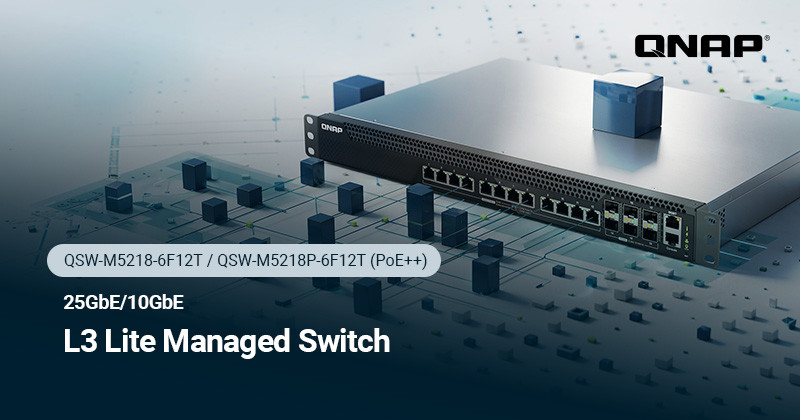
QNAP has unveiled the QSW-M5218 series, two managed switches with twelve 10GbE copper ports, six 25GbE SFP28 uplinks, and L3 Lite routing features, aimed at SMBs that have outgrown 10G uplinks. The lineup, announced on September 30, 2026 from Taipei, includes the QSW-M5218-6F12T and the QSW-M5218P-6F12T, which adds PoE power of up to 90W per port. The manufacturer hasn’t disclosed pricing or a retail availability date.
QNAP QSW-M5218 switches: the key facts in 30 seconds
- Two 1U models with 12 10GbE RJ45 ports and 6 25GbE SFP28 ports for uplinks.
- L3 Lite routing: static IPv4/IPv6 routes, a DHCP server, and inter-VLAN routing, without OSPF or BGP.
- The PoE version delivers up to 90W per port with a total power budget of 470W.
- It adds MC-LAG for redundancy and PTP IEEE 1588v2 for audio-over-IP and video-over-IP environments.
- QNAP hasn’t disclosed pricing or an availability date yet.
The approach addresses an increasingly common problem in offices and studios. NAS devices, virtualization servers, and workstations are already connecting at 10GbE, but many networks still aggregate that traffic through 1G or 2.5G switches, or through a single 10G uplink to the core. QNAP proposes keeping 10GbE toward the endpoints, taking advantage of existing Cat 6a copper cabling, and stepping up to 25GbE only on the trunk links, which multiplies uplink bandwidth per port by 2.5x.
L3 Lite: inter-VLAN routing without a core switch
The most interesting part of the series is in the software. Until now, an SMB that wanted 25GbE links and also needed to route traffic between subnets usually had to step up to a full L3 switch, which is pricier and more complex to configure. The QSW-M5218 units sit halfway between the two. Compared with a managed L2 switch, which only offers VLANs and quality of service (QoS), they add static IPv4 and IPv6 routing, a DHCP server, DNS, SNTP, and inter-VLAN routing. That way, traffic between network segments is handled on the switch itself instead of being sent up to the main router.
What they don’t have is dynamic routing. QNAP leaves out protocols like OSPF and BGP, which are reserved for the full L3 models, citing cost savings as the reason. That’s enough for an office with several VLANs (users, guests, cameras, servers); it isn’t for a network with multiple routers that need to exchange routes automatically.
The series adds high availability through MC-LAG (Multi-Chassis Link Aggregation), which groups links from several switches into a single logical connection so the network keeps running if one of them goes down, plus LACP for link aggregation. QNAP presents this as a complement to the high availability of its NAS units. For AV production, it includes PTP IEEE 1588v2 with Transparent Clock, which the manufacturer says delivers sub-microsecond synchronization at the hardware level, and IGMP Snooping to control multicast traffic in AV-over-IP setups.
“As 10GbE moves out of the central server room and reaches the desktop, the real bottleneck shifts from end devices to the uplinks and the power supply,” explains Ruby Chan, product manager at QNAP.
What differs between the two models
Both models share the same ports, 1U rack form factor, and switching capacity. The difference is in power delivery to connected devices, which changes power draw, depth, and weight.
| Feature | QSW-M5218-6F12T | QSW-M5218P-6F12T |
|---|---|---|
| 10GbE RJ45 ports | 12 (10G/5G/2.5G/1G/100M) | 12, with PoE++ |
| 25GbE SFP28 ports | 6 | 6 |
| Switching capacity | 540 Gbps | 540 Gbps |
| PoE | No | Up to 90W per port, 470W total |
| Max power consumption | 80W | 550W |
| Dimensions | 44 x 439 x 190 mm | 44 x 439 x 284 mm |
| Net weight | 2.74 kg | 4.19 kg |
| Cooling | 5 PWM fans | 5 PWM fans |
| Warranty | 2 years | 2 years |
Two figures are worth reading carefully. The 540 Gbps switching capacity counts traffic in both directions: the spec sheet lists non-blocking throughput of 270 Gbps, which matches the sum of all ports at their maximum speed (120 Gbps from the copper ports and 150 Gbps from the fiber ports). And the 470W PoE budget is enough to power all twelve ports at 30W each, as with PoE+ access points or cameras, but not to run them all at 90W: with high-power devices such as Wi-Fi 7 access points or PTZ cameras, the budget runs out after five of them at full load.
The uplink ports are SFP28, so they require transceivers or DAC cables, and the announcement doesn’t clarify whether any are included. The five fans also indicate these are units meant for a rack or a server room, not for sitting on a desk.
Local or cloud-based management
The switches are configured through QSS Pro (QNAP Switch System Pro), the manufacturer’s web interface, and can be monitored remotely from AMIZcloud, its cloud management platform, with no additional hardware. QNAP also ties them into its security lineup: they integrate with ADRA NDR X, its network detection and response system for NAS units, to isolate anomalous traffic or ransomware, and they’re compatible with the Airgap+ isolated backup solution. These features depend on having QNAP NAS units on the same network.
With this series, QNAP moves up a notch in its business networking lineup. In May it introduced the QSW 2000 series, a Layer 2 line running at 2.5GbE and 10GbE speeds, and this month it launched the TS-h966TX NAS with 10GbE — the kind of device the QSW-M5218 units are designed to connect without bottlenecks.
Frequently Asked Questions
What is an L3 Lite switch?
It’s a switch that, in addition to Layer 2 functions, can route traffic between VLANs and subnets using static routes. It doesn’t include dynamic routing such as OSPF or BGP, which is reserved for full L3 switches.
How many ports does the QNAP QSW-M5218 have?
Twelve 10GbE RJ45 ports supporting speeds from 100M to 10G, six 25GbE SFP28 ports for uplinks, and one 1GbE management port.
How much PoE power does the QSW-M5218P-6F12T offer?
Up to 90W per port with PoE++ (IEEE 802.3bt) and a total power budget of 470W across the twelve copper ports.
How much do QNAP’s new switches cost?
QNAP hasn’t disclosed pricing or an availability date in the series announcement.
Sources:
