
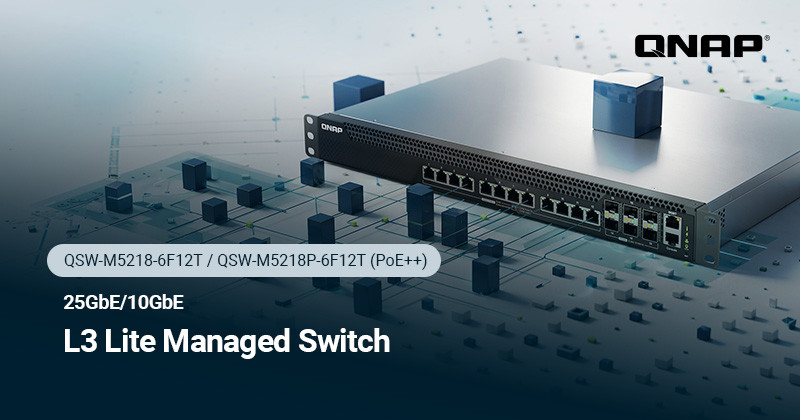
QNAP has unveiled the QSW-M5218 series, made up of two managed switches with L3 Lite features, twelve 10GbE ports and six 25GbE SFP28 uplinks. The QSW-M5218-6F12T and QSW-M5218P-6F12T models are aimed at small and medium businesses and at environments with heavy bandwidth needs, such as NAS infrastructure, virtualization or audio/video over IP.
QNAP first detailed the QSW-M5218 series in a report published days earlier, and this deeper look adds detail on how the company positions the switches for redundancy, synchronization and security in professional networks.
The QNAP QSW-M5218 in 30 seconds
- The new family combines 12 10GbE RJ45 ports with 6 25GbE SFP28 ports and reaches a switching capacity of up to 540 Gbps.
- L3 Lite routing lets the switch itself handle functions such as static IPv4/IPv6 routing and inter-VLAN routing.
- The QSW-M5218P-6F12T model adds PoE++ with up to 90W per port and a total power budget of 470W.
- MC-LAG, LACP and IEEE 1588v2 PTP provide redundancy, link aggregation and precise synchronization for certain professional environments.
- QSS Pro and AMIZcloud allow the switches to be managed and monitored from a web interface and from QNAP’s cloud platform.
QNAP’s pitch starts from an increasingly common situation in enterprise networks: servers, workstations and storage devices already use 10GbE connections, while the link that aggregates that traffic can fall short. The company places the role of the new family’s six 25GbE SFP28 ports precisely there, which can be used as higher-capacity links toward the network core.
Compared to a 10GbE link, each 25GbE connection delivers 2.5 times more bandwidth. The twelve 10GbE RJ45 ports allow direct connections to equipment that already runs at that speed and, according to QNAP, reuse existing Cat 6a copper cabling at the endpoints. That means upgrading the core of the network doesn’t necessarily require replacing all the cabling with fiber.
Two models with the same switching capacity
The series is made up of the QSW-M5218-6F12T and the QSW-M5218P-6F12T. Both include twelve 10GbE ports and six 25GbE SFP28 ports, with a switching capacity of up to 540 Gbps.
The main difference lies in Ethernet-based power delivery. The QSW-M5218P-6F12T includes 10GbE PoE ports and supports PoE++ under the IEEE 802.3bt standard, with up to 90W per port and a total power budget of 470W.
QNAP positions this variant for devices that need both power and connectivity over the same cable. The company says it can power up to 12 wireless access points or 30W PoE+ IP cameras, as well as higher-consumption devices such as Wi-Fi 7 access points or PTZ cameras.
The combination of PoE and 25GbE links also makes it possible to concentrate traffic generated by wireless devices and other network-connected equipment on the same switch. QNAP notes that VLAN segmentation can be used to isolate that traffic and keep trunk links available for higher-speed communications.
L3 Lite routing without a full L3 switch
One of the differences between the new family and managed switches focused on Layer 2 features is the addition of L3 Lite capabilities. QNAP includes static IPv4 and IPv6 routing, a DHCP server, and inter-VLAN routing.
This allows certain communications between network segments to be handled directly from the switch. The company presents this feature as a way to offload work from the main router and reduce latency for certain internal communications.
At the same time, the QSW-M5218 switches don’t include the dynamic routing features found on full L3 models, such as OSPF or BGP. QNAP is thus positioning the series for installations that need segmentation and internal routing without the more advanced features of a full Layer 3 switch.
Configuration can be managed through QSS Pro, QNAP’s switch management system. The company also integrates the series with AMIZcloud, from which equipment installed at different locations can be monitored, managed and have its firmware updated.
MC-LAG and PTP synchronization for professional networks
Redundant link availability is another element included in the new family. The switches support MC-LAG (Multi-Chassis Link Aggregation), a technology that groups links connected to multiple switches under a single logical connection. QNAP pairs it with LACP, the link aggregation protocol, to boost performance and fault tolerance for physical connections.
The company also envisions scenarios where storage is part of the same architecture. Combined with the high-availability features of certain QNAP NAS units, it offers protection that covers both the storage layer and the network layer, according to the company.
For IP-based audio/video applications, the QSW-M5218 switches support IEEE 1588v2 PTP (Precision Time Protocol) and Transparent Clock. QNAP says synchronization happens at the hardware level and can reach sub-microsecond precision, while also compensating for the latency introduced by switching.
This feature is paired with IGMP Snooping to manage multicast flows more precisely. The goal is to prevent unnecessary traffic from eating up bandwidth on networks where media servers, storage and video displays coexist.
QNAP positions this offering especially for AVoIP environments, where synchronization between different audio and video elements can be necessary to keep playback aligned.
Security and centralized management
The new series also integrates with other tools from the manufacturer. QNAP points to compatibility with ADRA NDR X, its network detection and response solution, to identify anomalous traffic and help isolate certain threats when used alongside compatible NAS units.
It also supports the Airgap+ isolated backup solution, which QNAP positions to reduce the risk of the backup environment being compromised during an attack on the network.
For management, QSS Pro provides a web interface to manage L2 and L3 Lite features and firmware updates. AMIZcloud adds the ability to monitor switches deployed at different locations without additional hardware or software for that centralized management.
QNAP announced the new models on September 30, 2026. The announcement does not detail pricing or a specific commercial availability date for each market. The company points to its catalog for up-to-date information on the lineup.
Frequently asked questions
How many ports do the new QNAP QSW-M5218 switches have?
Both models include 12 10GbE RJ45 ports and 6 25GbE SFP28 ports. Switching capacity reaches up to 540 Gbps.
What’s the difference between the QSW-M5218-6F12T and the QSW-M5218P-6F12T?
The QSW-M5218P-6F12T adds PoE++ connectivity to its 12 10GbE ports. It can deliver up to 90W per port and has a total power budget of 470W.
Do the QSW-M5218 switches support inter-VLAN routing?
Yes. The series includes L3 Lite features with inter-VLAN routing, static IPv4 and IPv6 routing, and a DHCP server.
What is the PTP support on these switches for?
IEEE 1588v2 PTP support allows devices on a network to be precisely synchronized. QNAP aims it especially at audio/video over IP applications together with IGMP Snooping.
