
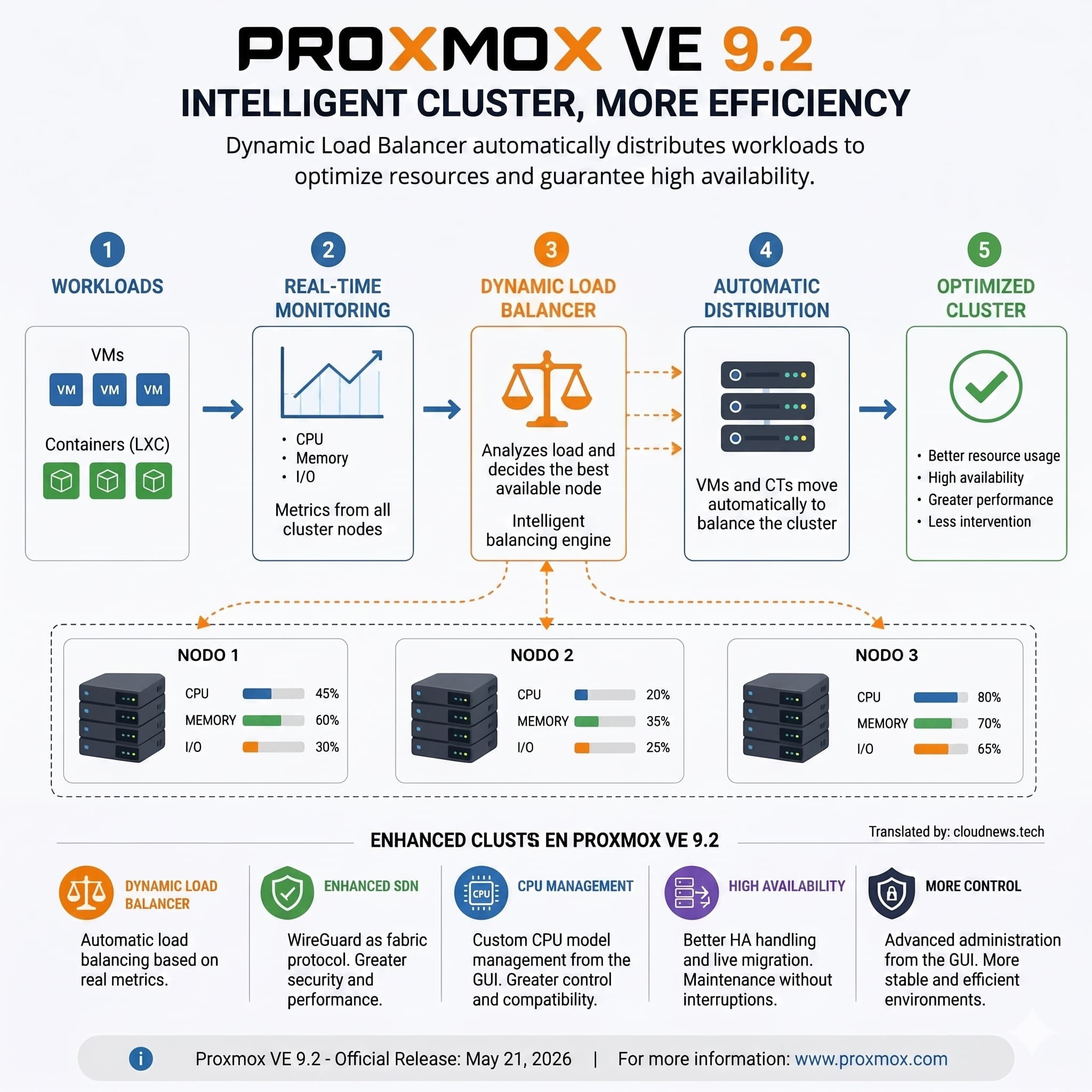
Proxmox VE still lacks a cluster file system equivalent to VMware’s VMFS that covers every use case for shared storage on a SAN. That’s the conclusion of the developer known as gyptazy in an analysis published in late October 2026, which reviews three projects trying to fill that gap: a shared LVM Thin plugin, MeshXFS, and CetraFS. None is yet a mature solution, and the author is involved in two of them.
Shared storage on Proxmox VE in 20 seconds
- Proxmox VE has no direct equivalent to VMFS for SAN over iSCSI, Fibre Channel, or NVMe-oF.
- Shared LVM Thin adds thin provisioning and snapshots on top of an existing SAN.
- MeshXFS and CetraFS let multiple nodes mount the same disk at once.
- All three are young projects that need testing before they’re used in production.
The issue carries more weight now that many companies are leaving VMware after Broadcom’s price hikes. Cloud News has already reported how Broadcom’s VMware price hikes are pushing customers toward Proxmox. Anyone coming from vSphere usually brings a storage array connected over iSCSI or Fibre Channel and is used to VMFS giving them, on that same volume, thin disks, snapshots, and live migration between hosts. Proxmox doesn’t offer that combination out of the box.
What Proxmox Offers Today With a SAN
The usual option is thick-provisioned LVM on a shared LUN. It’s reliable, but every virtual disk reserves its full size from the start. Proxmox VE 9.0, released in August 2025, added snapshots to that shared LVM through volume chains, where each snapshot records only the differences from the previous one. Thin provisioning is still missing: Proxmox’s native LVM-Thin offers it, but only on local storage.
There are other paths. Ceph is well integrated into Proxmox and offers replication and self-healing, though it demands more hardware, networking, and expertise than reusing an existing array. GFS2 and OCFS2 are veteran Linux cluster file systems, but according to gyptazy they’re usually not the first choice for virtual machines on Proxmox, and Lustre or BeeGFS are too complex for small clusters. For two-node environments without a SAN, Proxmox also lets you replicate virtual machines with ZFS, with its own limits.
Three Projects to Fill the VMFS Gap
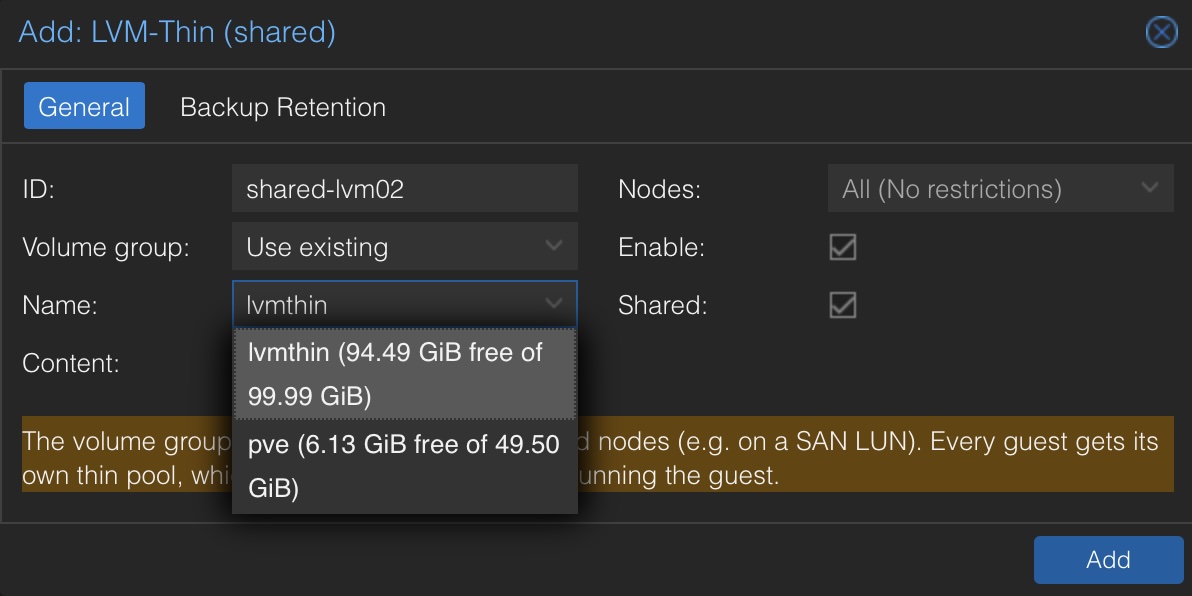
Shared LVM Thin is a storage plugin developed by gyptazy himself. It creates a dedicated thin pool for each virtual machine inside a shared LVM volume group and activates it only on the node where that machine is running; when the machine migrates, it deactivates the pool on the source node and activates it on the destination. It supports snapshots, rollback, resizing, templates, and linked clones, and protects LVM metadata operations with cluster-level locking. It’s managed from the command line, the API, or the web interface, and is distributed as a Debian package from its repository. Its advantage is reusing an existing SAN without deploying a new distributed stack; in exchange, you need to watch real physical capacity and thoroughly test multipath and failure recovery.
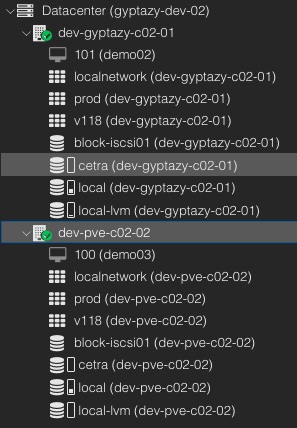
MeshXFS takes a different approach: it’s a POSIX cluster file system built on XFS code, licensed under GPL-2.0, that lets multiple nodes mount the same block device for reading and writing. It adds distributed locking, node fencing through SCSI persistent reservations, and journal recovery, and runs over iSCSI SAN or dual-primary DRBD. It was created by Steve Shoecraft, who according to Phoronix says all the cluster code was written by AI agents, mainly Claude Opus, without him editing or reviewing it, and that every release goes through a battery of about 30 tests on real clusters. The project says it has been validated with 2, 4, 8, and 16 nodes. Gyptazy considers it an interesting candidate for labs, testing, and development.
CetraFS is an independent file system, with its own on-disk format, kernel module, and tools, that doesn’t derive from XFS. It coordinates nodes with the atomic SCSI COMPARE AND WRITE command, uses a per-node journal, on-disk checksums, and per-node allocation groups, and is designed for virtual machine disk images and live migration. Its development is linked to Massimo Cetra, and gyptazy has contributed the integration into the Proxmox web interface. It’s still in a pre-1.0 release, requires arrays that support COMPARE AND WRITE, and needs properly configured fencing and multipath.
Why Caution Is Warranted
None of the three has the track record of VMFS, ext4, or Ceph itself, and gyptazy doesn’t offer performance figures or comparative benchmarks. It’s also worth reading the analysis knowing who wrote it: the author developed Shared LVM Thin, took part in CetraFS’s integration, and distributes packages for both from his own repository. His conclusion is cautious: there’s no single solution that replaces VMFS, the choice depends on existing infrastructure and the complexity you’re willing to take on, and any option needs to be tested for recovery, fencing, and failure scenarios, always with independent backups.
The MeshXFS case raises a concern of its own. A cluster file system is one of the most delicate pieces of infrastructure, because a bug in locking or recovery can corrupt data across several nodes at once. The fact that the cluster code hasn’t gone through human review is one more reason to limit it, for now, to test environments. For anyone migrating from VMware with a SAN, the conservative path is still shared thick LVM with Proxmox VE 9’s snapshots, or Ceph if the infrastructure can support it.
Frequently Asked Questions
Does Proxmox VE have an equivalent to VMFS?
Not natively. It offers shared thick-provisioned LVM with snapshots since Proxmox VE 9, Ceph, and other options, but none brings together all of VMFS’s features for a SAN.
Can LVM-Thin be used as shared storage on Proxmox?
Not with native LVM-Thin, which only works locally. gyptazy’s Shared LVM Thin plugin makes it possible by creating a thin pool per virtual machine that’s only activated on one node.
What is MeshXFS?
A cluster file system based on XFS, licensed under GPL-2.0, that lets multiple nodes mount the same disk at once. Its creator says the cluster code was written by AI agents.
Are they ready for production?
The analysis itself presents them as young projects that need testing first, especially around recovery and fencing. CetraFS is in a pre-1.0 release, and MeshXFS is recommended for labs.
Sources:
