
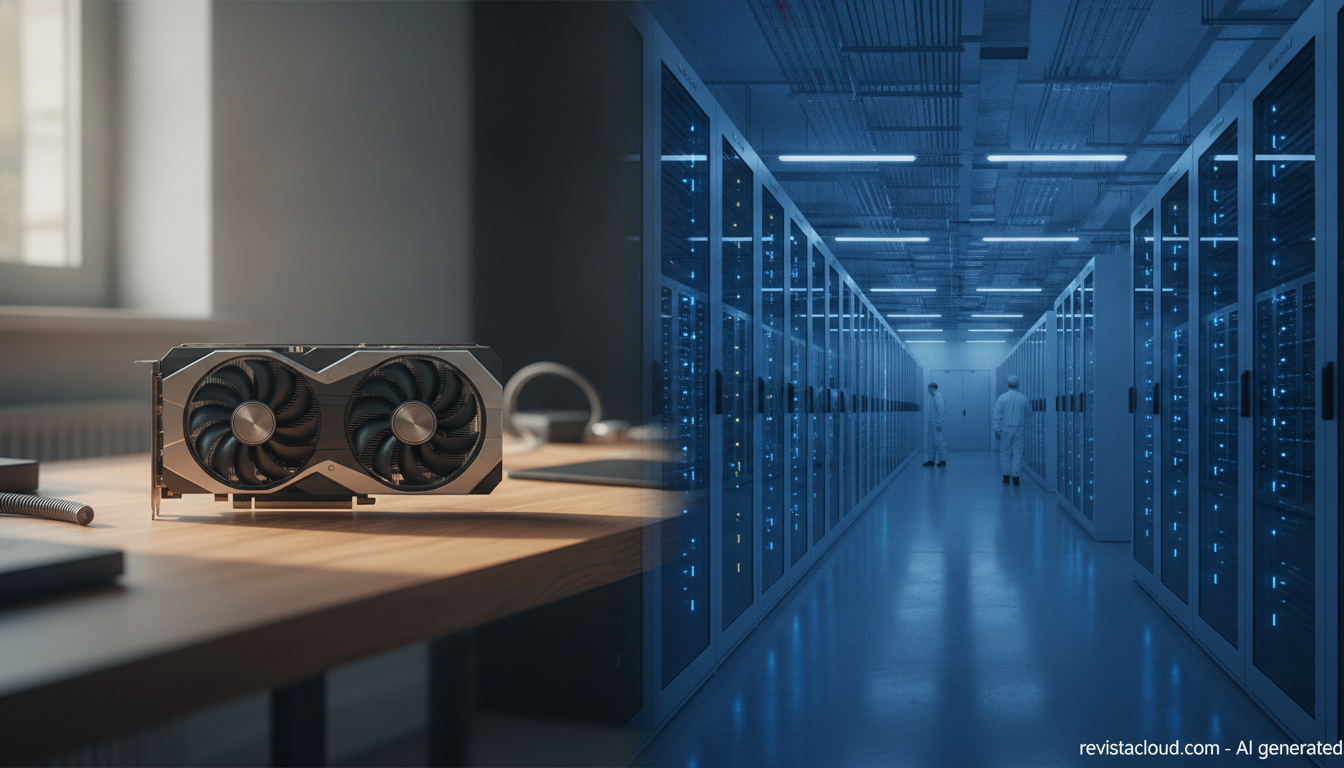
The threat to OpenAI’s and Anthropic’s business might not be in their books, but in a 24GB graphics card capable of running good-enough AI models locally: that’s the provocative, and debatable, thesis published by the magazine Jot Down. The piece, written by Ángel L. Fernández Recuero on September 26, 2026, argues that what could break down in the coming years is the logic of paying per token when a large share of a company’s daily work fits on a machine it already owns.
The local-AI-versus-OpenAI-and-Anthropic thesis in 20 seconds
- Jot Down argues a PC with 24GB of VRAM already covers plenty of business tasks.
- Its author estimates that 20% to 40% of general-purpose inference could shift to local hardware before 2030.
- OpenAI expects to burn $278 billion between 2026 and 2030, according to the FT.
- Anthropic, by contrast, has told investors it will post adjusted operating profit for a second straight quarter.
The piece doesn’t literally predict anyone’s bankruptcy, despite the headline. Its author admits both companies can survive and notes that “the cloud won’t disappear.” What he’s really arguing is something else: that for a growing share of use cases, the subscription-and-API model may stop being the most economically rational choice compared with hardware bought once.
What Jot Down argues
The argument starts from personal experience. Fernández Recuero began using local models out of frustration with the excessive caution and filters he sees in large U.S. and Chinese models, and found that models that aren’t at the frontier handle office tasks well: sorting documents, summarizing files, searching internal databases, drafting emails and reports, reviewing code, or automating routine processes. For that, he writes, you don’t need a data center, just a consumer GPU with 24GB of memory and models compressed through quantization, using formats like Q4_K_M or IQ3_XS.
The piece also leans on hardware. It notes that machines built around the AMD Ryzen AI Max+ 395 support up to 128GB of shared memory, and that Apple’s chips split the same physical memory between CPU and GPU — two ways to run larger models without a dedicated card. His cost example is a small business that buys an $800 AI machine in 2029 and depreciates it over three years: about $22 a month in hardware and $30 to $40 including electricity, storage, and maintenance. He sums it up with an image: a computer “under the desk that, once bought, never sends another bill.”
Those figures are worth reading for what they are. The 20%-to-40% migration estimate is the author’s own, not a published study, and the $800 scenario assumes memory and GPU prices return to a normal curve. Today the opposite is happening: the article puts the card in its photo, an RTX 5090 with 32GB, at around $3,500, driven up by AI demand.
The real numbers at OpenAI and Anthropic
The financial part does have documentary backing, even if it comes through leaks. According to an internal OpenAI presentation published by the Financial Times and picked up by Reuters on September 18, 2026, the company expects negative free cash flow of $278 billion between 2026 and 2030 and compute and infrastructure spending of around $856 billion through the end of the decade. At the same time, it expects to grow revenue tenfold, from $36 billion in 2026 to $350 billion in 2030. The $122 billion it raised in March, at an $852 billion valuation, would run out around 2028.
OpenAI has also opened an advertising track. It began testing ads in ChatGPT in February and, by late August, said it had topped $1 billion in annualized ad revenue, with a target of $2.5 billion by year-end, according to SiliconANGLE. Anthropic is on a different path: as Jot Down notes, it maintains that Claude won’t carry ads and funds itself through enterprises, developers, and subscriptions. According to the Financial Times, it has told shareholders its adjusted operating profit will be positive for a second straight quarter, with gross margins above 80%, a figure that excludes revenue shared with partners like Amazon and the cost of training its models. Reuters couldn’t independently verify those figures.
The paradox Jot Down points to is real as far as it goes: these companies are pouring hundreds of billions into centralized infrastructure to sell inference, while a share of that inference is starting to become viable on hardware people already own. But the two companies aren’t in the same situation, and lumping them together weakens the argument.
Where the thesis holds up, and where it falls short
Revista Cloud’s reading is that the thesis gets the direction right and overstates the speed. Running a quantized 27-to-30-billion-parameter model at 4 bits locally takes up around 15-18GB, which leaves room on a 24GB card for the working context. For narrow, repetitive tasks on data a company doesn’t want to send outside its walls, the savings can be enormous: Noticias.ai already reported the case of a company that cut its translation bill from $5,600 to $13 a month with local AI. Data sovereignty also plays in its favor: under the GDPR and the EU AI Act, not sending sensitive information to a third party makes compliance much simpler.
The flip side is less flattering. A machine under the desk offers no high availability, doesn’t scale to dozens of simultaneous users, and needs someone to update models, manage access, and watch security. Frontier models remain far superior at long-horizon reasoning, complex coding, and agents, and many companies will keep paying for that gap. The most likely outcome is a hybrid market, with routine tasks running locally or on private cloud and occasional calls to the big models when they’re needed. Proposals like private AI cloud platforms that combine private infrastructure, agents, and inference already operate in that middle ground, aimed at companies that want their own models without putting a machine under every desk.
The practical takeaway for a company is less dramatic than Jot Down’s headline, but useful: measure how much of your API spending goes to tasks an open model handles just as well, and check whether that share fits on hardware you already own.
Frequently asked questions
What does the Jot Down article argue?
That local inference on 24GB cards could take 20% to 40% of general-purpose AI spending away from OpenAI and Anthropic before 2030, an estimate from the author himself.
How much money does OpenAI expect to lose?
According to an internal presentation published by the Financial Times, OpenAI expects negative free cash flow of $278 billion between 2026 and 2030.
Is Anthropic profitable?
According to the Financial Times, Anthropic has told shareholders its adjusted operating profit will be positive for a second straight quarter, though Reuters couldn’t verify it.
What models fit on a 24GB GPU?
Models of roughly 27 to 30 billion parameters quantized to 4 bits, which take up around 15-18GB and leave room for context.
Sources:
- Jot Down: La quiebra de OpenAI y Anthropic cabe en menos de 24GB
- Reuters via The Star: OpenAI forecasts cash burn near $280 billion by 2030, FT reports
- Reuters via The Star: Anthropic tells investors it will be profitable for second straight quarter
- SiliconANGLE: OpenAI says its ad business has already hit $1B in annualized revenue
