
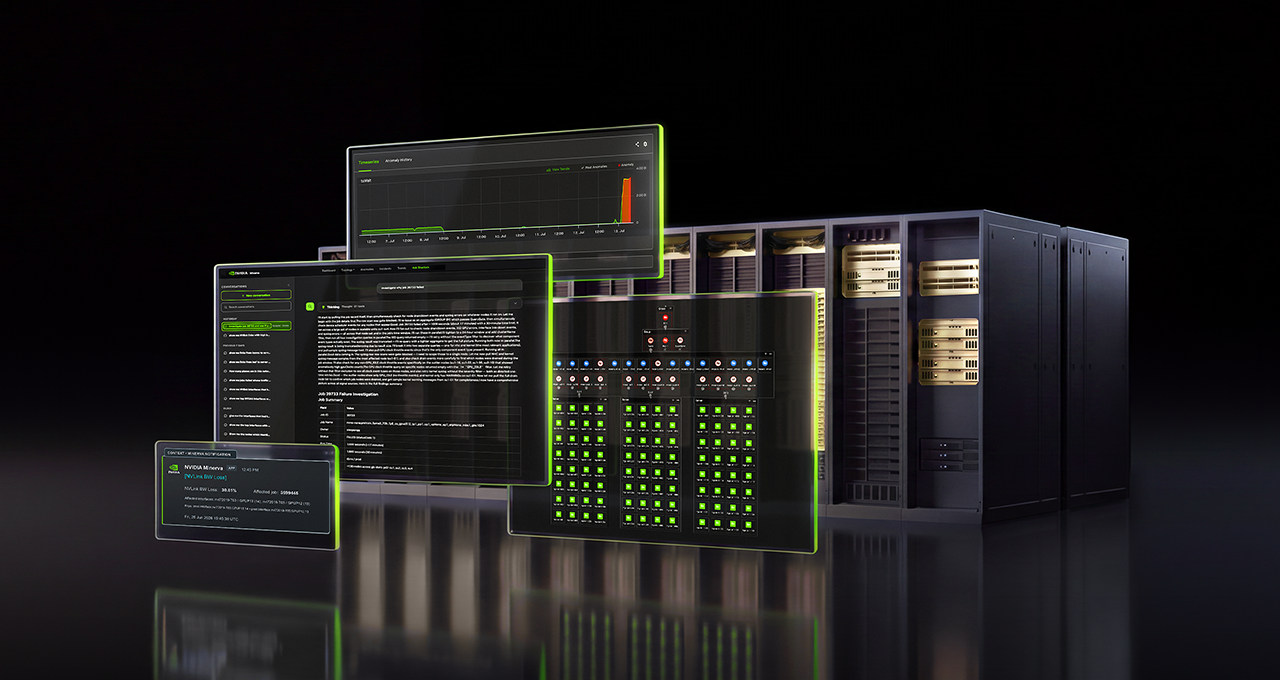
NVIDIA has unveiled Minerva, an AIOps (AI-driven IT operations) platform that brings together GPU, network, storage, scheduler, and workload telemetry into a single view to catch failures in so-called AI factories earlier. The company announced it on October 22, 2026, at GTC Berlin, with IREN as its first user and a list of operators — including Lambda, IBM, and Tesla — planning to deploy it.
NVIDIA Minerva, the observability platform for AI factories, in 30 seconds
- NVIDIA unveiled Minerva on October 22, 2026, at GTC Berlin as an AIOps platform for AI data centers.
- It cross-references data from GPUs, SuperNICs, switches, cables, storage, and jobs in a knowledge graph.
- NVIDIA says it analyzes billions of data points per hour to anticipate failures and group alerts together.
- IREN is already using it; Bitdeer AI, IBM, Jio, Lambda, and Tesla, among others, plan to deploy it.
- Dell, Lenovo, and Supermicro will offer it; there’s no pricing or general availability date yet.
The problem Minerva aims to solve is a familiar one to anyone running large clusters. In a training job spread across thousands of GPUs, a single faulty card, a cable dropping packets, or a slow storage drive can stall the entire job, and the warning signs often go unnoticed because networking, compute, and machine learning teams each watch their own piece with different tools.
A graph that ties hardware and jobs together
According to NVIDIA’s blog post, written by Brian Sparks, Minerva builds a dynamic knowledge graph that links every GPU, every SuperNIC, every switch, and every cable to the jobs running on them. On that foundation, the platform applies supervised and unsupervised machine learning models to detect anomalies that haven’t been seen before, predict failures as they start to form, and group related events into a single incident with its likely root cause.
NVIDIA says the system analyzes billions of data points per hour and is built for clusters with hundreds of thousands of GPUs. It includes an AI assistant with a natural-language interface, can connect to external agentic AI tools, and lets teams choose between human-supervised remediation or automated fixes through the infrastructure’s APIs.
NVIDIA measures the benefit with what it calls AI factory performance: GPU hours put to use, goodput (the useful work that comes out of the cluster, net of what’s lost to failures and restarts), uptime, and token output. It promises longer stretches between outages, faster repairs, and less alert noise, though the announcement doesn’t include improvement figures or independent benchmarks to back that up.
Who’s using it and who will sell it
IREN, the former bitcoin miner turned AI cloud provider, is the only customer NVIDIA presents as already running Minerva. Its chief technology officer, Denis Skrinnikoff, says in the announcement that the platform gives its operations team a single view of the network, GPUs, and jobs, and lets them focus on preventive maintenance rather than troubleshooting. The Next Web notes that NVIDIA can invest up to $2.1 billion in IREN under an agreement signed in May.
The list of companies planning to deploy it includes Aolani, Bitdeer AI, IBM, Jio, Lambda, Quake AI, and Tesla, and Dell Technologies, Lenovo, and Supermicro will include it in their AI factory portfolios. NVIDIA hasn’t published pricing or a general availability timeline, and it hasn’t clarified whether Minerva will work only with its own networking hardware or also with equipment from other manufacturers.
Software to sell more than just chips
The launch fits the strategy NVIDIA has been rolling out at GTC Berlin, where it also unveiled updates to DSX, its reference design for AI factories. We’ve reported on how NVIDIA DSX pledges lower water and energy use for European AI factories and on the DSX POD format, with containerized AI factories ready in 14 days. Minerva rounds out that lineup with the operations layer — the one that decides how many GPU-hours end up turned into useful work.
For operators, the appeal is obvious if it delivers on its promise: in clusters where every idle GPU-hour costs money, getting ahead of a failure is worth more than diagnosing it quickly. But it also deepens reliance on a single vendor that already sells the accelerators, the network, and now the tool that watches over both. That trade-off between convenience and control is one every company will have to weigh once NVIDIA details pricing and terms.
Frequently Asked Questions
What is NVIDIA Minerva?
It’s an NVIDIA AIOps platform that brings together GPU, network, storage, and workload telemetry to detect anomalies, predict failures, and group alerts in AI factories.
When was Minerva announced?
NVIDIA announced it on October 22, 2026, at its GTC conference in Berlin.
Who’s already using Minerva?
IREN is already using it, and Aolani, Bitdeer AI, IBM, Jio, Lambda, Quake AI, and Tesla plan to deploy it. Dell, Lenovo, and Supermicro will offer it to their customers.
How much does Minerva cost?
NVIDIA hasn’t published pricing or a general availability date.
Sources:
