
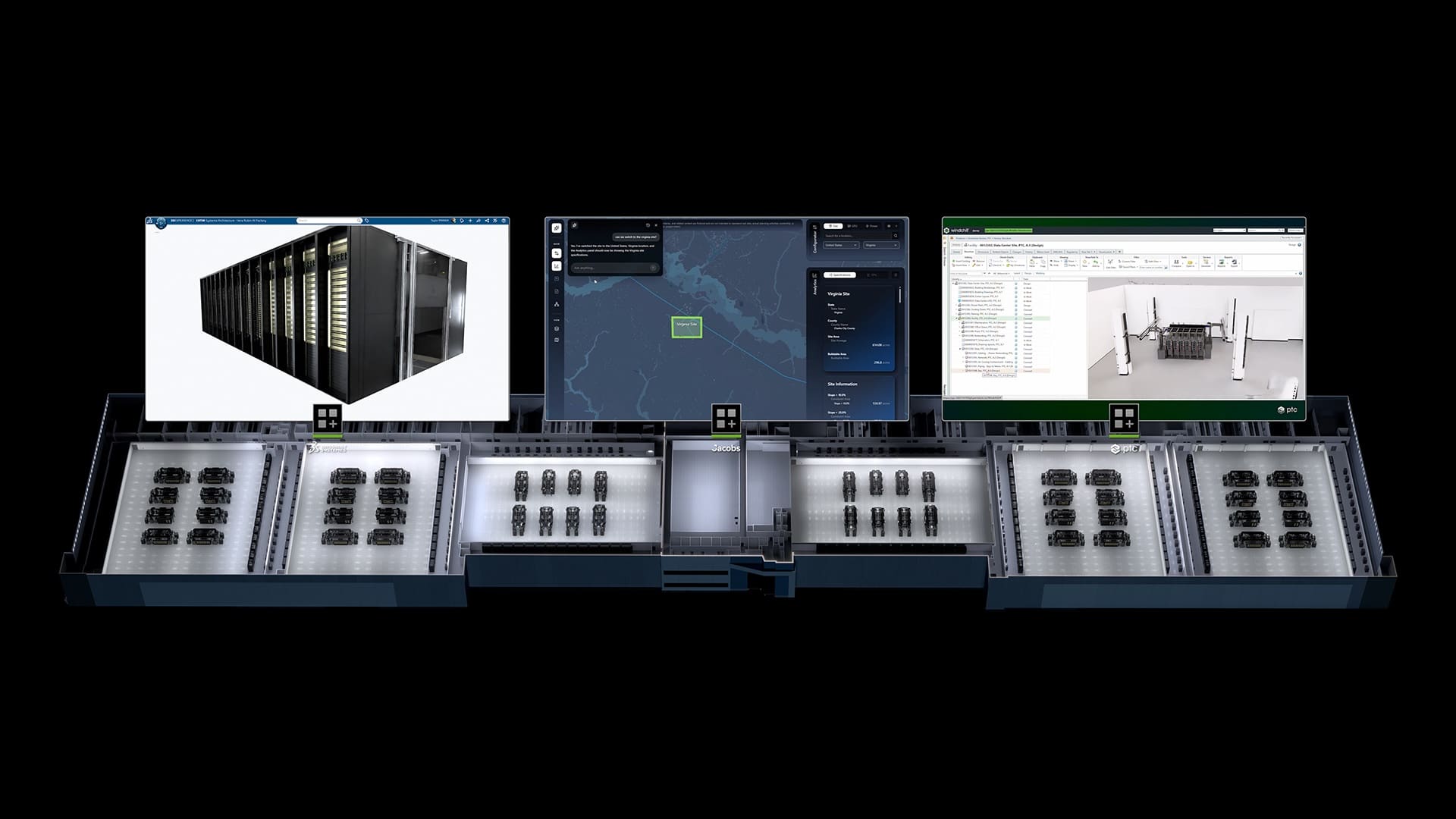
European partners of NVIDIA are adopting the NVIDIA DSX platform to build AI factories that use less water for cooling and less electricity for the same workload. The company announced this on October 21, 2026 at GTC Berlin, citing its own and customers’ test figures, including an assessment from Nscale in Iceland that reports a 49% jump in inference performance at the same power draw.
NVIDIA DSX for European AI factories in 20 seconds
- DSX designs combine liquid-cooled compute with closed-loop dry coolers.
- NVIDIA estimates 54 million liters of water saved per day at 2 GW scale.
- DSX MaxLPS promises up to 30% less energy for the same token output.
- Nscale, Lambda, and the UK grid provide the first test results.
NVIDIA’s message to Europe centers on efficiency. Warren Barkley, vice president of product management for DSX, argued that Europe’s technology leadership depends on how well it turns energy and infrastructure into intelligence, and that DSX brings together partner technology and expertise to build responsibly and get AI services to customers sooner. Josh Payne, founder and CEO of Nscale, tied Europe’s AI ambitions to the need to make the most of every megawatt.
Cooling With Almost No Water, With Caveats
The DSX reference designs combine liquid-cooled compute with closed-loop dry coolers, which expel heat without evaporating water. NVIDIA says that can bring a facility’s cooling water consumption close to zero. The NVIDIA Vera Rubin infrastructure supports fully liquid cooling with coolant temperatures of up to 45°C.
The most striking figure is NVIDIA’s own estimate: at a 2 GW scale, this approach would save 54 million liters of water a day compared with systems that use cooling towers, roughly the equivalent of the daily consumption of 180,000 households. The company acknowledges that local climate determines whether backup mechanical cooling is needed during the hottest periods, so actual savings will vary depending on where each facility is built.
More Tokens on the Same Power: What the Tests Show
DSX MaxLPS dynamically allocates power within a facility’s contracted electrical budget, building on the push to squeeze more tokens out of every megawatt that NVIDIA has been making across its AI factories. NVIDIA says it can cut the energy needed for the same token output by up to 30%. CoreWeave, Firmus, Google Cloud, IREN, Lambda, Nebius, Nscale, and Sharon AI are evaluating it, which doesn’t amount to a commercial rollout. The published tests are these:
- Lambda: in a proof of concept with HGX B200 systems, cluster token throughput rose 24% and GPU capacity rose 19%, within a fixed power budget.
- Nscale: at its Iceland AI factory, with four GB300 NVL72 racks, it logged 49% more inference performance and 37% more managed GPU capacity using the same 264 kW of contracted power.
- DSX Flex: in an early test with Emerald AI, EPRI, Nebius, Great Britain’s National Grid, and NVIDIA, a Blackwell Ultra cluster cut its consumption by up to 40% during simulated grid events without stopping critical workloads.
Nscale is also using DSX Sim to build digital twins of its Portugal and Iceland facilities. As this outlet reported earlier, Nscale acquired Anyscale to control AI infrastructure from energy to software.
Open Software and an Equipment Catalog on Hugging Face
NVIDIA is launching the SimReady Central Library on Hugging Face, a repository of digital models of physical equipment ready for simulation. It starts with validated power and cooling assets, such as those from Vertiv, and PTC is helping create those assets from CAD designs. Combined with DSX Sim, it lets teams test power and cooling configurations before installing the hardware.
In operations, three components of DSX OS, the modular open-source software portfolio for managing AI factories, are entering developer preview: Config Manager automates network configuration, Rack Management Service handles power, inventory, firmware, and switches at the rack level, and Cluster Readiness Engine validates GPU clusters before they go into production and flags failing nodes. CoreWeave, Crusoe, Lambda, Nebius, and Nscale are evaluating them.
The ecosystem named includes AVEVA, Dassault Systèmes, Procore, and Siemens in software, and ABB, Eaton, GE Vernova, Hitachi Energy, Schneider Electric, Siemens Energy, Trane Technologies, and Vertiv in power and cooling. Trane has published seven thermal management reference designs, three of them 250 MW cooling designs based on DSX. Equipment with DSX Ready qualification includes Trane’s LiquidStack GigaModular, Vertiv’s 2.3 MW CoolChip coolant distribution units, and Hitachi Energy’s battery system. The announcement cautions that availability of several features isn’t guaranteed and gives no general-availability dates.
Frequently Asked Questions
How much water does NVIDIA DSX save?
NVIDIA estimates that at a 2 GW scale, its designs would save 54 million liters a day compared with cooling towers, though local climate may require backup cooling.
What is DSX MaxLPS?
It’s a system that allocates power within a facility’s electrical budget. NVIDIA says it cuts the energy needed for the same token output by up to 30%.
What results did Nscale get in Iceland?
With four GB300 NVL72 racks, 49% more inference performance and 37% more managed GPU capacity using the same 264 kW.
What is SimReady Central Library?
It’s a Hugging Face repository of digital models of power and cooling equipment ready to simulate AI factories before they’re built.
Sources:
