
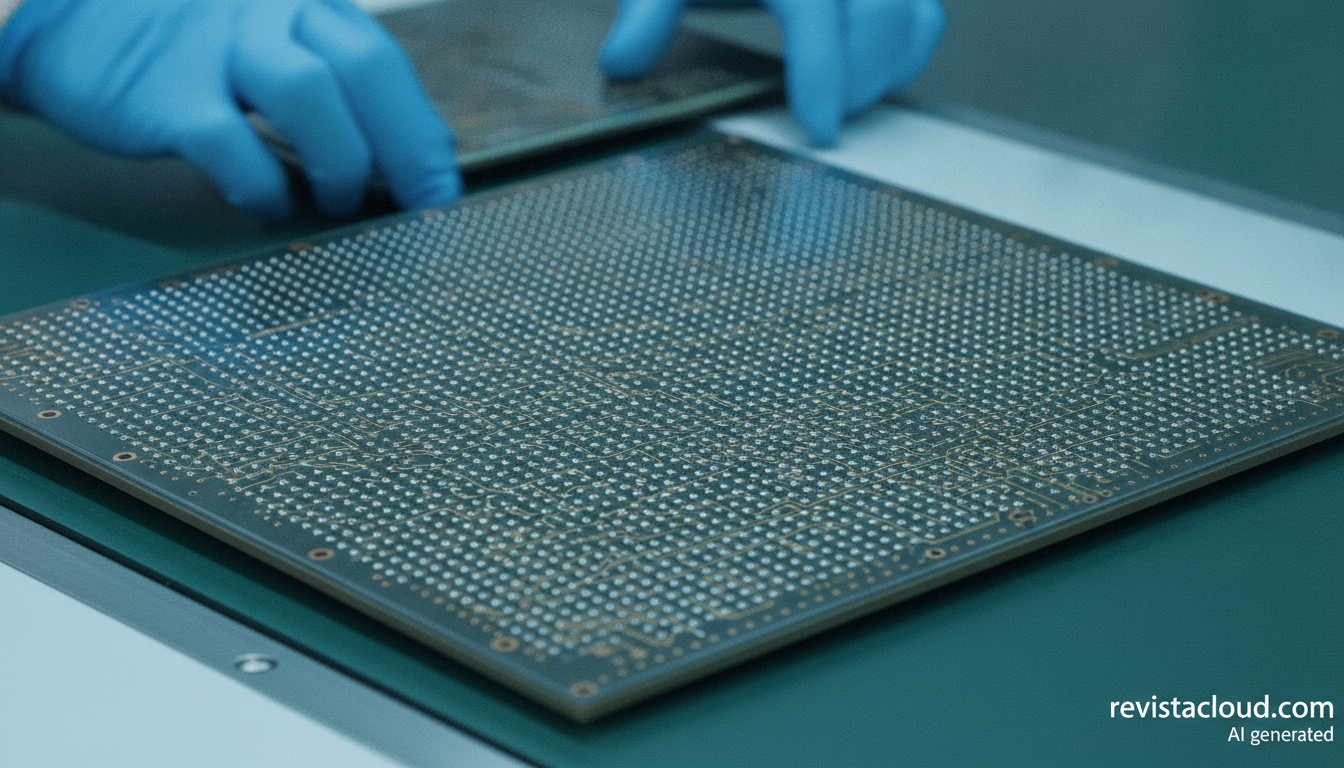
NVIDIA has locked in FC-BGA substrate capacity, the base on which its AI chips are mounted, through agreements with IBIDEN, Samsung Electro-Mechanics and Unimicron that are part of its plan to grow that capacity 2.5x within three years. The moves come in an increasingly tight market, which Digitimes expects to reach $27.3 billion in size by 2030, though other estimates are considerably lower.
NVIDIA’s substrate race in 20 seconds
- NVIDIA wants to grow its AI chip substrate capacity 2.5x in three years.
- IBIDEN will triple its Ono plant with an advance payment from NVIDIA.
- Samsung Electro-Mechanics and Unimicron are also reserving capacity.
- FC-BGA market forecasts range from $12.12 billion to $27.3 billion, depending on the source.
FC-BGA (flip-chip ball grid array) substrates are the multilayer boards that connect the chip to the server motherboard. In AI accelerators they have become a bottleneck: according to BigGo Finance, server substrates have more than four times the surface area of a PC’s and more than 20 layers, and NVIDIA’s upcoming Rubin Ultra substrate will measure 153 × 77.5 mm, almost double that of Blackwell. Few companies in the world know how to manufacture them at volume.
NVIDIA’s agreements with IBIDEN, Samsung and Unimicron
NVIDIA detailed its plans on October 21, 2026, at GTC Berlin, according to its announcement. Japan’s IBIDEN is receiving an advance payment of several billion dollars to reserve capacity at its Ono plant, which will triple its output, with new capacity coming online starting in the first quarter of 2028. Japanese weekly Bunshun put that advance at around ¥280 billion, close to $1.8 billion, though neither company has confirmed it, according to RCRTech.
South Korea’s Samsung Electro-Mechanics is joining NVIDIA’s supply chain with immediate capacity from its current plants plus new factories in Sejong and Busan; by 2028, production reserved for NVIDIA will account for a significant share of its annual substrate capacity. Taiwan’s Unimicron, for its part, will expand its substrate capacity under a reservation agreement that starts contributing volume in the second quarter of 2027 and reaches full capacity by mid-2028. NVIDIA says more agreements are in the works.
Jensen Huang, NVIDIA’s CEO, summed up the situation in the announcement: “Demand is extraordinary” and “capacity is the constraint.” Substrates are only part of the plan, which also includes more advanced packaging capacity with Amkor, testing capacity with KYEC and optical engine capacity with SPIL.
A growing market with widely different forecasts
The size of the market depends on who’s measuring it. Digitimes reports that the FC-BGA substrate market is heading toward $27.3 billion by 2030, while Intel Market Research, cited by BigGo Finance, puts it at $5.95 billion this year and $12.12 billion by 2034. The gap is likely down to what each estimate includes, so both figures are best read as indicative.
What the sources do agree on is the lack of supply. Samsung Electro-Mechanics has been running at full FC-BGA capacity since the second half of 2026, and Goldman Sachs estimates, according to RCRTech, that the ABF substrate shortfall could reach 42% by 2028. Intel already cites substrate and memory shortages among its risks, as Cloud News reported when analyzing its third-quarter results.
Customer advances to finance new plants
The model taking hold echoes what’s happened in memory: major customers pay in advance so substrate makers can expand their lines. IBIDEN’s CEO acknowledged that a substantial part of its ¥500 billion investment over three years is being financed through customer prepayments. For the rest of the market, that could mean much of the new capacity arrives already committed. Further out, analysts expect glass substrates and new packaging techniques to arrive around 2028 or 2029, which could reshuffle the picture again. Cloud News has also reported on how NVIDIA has revised Vera Rubin’s specs for volume production.
Frequently Asked Questions
What is an FC-BGA substrate?
The multilayer board that connects a chip, such as a GPU or CPU, to the motherboard. In AI chips they are increasingly large and difficult to manufacture.
Who has NVIDIA signed with to secure substrates?
IBIDEN, which will triple its Ono plant; Samsung Electro-Mechanics; and Unimicron, through capacity reservations and advance payments.
How much does NVIDIA want to increase its substrate capacity?
NVIDIA plans to grow it 2.5x within three years.
How big is the FC-BGA substrate market?
Forecasts vary: Digitimes puts it at $27.3 billion by 2030, while Intel Market Research puts it at $12.12 billion by 2034.
Sources:
- NVIDIA: NVIDIA and Supply Chain Partners Expand Capacity to Accelerate AI Infrastructure Buildout
- RCRTech: Nvidia commits billions to expand AI supply chain capacity
- BigGo Finance: FC-BGA Shortage Deepens as AI Chips Get Bigger
- Digitimes: Nvidia secures substrate capacity as FCBGA market targets US$27.3 billion by 2030
