
Intel brought in $16.5 billion in revenue in the third quarter of 2026, up 21% from a year earlier, driven by its data center and AI business, which grew 78% to $7.3 billion. The company reported results on October 29, 2026, and CEO Lip-Bu Tan says the immediate priority is securing more manufacturing capacity to meet demand for Xeon processors.
Intel’s Q3 results in 30 seconds
- Revenue of $16.5 billion, up 21% from Q3 2025.
- Data Center and AI brought in $7.3 billion (+78%), the company’s biggest growth in 15 years.
- The PC business fell 5%, and Intel expects weakness to continue at least through mid-2027.
- For Q4, Intel expects $15.0 to $16.0 billion in revenue and a 38% adjusted gross margin.
CFO David Zinsner called it “another solid quarter,” with revenue, gross margin, and earnings per share all beating expectations, including what he described as “the largest data center revenue growth in 15 years.” Tan added that the priority is to “unlock additional supply to meet the extraordinary demand” for the Xeon family. Among the risks, the earnings report cites substrate and memory shortages affecting the entire industry.
Data centers pull ahead while the PC business slows
Intel Products, the division that groups the chips the company sells, brought in $15.4 billion (+22%). Within it, Data Center and AI (DCAI) generated $7.3 billion, compared with $8.1 billion for the client group, now called Client Computing and Physical AI Group, which fell 5%. In other words, the server business is now nearly as large as the PC business, which remains the bigger of the two.
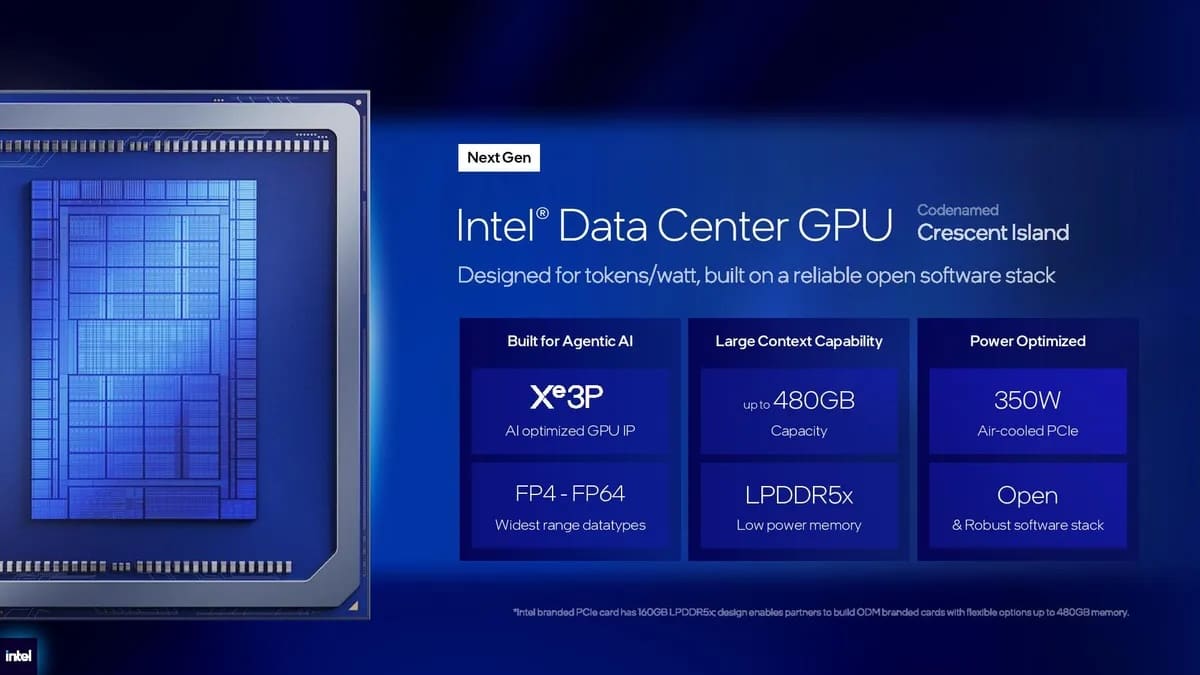
On the product side, Intel highlighted a multi-year agreement with Oracle to expand the use of Xeon in Oracle Cloud Infrastructure, including future instances based on Diamond Rapids, and gave details on its D-series GPU, previously known as Crescent Island. It also mentioned collaborations with SAP on physical AI and with AMD on oneDNN optimizations for PyTorch — a relationship with its rival that goes beyond chips, after Lip-Bu Tan acknowledged talks with AMD’s Lisa Su. Separately, Intel plans to acquire Classiq to build a full-stack quantum computing platform.
Intel Foundry grows, but still loses money
Intel Foundry, the manufacturing business, brought in $6.7 billion (+58%), though a large part of that figure comes from internal sales: intersegment eliminations subtract $6.3 billion from the consolidated total. The division posted an operating loss of $1.853 billion for the quarter.
In October, Intel released version 0.9 of the Intel 14A process design kit (PDK) and announced partnerships with ASML to prepare High-NA EUV lithography, with Lam Research and Applied Materials for new capacity and joint R&D, and with Lens Technology on advanced packaging. It also completed the RAMP-C program within Secure Enclave, the secure manufacturing program for the U.S. government.
Margin, cash, and the outlook for year-end
Gross margin improved to 43.0% on a GAAP basis (44.1% adjusted). Adjusted earnings per share came in at $0.52, up from $0.23 a year earlier, while GAAP EPS fell from $0.90 to $0.60. Operating cash flow was $5.1 billion, and adjusted free cash flow was $1.639 billion. Intel closed a $23 billion capital raise while maintaining its investment-grade rating, and had 81,100 employees at quarter’s end, down from 88,400 a year earlier.
The outlook for the fourth quarter points to revenue of $15.0 to $16.0 billion, below what the company billed in the third, with an adjusted gross margin of 38.0% and adjusted earnings per share of $0.25. Zinsner says the company will keep investing in capacity and working capital to increase supply, and expects the PC slowdown to continue at least through the first half of 2027.
Frequently asked questions
How much revenue did Intel report in the third quarter of 2026?
$16.5 billion, up 21% from the $13.7 billion reported in the same quarter of 2025.
How much did Intel’s data center business grow?
Data Center and AI brought in $7.3 billion, up 78%, the company’s biggest growth in 15 years according to the CFO.
What is Intel’s outlook for the fourth quarter?
Revenue of $15.0 to $16.0 billion, an adjusted gross margin of 38.0%, and adjusted earnings per share of $0.25.
Does Intel Foundry make money?
No. It brought in $6.7 billion, up 58%, but posted an operating loss of $1.853 billion for the quarter.
Sources:
