
Nutanix has been named a Leader in the 2026 Gartner Magic Quadrant for server virtualization platforms, published on September 14, in a market still being reshaped by the changes at VMware. Gartner places Nutanix among the leaders and, according to the company, at the highest point on the Ability to Execute axis. But the same study also includes Proxmox, an open-source alternative that raises a different question: how far does an enterprise really need a large proprietary platform to build enterprise virtualization infrastructure?
Enterprise virtualization in 20 seconds
- Gartner published its Magic Quadrant for server virtualization platforms on 09/14/2026.
- Nutanix appears as a Leader and stands out especially for its Ability to Execute.
- Proxmox also appears among the platforms Gartner evaluated.
- Proxmox VE combines KVM, LXC, high availability, storage, and cluster management under an open-source license.
- The debate no longer revolves solely around VMware: cost, control, support, and architecture carry increasing weight.
Nutanix’s marketing message starts from a real data point, though it’s worth putting it in context. Gartner evaluates this market along two dimensions, Ability to Execute and Completeness of Vision, and its 2026 edition includes Broadcom (VMware), Microsoft, Red Hat, Nutanix, Proxmox, HPE, Canonical, Citrix, Oracle, SUSE, and other vendors. Gartner itself also warns that its Magic Quadrant is not a recommendation to automatically select the vendor placed in a given category.
Nutanix has used the report to position its Nutanix Cloud Infrastructure (NCI) platform as an alternative for organizations that want to combine virtualization, storage, networking, and infrastructure management. Its AHV hypervisor is based on KVM and is part of a broader platform aimed at hybrid environments and workloads spanning virtual machines, containers, and artificial intelligence.
The interesting part is that Proxmox appears in the same market study. And while that doesn’t mean Gartner places both solutions at the same level or that their models are equivalent, it does reflect how much the virtualization market has broadened.
Proxmox isn’t simply a cheap alternative to VMware
Proxmox VE uses KVM and QEMU for full virtualization and LXC for containers. The platform includes cluster management, high availability, live migration, storage, networking, backups, and a web interface. It also allows integration with technologies such as Ceph and ZFS.
Its code is available under the GNU AGPLv3 license. Downloading and using the software doesn’t require a commercial license to unlock the core features, while enterprise subscriptions are tied to support and access to the Enterprise repository.
That introduces a meaningful difference from models based on proprietary licenses. An organization can install Proxmox, build a lab, test clusters, migrations, storage, and high availability, and then carry that knowledge into production without having to change editions to access the platform’s core features.
But savings on licensing shouldn’t be confused with an absence of costs.
An enterprise Proxmox deployment needs servers, storage, redundant networking, backups, monitoring, qualified staff, and support when the internal team can’t handle the full operation on its own. The architecture also determines a large part of the final outcome.
David Carrero Fernández-Baillo, co-founder of Stackscale (Grupo Aire), has raised precisely this point when analyzing Proxmox from the standpoint of a real infrastructure. In an analysis published by Stackscale, he argues that Proxmox shouldn’t be treated simply as a cheap alternative to VMware, but as an architecture decision. The focus, he explains, also needs to be on the network, storage, quorum, high availability, backups, and sizing.
That observation is especially relevant when talking about replacing platforms that have been in use for years. Installing Proxmox on three servers doesn’t automatically turn that infrastructure into an enterprise environment ready for any workload.
High availability can restart a virtual machine on another node when a failure occurs, but it doesn’t replace the redundancy of a database, a load balancer, or an application designed to tolerate failures. Likewise, a snapshot isn’t an independent backup, and a Ceph system needs the right network, disk, and node architecture.
Switching platforms, then, requires looking at more than just the hypervisor’s bill.
Nutanix and Proxmox answer different needs
A direct comparison between Nutanix and Proxmox is tempting, but it can lead to overly simple conclusions.
Nutanix builds an integrated enterprise proposal around NCI and AHV. Its platform combines virtualization with storage, networking, and management tools, and aims to offer a unified experience for administering different types of workloads. Gartner recognizes Nutanix as a Leader in its 2026 edition, and the company highlights its position in Ability to Execute.
Proxmox starts from a different philosophy. The project integrates open, well-known technologies from the Linux ecosystem and offers a common management layer. That makes it possible to build anything from relatively small installations to clusters with high availability and distributed storage.
The difference isn’t only whether one platform is proprietary and the other open. It’s also about who takes on the responsibility of integrating and operating each piece.
With an integrated platform like Nutanix, many of those decisions are baked into the product and its support services. With Proxmox, there’s more freedom to choose hardware and storage, but the design and the technical team’s know-how also become more important.
| Aspect | Nutanix | Proxmox VE |
|---|---|---|
| Model | Integrated enterprise platform | Open-source software |
| Virtualization | AHV based on KVM | KVM/QEMU |
| Containers | Integrated into the Nutanix platform | LXC |
| Clustering and high availability | Yes | Yes |
| Storage | Integrated, with support for external storage | ZFS, Ceph, NFS, iSCSI, and other options |
| Management | Centralized Nutanix platform | Web interface, CLI, and API |
| Open source | Open components and technologies, commercial platform | GNU AGPLv3 |
| Support | Commercial support from Nutanix | Community and commercial subscriptions |
| Focus | Integrated, hybrid enterprise infrastructure | Flexibility and control over the infrastructure |
The data in the table comes from the features published by both vendors and doesn’t imply a judgment about which one is better for any specific organization.
The VMware market has opened the door to more alternatives
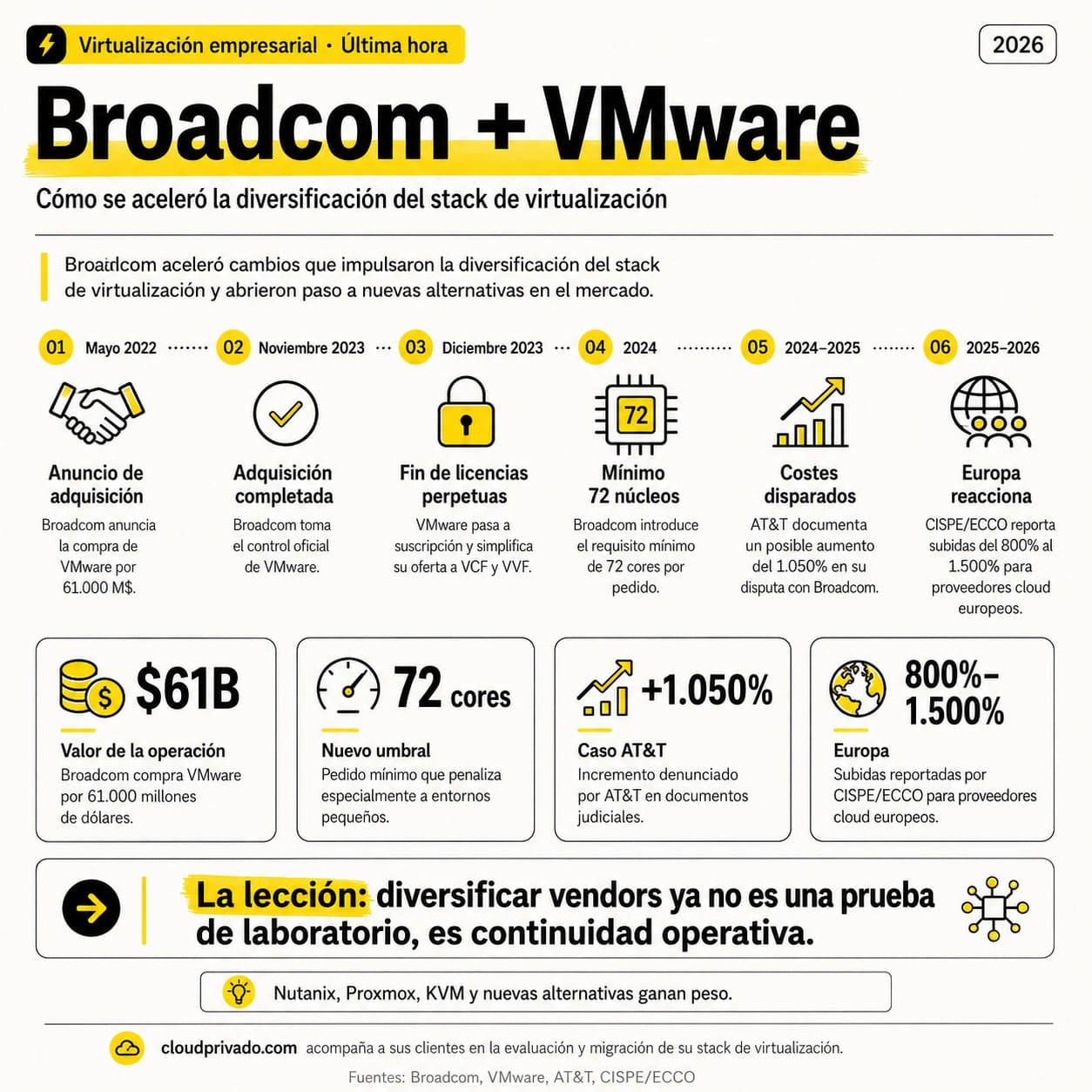
Broadcom’s moves around VMware have forced many companies to review their virtualization strategies. Gartner describes the current market as one of the most disruptive periods of the past decade and notes that infrastructure leaders need to reassess their options for current and future virtualized workloads.
That scenario helps explain the interest in Nutanix, but also in Proxmox, XCP-ng, Hyper-V, OpenShift Virtualization, and other alternatives.
Proxmox, meanwhile, is expanding its presence into scenarios that go beyond the lab. The company itself presents Proxmox VE as an open-source enterprise virtualization platform and documents clustering, high availability, live migration, distributed storage, and recovery features.
There are also published cases of migrations from VMware to Proxmox. Proxmox documents, for example, the case of HorizonIQ, which moved more than 300 virtual machines to a 19-node cluster with Ceph storage. This is a case presented by the vendor itself and should therefore be read as a specific commercial reference, not as general proof that every migration produces the same result.
The choice between platforms should start from the existing infrastructure and the technical needs at hand. A company with a large investment in VMware tooling may weigh a migration very differently from an organization that’s building its first private cloud from scratch. Likewise, a company deeply tied to Windows Server may apply different criteria than one that works mainly with Linux.
In that context, the most interesting data point in Gartner’s new report may not simply be that Nutanix shows up as a Leader. It also matters that Proxmox is now among the vendors Gartner analyzes in an enterprise virtualization market that, until a few years ago, was far more concentrated.
That doesn’t make Proxmox the winner of any ranking, nor does it mean it will replace Nutanix or VMware in every environment. It does show that the conversation around virtualization is changing.
For some companies, Nutanix may make sense because of its level of integration and its enterprise support model. For others, Proxmox may be appealing for its open-source nature, flexibility, and ability to build a platform without being tied to a single software vendor.
The question is no longer just which hypervisor has more features. It’s also about how much control an organization wants to keep, how much in-house technical knowledge it has, what infrastructure it needs around the hypervisor, and what dependency it’s willing to accept long term.
FAQ
What does Gartner say about Nutanix in 2026?
Gartner has placed Nutanix as a Leader in its 2026 Magic Quadrant for server virtualization platforms. Nutanix also notes it was positioned at the highest point on the Ability to Execute axis.
Does Proxmox appear in Gartner’s Magic Quadrant?
Yes. Proxmox is among the platforms Gartner included in its 2026 study on server virtualization.
Can Proxmox replace VMware?
Proxmox can be used as an alternative to VMware in certain scenarios and offers features such as clustering, high availability, and live migration. Whether a migration makes sense depends on workloads, storage, networking, integrations, the team’s expertise, and support requirements.
Is Proxmox really open-source software?
Yes. Proxmox VE is distributed under the GNU AGPLv3 license and offers commercial subscriptions focused mainly on support and access to the Enterprise repository.
