
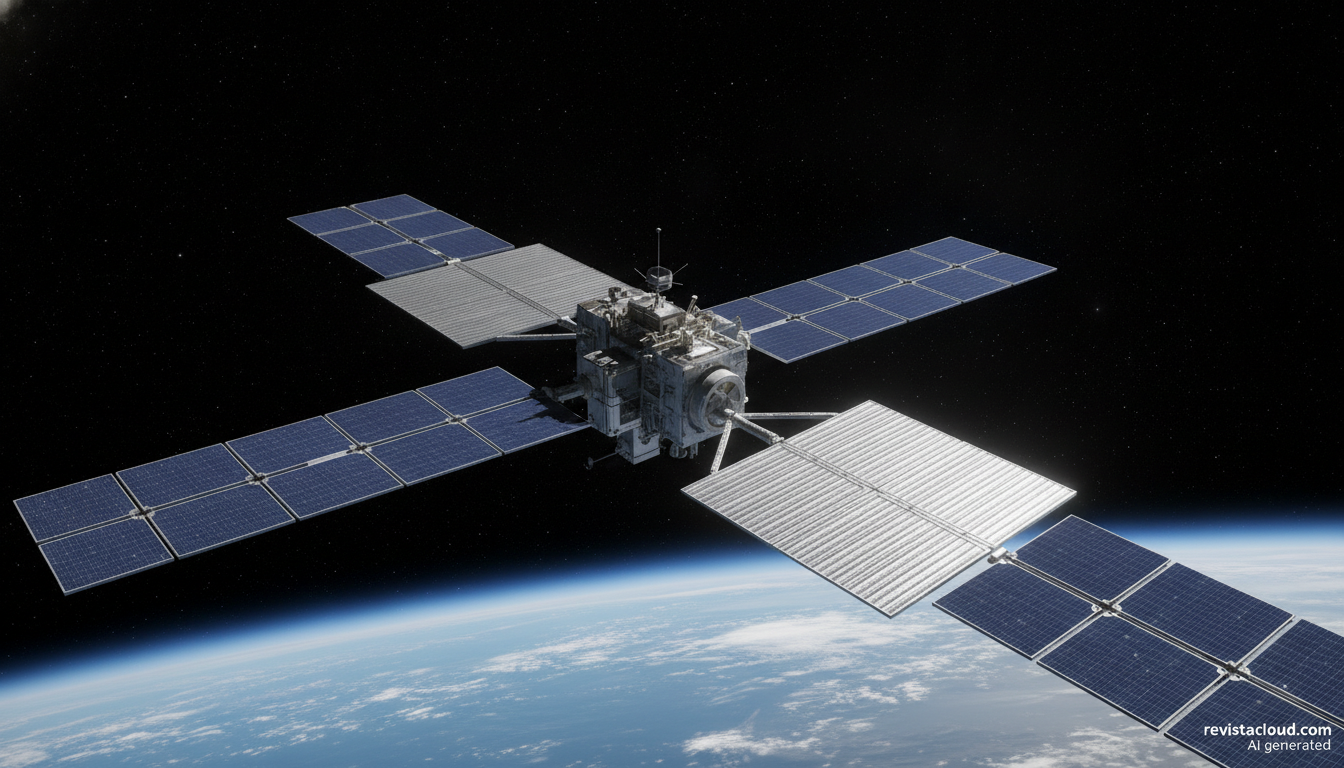
Elon Musk has come out in defense of the data-center satellites SpaceX wants to put into orbit, explaining on X how he plans to cool them: with aluminum radiators pointed away from the Sun, capable, he says, of dissipating about 1,300 watts per square meter. He was responding to a user who argued that a vacuum is a powerful thermal insulator and that, since heat can only be shed through radiation, AI compute satellites had little chance of becoming reality. SpaceX has talked about launching up to a million of these satellites.
The key points on cooling SpaceX’s AI satellites in 30 seconds
- The criticism: in space, heat can only be shed through radiation, which makes cooling data centers in orbit difficult.
- Musk’s response: an aluminum radiator pointed away from the Sun can dissipate about 1,300 W/m².
- The ratio: with solar panels generating about 250 W/m², the satellite would need roughly five times more panel area than radiator area.
- The context: Sam Altman considers space data centers “ridiculous” given the current landscape.
Musk’s two posts, picked up by Wccftech, were brief. In the first, he wrote: “~1300 W/m^2 is easily achievable for an aluminum radiator pointed away from the Sun, as it is mostly just seeing cosmic background radiation at ~3 degrees above absolute zero!” In the second, he added: “Solar panels generate ~250 W/m^2, so you should expect them to have ~5 times the area of the radiator. Most of the mass of the satellite is solar panels.”
What the Physics of the Radiator Says
In a vacuum there’s no air to carry heat away by convection, so everything the chips generate has to leave as infrared radiation. The amount is set by the Stefan-Boltzmann law: it grows with the surface’s emissivity, with its area, and above all with the fourth power of its temperature. That’s why Musk emphasizes two things. The first is orientation: the radiator has to face deep space, not the Sun, which would heat it up. The second is that the hotter an object is, the faster it cools by radiation. Coated aluminum radiators also have a higher infrared emissivity than solar panels.
The 1,300 W/m² figure comes with fine print Musk doesn’t spell out. Applying the same law with a typical emissivity of 0.9, dissipating 1,300 W per square meter from a single face requires the radiator to be at around 125°C; if it radiates from both faces, about 650 W/m² per face, the required temperature drops to around 60°C. Both are manageable radiator temperatures, but they require carefully designing the loop that carries heat from the chips to the radiator. In addition, in low orbit the radiator doesn’t see only the cosmic background at 3 degrees above absolute zero: it also receives the infrared radiation the Earth emits and the sunlight it reflects, which narrows the margin depending on orbit and orientation.
The surface-area ratio Musk gives is consistent with his own numbers. If the panels generate about 250 W/m² and nearly all of that electricity ends up as heat in the chips, each square meter of radiator at 1,300 W/m² offsets a bit more than five square meters of panels. Hence his conclusion that solar panels, not the cooling system, dominate the satellite’s weight.
A Project With Heavyweight Skeptics
The debate isn’t purely technical. Sam Altman, CEO of OpenAI, said in February in an interview with Indian Express that “the idea with the current landscape of putting data centers in space is ridiculous,” though he admitted there will come a point when it makes sense: “Orbital data centers are not something that’s going to matter at scale this decade.” That view lines up with what SpaceX itself has signaled: large-scale AI in space won’t arrive until the 2030s.
Cooling is just one piece of the puzzle. An orbital data center also has to deal with radiation that damages electronics, the impossibility of replacing failed components, the latency and bandwidth of communications with the ground, and the cost of launching every kilogram. Musk didn’t address those points in his response.
Behind this is the business SpaceX wants to justify. According to Wccftech, in its regulatory filings the company puts its total addressable market at $28 trillion, with data-center satellites as a key part of it, and Musk believes that estimate is actually too low. These are the company’s own projections, not revenue, and the plan for a million satellites remains just that: a plan.
Frequently Asked Questions
How is a data-center satellite cooled?
Through infrared radiation, using radiators pointed toward deep space and away from the Sun, since there’s no air in a vacuum for convection.
What figure did Elon Musk give?
That an aluminum radiator pointed away from the Sun can dissipate about 1,300 W per square meter, and that solar panels, generating about 250 W/m², would need roughly five times more surface area.
What does Sam Altman think about space data centers?
That given the current landscape the idea is ridiculous, though he believes they will eventually make sense — just not at scale this decade.
Source: Wccftech, based on posts by Elon Musk on X
This article is also available in Spanish: «Musk defiende sus satélites de IA: 1.300 W/m² de radiación para enfriarlos», on revistacloud.com.
