
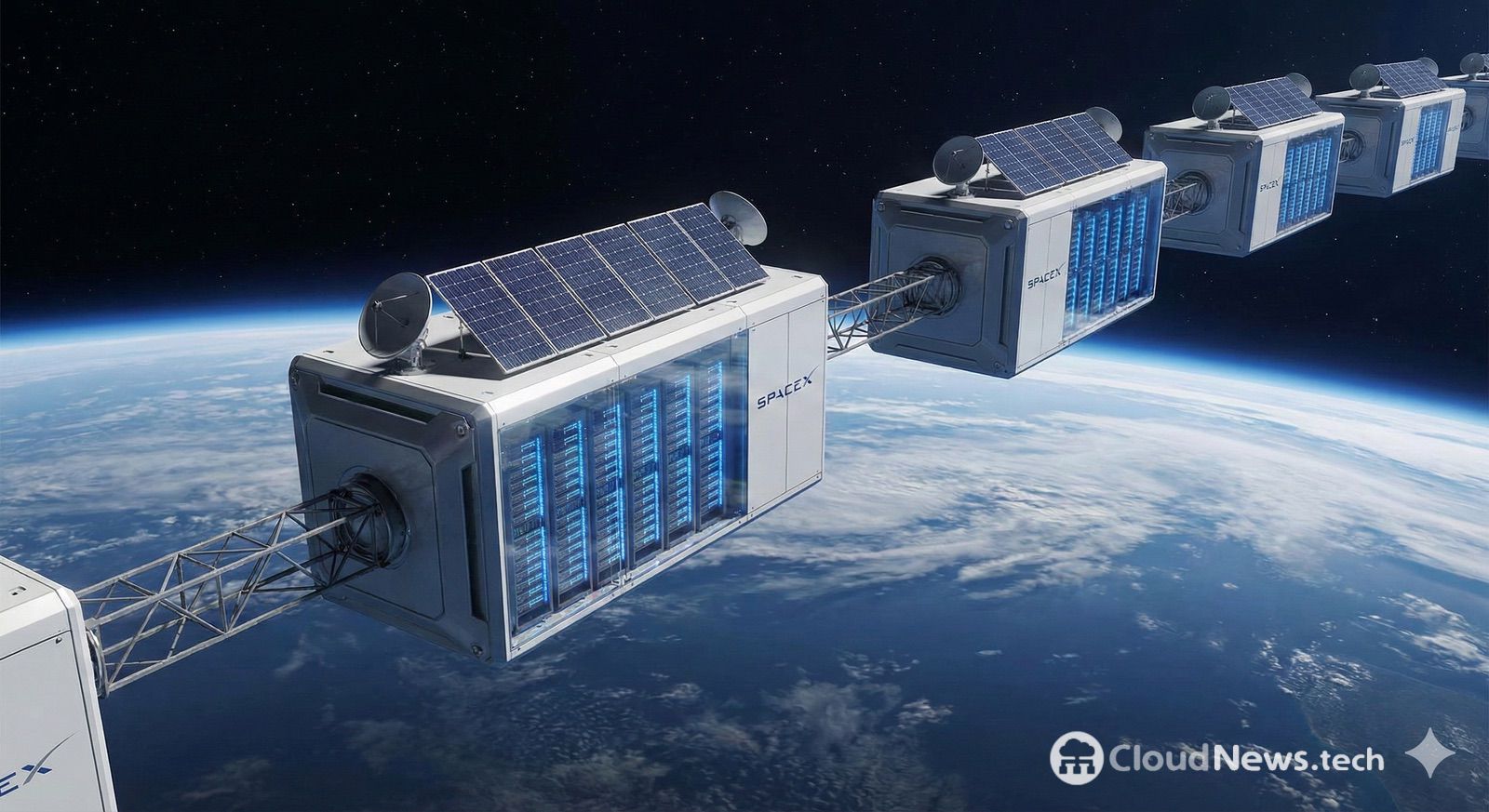
SpaceX is turning artificial intelligence into one of the biggest bets in its business, with a strategy that spans ground-based data centers and a future constellation of satellites capable of running AI workloads in orbit. The company estimates a $26.5 trillion addressable market for AI, though its own filings describe orbital data centers as a technology that’s still in development, with its growth depending on Starship, launch costs, and several technical challenges.
SpaceX’s AI-in-space bet in 20 seconds
- SpaceX puts the potential market at $26.5 trillion for AI and $2.4 trillion for its infrastructure.
- The company expects to start deploying orbital computing satellites as early as 2028.
- Starship is key to cutting the cost of putting large amounts of hardware into orbit.
- The challenge isn’t just launching the servers: they also need cooling, radiation shielding, and hardware replacement.
- Companies like Starcloud are already testing GPUs in orbit, but the economics of large-scale infrastructure remain unproven.
SpaceX’s pitch starts from a very down-to-earth problem. AI data centers need ever more electricity, network capacity, and available land. Building new facilities means securing power supply, permits, grid connections, and specialized equipment. The company argues that moving part of that capacity to space would sidestep some of those constraints and let it deploy new compute modules more flexibly.
But there’s a considerable gap between a constellation of satellites carrying AI processors and an orbital data center able to compete economically with a ground-based facility.
SpaceX puts the AI market at $26.5 trillion
The public offering document SpaceX filed in Europe puts artificial intelligence at the center of its growth projections. The company calculates a total addressable market of $28.5 trillion, of which $26.5 trillion would correspond to different AI segments. That estimate dwarfs the one a recent analysis from Bain & Company put on the table, which pegged the AI market businesses would need to justify current spending at roughly $6 trillion a year by 2031, with Bain seeing only about $1.8 trillion materializing.
Within that figure, SpaceX estimates $2.4 trillion for AI infrastructure, plus $760 billion for consumer subscriptions, $600 billion for digital advertising, and $22.7 trillion for enterprise applications. These are SpaceX’s own market estimates, not projected revenue or an independent valuation of its business.
The company defines AI compute as its next trillion-dollar-scale market and plans to use its rockets and satellite infrastructure to deploy computing capacity in orbit. In the same filing, it says it’s already working on satellites specifically designed to run AI compute and expects to begin deploying them as early as 2028.
That timeline doesn’t mean an orbital network equivalent to today’s giant data center campuses will exist by 2028. It’s the expected start of deployment. Reaching large-scale infrastructure would require many launches, mass production of satellites, and rocket technology with a sufficiently high launch cadence.
In fact, SpaceX acknowledges in its filing that deployment depends on Starship and its computing satellites reaching certain scale milestones. The company calculates that, once deployed, orbital infrastructure could reduce some of the construction costs tied to ground-based data centers, since it wouldn’t need conventional buildings, grid connections, or certain mechanical installations.
Space removes the water problem, but not the heat
One of the most repeated ideas around space-based data centers is that vacuum and abundant solar power would solve part of the problems that plague ground-based ones. The technical reality is more complicated.
In a conventional data center, servers turn almost all the electricity they consume into heat. On Earth, that heat can be carried away with air, water, heat exchangers, and other equipment. In space, there’s no air around the satellite that could carry that heat away through convection.
The alternative is to use radiators that emit thermal energy into space. SpaceX explains in its filing that it’s studying radiative cooling architectures and plans to apply technologies such as radiators, vapor chambers, active loops, and coatings to dissipate the heat generated by its processors.
This same problem shows up in other companies’ projects. Starcloud has already sent an NVIDIA H100 to space and is developing higher-power systems. Its next platform, Starcloud-3, is designed as a roughly 200 kW, three-ton platform meant to launch on Starship.
The difference in scale matters. An experimental satellite with a single GPU proves that computing in orbit is possible. An orbital data center needs to multiply that capacity many times over, manage heat, maintain communications, withstand radiation, and accept that components can’t be repaired as easily as at a ground-based facility.
Starship will be a decisive piece
Launch cost is another major obstacle. Getting servers, electrical systems, radiators, and support structures into space is still far more expensive than trucking them to a plot of land on Earth.
Starcloud calculates that the economics of its orbital data centers could change if launch costs reach roughly $500 per kilogram. The company expects Starship to be one of the vehicles that gets it closer to that cost level, and it has designed Starcloud-3 specifically around the new SpaceX rocket’s payload capacity — a bet on the same vehicle SpaceX itself is racing to scale up for its Colossus AI cluster on the ground.
The problem is that Starship is still in development. SpaceX is also transitioning from Falcon 9 to the new vehicle while launch demand keeps growing. TechCrunch reported in August that Starcloud is trying to lock in launch capacity, anticipating that access to space will remain a limited resource for the next few years.
That’s why some forecasts place the real economics of space-based data centers further out. An analysis cited by Semafor estimated they could approach cost parity with ground-based facilities sometime in the 2030s, while other analyses suggest the break-even point could come even later, depending on how launches evolve.
SpaceX itself is more ambitious about the initial timeline and talks about starting deployments in 2028. The two dates aren’t necessarily contradictory: 2028 may mark the start of the first computing satellites, while the 2030s may be the horizon for orbital infrastructure with enough economic scale.
Hardware refresh cycles are also still an open question. GPUs and other AI accelerators evolve on much faster cycles than most satellites. SpaceX is considering modular designs and argues that an orbital architecture could make it easier to swap in new hardware generations, but it also acknowledges it doesn’t expect to repair failed processors directly in space.
Connectivity between satellites will be another essential piece. SpaceX already had more than 23,000 laser links between satellites as of March 31, 2026, according to its own prospectus, and plans to use that network as the backbone for connecting future orbital computing platforms.
The scenario SpaceX is laying out, then, isn’t simply about placing GPUs around Earth. It’s an architecture that combines reusable rockets, satellite manufacturing, solar power, radiative cooling, laser links, and compute capacity. The proposal brings together several technological pieces that already exist separately, but it still has to prove they can work together at the scale and cost required.
In the meantime, SpaceX’s immediate AI business remains firmly on the ground. The company already operates large compute facilities and is expanding that capacity to serve its models and services. Orbital compute shows up as a later bet, one for when energy costs, land availability, and grid connections start to limit ground-based expansion more severely.
Frequently asked questions
When does SpaceX want to start deploying data centers in space?
SpaceX says in its filing that it expects to start deploying orbital computing satellites as early as 2028. That doesn’t mean a fully deployed, large-scale commercial network will exist that year.
How big is the AI market SpaceX is projecting?
SpaceX estimates a $26.5 trillion addressable market for artificial intelligence, within a total quantifiable market of $28.5 trillion that also includes connectivity and space services. These are the company’s own market estimates.
What’s the main challenge for data centers in space?
Launch cost, cooling, radiation, maintenance, and hardware replacement are among the main challenges. The economics depend heavily on reusable rockets bringing down the cost per kilogram sent to orbit.
Are there already GPUs running in space?
Yes. Starcloud has put a satellite with an NVIDIA H100 into orbit and is developing higher-power platforms. These projects demonstrate orbital computing is possible, but they’re still far from the scale of a large ground-based data center.
