
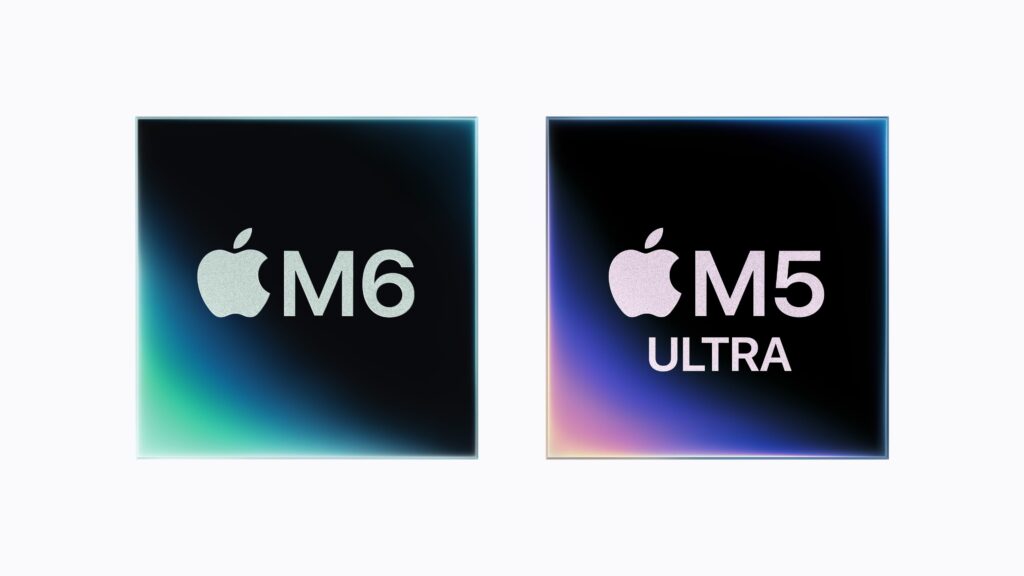
A supposed benchmark result for the still-unannounced Apple M6 Pro showed up on Geekbench 7 with numbers that would put it above the M5 Max, but the listing has been seriously called into question. John Poole, Geekbench’s creator, told MacRumors he’d found “internal inconsistencies” that lead him to believe the result is probably not legitimate.
The supposed M6 Pro in 20 seconds
- A Geekbench 7 listing attributed exceptionally high scores to the M6 Pro.
- John Poole found internal inconsistencies and believes the result is probably fake.
- The supposed chip would beat the 18-core M5 Max in the published tests.
- Bloomberg had already reported that Apple might skip the M6 Pro and M6 Max entirely.
- Geekbench results shouldn’t be treated as a reference for the M6 Pro’s real performance.
The listing quickly drew attention because it pointed to a performance jump far bigger than you’d expect from a conventional Apple Silicon update. The supposed M6 Pro showed up with a single-core score close to 5,000 points and a multi-core result that would beat the M5 Max.
The problem is that Geekbench’s own creator has cast doubt on the data’s authenticity. As John Poole explained to MacRumors, he found internal inconsistencies in the result that point to the listing not coming from a legitimate test.
The warning carries particular weight because Geekbench is exactly the platform the supposed result came from. This isn’t just an outside reading of the numbers — someone responsible for the software itself has questioned the listing.
Numbers too good to treat as a reference
The supposed M6 Pro drew attention for its CPU scores. According to the leaked listing, the processor achieved single-core results close to 5,000 points and multi-core performance that would clearly beat the 18-core M5 Max.
On paper, those numbers would make the chip a considerable leap over the previous generation. But that performance can’t be treated as confirmed while the listing remains in question.
The Apple Silicon context also makes the supposed result harder to read. Apple has recently released the M6, and Geekbench already has real results for that chip. In the available listings, the M6 reaches around 4,600 points on Geekbench 6 in certain runs, while its first Geekbench 7 results, published before launch, pointed to 4,071 points single-core and 22,783 multi-core.
That helps put the supposed M6 Pro in perspective, but it doesn’t validate its numbers. A single, isolated result should never be read as an official spec for a processor Apple hasn’t announced yet.
It’s also worth separating two different questions. The fact that the numbers are technically plausible doesn’t prove the listing is genuine. And the fact that Apple could build a chip with certain characteristics doesn’t mean it will actually sell one under that name.
Apple’s roadmap adds to the doubts
There’s another factor that lowers the credibility of this supposed benchmark. Bloomberg has reported that Apple is planning to skip the M6 Pro and M6 Max variants and move straight to the M7 Pro and M7 Max. MacRumors also cites this reporting when covering the questioned result — though other supply-chain information suggests Apple may still be working on M6 Pro and M6 Max variants with a more modular design.
That doesn’t by itself confirm the Geekbench listing is fake. An internal prototype could exist even if it never reaches the market, and a name shown by a benchmarking tool doesn’t prove Apple will use it commercially either.
But it does mean the supposed result needs even more caution. There’s no Apple announcement confirming the M6 Pro’s commercial existence, and on top of that, Geekbench’s creator has flagged problems with the listing.
The case is a reminder of a common limitation of benchmark databases: a result being published doesn’t automatically mean it represents a real product. Listings can contain errors, unusual configurations, or, in some cases, manipulated data.
The M5 Max remains the real reference point
The M5 Max is an actual shipping product with Geekbench results that provide a real reference. In data compiled by MacRumors, the M5 Max averages around 3,731 points single-core on Geekbench 7, while the M6 now shipping in new machines has posted higher results on that same test.
That’s why the comparison with the supposed M6 Pro is eye-catching, but it doesn’t let anyone establish a real evolution of Apple Silicon. Doing that would require verified results from identifiable hardware and, ideally, several independent runs.
Geekbench’s own database shows variation between different machines and runs. A single entry isn’t enough to establish how a processor behaves, especially when there are doubts about the listing’s integrity.
For now, the situation is much simpler than the numbers that have circulated would suggest: there’s no reliable M6 Pro benchmark that shows that chip beating the M5 Max.
The listing exists and has generated headlines, but John Poole has flagged inconsistencies that call its authenticity into question. Absent a verified test or official information from Apple, single-core numbers near 5,000 points should be treated as unconfirmed.
Attention is also turning to Apple’s strategy for its next processor generations. If reports about skipping straight from the M6 to the M7 Pro and M7 Max end up holding true, the supposed M6 Pro might not represent a product that ever reaches the market.
What can be verified for now is that Apple is moving ahead with the M6 and that benchmark results for that chip are already published on Geekbench. The supposed M6 Pro, by contrast, still belongs to the realm of questioned listings and rumors.
FAQ
Does the Apple M6 Pro officially exist?
Apple hasn’t officially announced the M6 Pro. Bloomberg has also reported that the company might skip the M6 Pro and M6 Max variants and move to the M7 Pro and M7 Max instead.
Are the M6 Pro’s Geekbench 7 results real?
The listing has been called into question. John Poole, Geekbench’s creator, told MacRumors he’d found internal inconsistencies that lead him to believe the result is probably not legitimate.
Is the supposed M6 Pro faster than the M5 Max?
That can’t be concluded from this listing. The published numbers would put it above the M5 Max, but the benchmark is in question and isn’t a reliable measurement of the M6 Pro’s performance.
Which M6 results are actually available?
Geekbench already has results for the Apple M6. MacRumors reported a Geekbench 7 test with 4,071 points single-core and 22,783 multi-core, though a single result also doesn’t represent the performance of every configuration on its own.
