
Kingston Technology has once again closed out the year as the world’s largest independent maker of DRAM memory modules, with an estimated 62% share of 2025 revenue, according to rankings from consultancy TrendForce. The US company announced the figure on September 28, 2026, just days after TrendForce itself published its annual report on a market that generated roughly $21.2 billion, up 59% from the prior year.
The 2025 DRAM module market’s key facts in 20 seconds
- Kingston keeps the top spot with 62% share, according to TrendForce.
- The market brought in $21.2 billion in revenue, up 59% from 2024.
- Kingston grew 48%, below the overall market, and its share slipped from 66%.
- ADATA, Ramaxel, and Innodisk grew much faster.
The ranking measures module makers, meaning the companies that buy memory chips from Samsung, SK hynix, Micron, and other producers and mount them onto the cards that end up in PCs, servers, and industrial equipment. In that segment, Kingston has held a huge lead for years: its 62% amounts to nearly two-thirds of the market, and the top five together account for 77% of revenue.
The headline Kingston highlights is that it keeps the top spot. What its announcement doesn’t mention is that its slice of the pie has shrunk. In its equivalent announcement last year, the company attributed to TrendForce a 66% share in 2024, on a $13.3 billion market. It has now grown 48%, eleven points below the market, which translates into four points of lost share.
Rivals are growing faster
The gap with the rest of the field remains enormous. According to the TrendForce table Kingston itself circulates, Taiwan’s ADATA holds second place with 6%, followed by China’s Ramaxel (4%), Kimtigo (3%), and Team Group (2%). Rounding out the list are Patriot (2%), Innodisk (1%), Apacer (1%), and AGI (0.2%). The remaining makers split the other 19%.
But growth rates tell a different story. TrendForce puts Ramaxel’s revenue growth at 153%, Innodisk’s at 132%, Apacer’s at 96%, Patriot’s at 89%, and ADATA’s at 82%. Only Kimtigo (20%) and AGI (26%) grew more slowly than Kingston among the top nine.
Some analysts attribute this more to smart inventory buying than to sales prowess. In Ramaxel’s case, the growth rests on server RDIMM module deals with Chinese DRAM and cloud-service providers, while Innodisk has leaned on the industrial and edge AI markets.
Cloud AI made memory more expensive for everyone
The revenue jump isn’t explained by selling more modules alone. TrendForce attributes it mainly to price increases and shipments bunching up in the second half of the year. In 2024, the same market had grown just 7%.
The year had two phases. In early 2025, module makers stockpiled DDR4 memory on fears of tariffs and chipmakers’ plans to stop producing it. Afterward, demand from US and Chinese cloud service providers for AI servers, including those running agents, sent DRAM consumption for servers soaring. That squeezed the memory available for PCs and consumer electronics and pushed prices up.
It’s the same pressure CloudNews has tracked throughout 2026, with AI data centers pulling on memory and pushing DRAM and NAND prices higher. For a module maker, a market like that rewards whoever has memory in stock when prices rise.
Kingston argues that’s exactly what it did. According to its release, its supply investments let it manage inventory throughout the year and meet channel demand as DRAM costs climbed in the second half. “Our ability to anticipate market transitions, manage inventory effectively, and deliver reliable memory solutions allowed us to support partners and customers throughout the year,” said Kristy Ernt, Kingston’s DRAM business lead.
Servers, industry, and DDR5
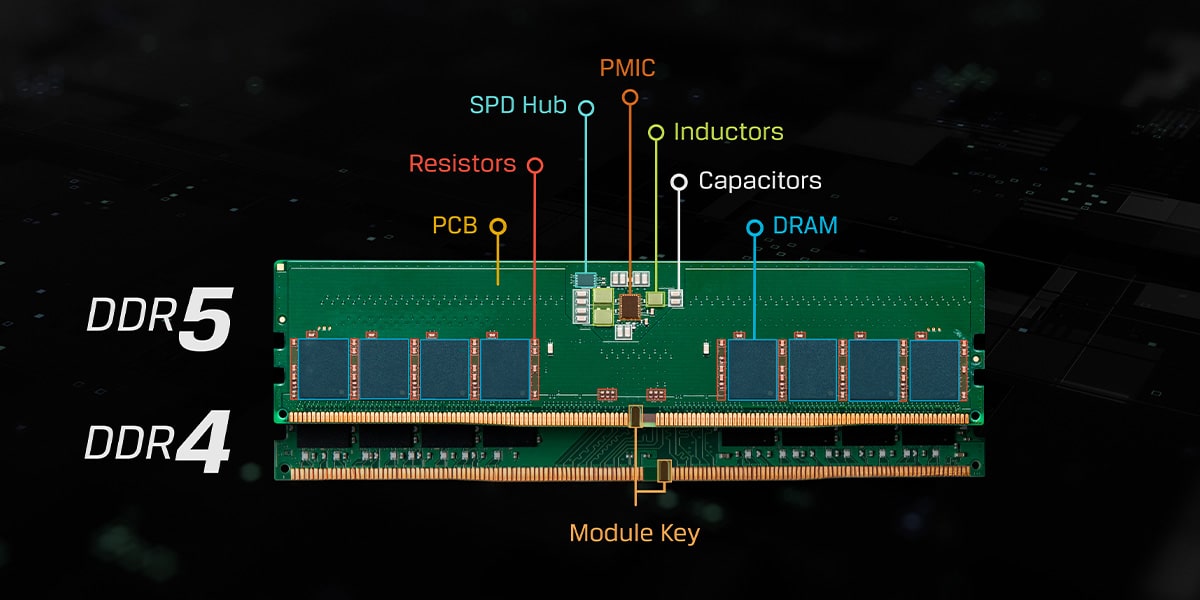
TrendForce also notes a shift in the sector’s focus. Module makers concentrated more in 2025 on industrial and enterprise-server markets and sped up the transition of their catalogs to DDR5. The consultancy does not offer a firm forecast for 2026 in its report.
Kingston says it keeps expanding its lineup for consumer, enterprise, industrial, and data-center use. The release, however, does not provide its own revenue figures or break down how much of its growth came from servers versus PCs. Based on TrendForce’s data, its module sales would be around $13 billion, an estimate derived from applying its share to the total market size, not a figure the company has published.
Frequently asked questions
What market share does Kingston hold in DRAM modules?
According to TrendForce, 62% of global DRAM module market revenue in 2025, down from the 66% the company attributed to 2024.
How much did the DRAM module market make in 2025?
About $21.2 billion, up 59% from 2024, driven mainly by rising memory prices.
Who is the second-largest DRAM module maker?
ADATA, with 6% share and 82% revenue growth in 2025, according to TrendForce.
Why did DRAM prices rise so much in 2025?
Demand from cloud providers for AI servers absorbed much of production and left less memory for PCs and consumer devices, compounded by early-year DDR4 stockpiling.
Sources:
