
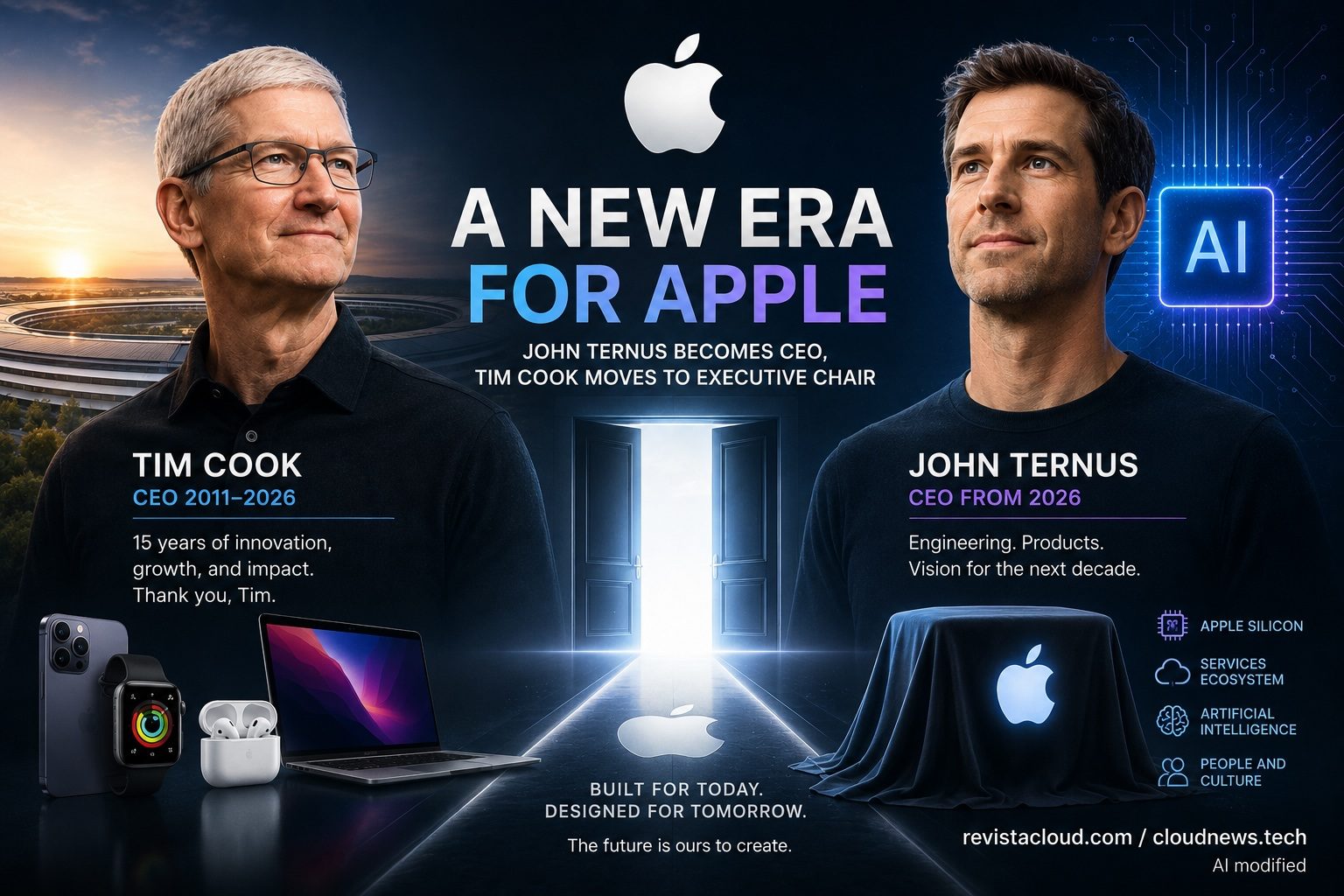
Apple is entering a new era on September 1, 2026. John Ternus has officially taken over as chief executive, succeeding Tim Cook, who is stepping down from the company’s day-to-day leadership after 15 years. The handover, announced months in advance, keeps Cook inside Apple as executive chairman of the board and puts one of the people behind the company’s recent hardware progress in charge of the business.
Tim Cook’s handover in 30 seconds
- John Ternus takes over as Apple’s CEO on September 1, 2026.
- Tim Cook steps down from day-to-day management after 15 years, though he remains executive chairman of the board.
- Ternus has worked at Apple since 2001 and previously led Hardware Engineering.
- The change comes as artificial intelligence stands out as one of the company’s biggest technology challenges.
- His first major product event as CEO comes just days after the handover.
Apple had announced back in April that Ternus would succeed Cook, so the change isn’t the result of a sudden departure. The transition also preserves a kind of continuity that’s unusual in major corporate handovers: the former CEO stays inside the structure while his successor takes operational control.
The profile chosen also says a lot about the Apple that Ternus inherits. In recent years, the company has come to control an increasing share of its own technology, from the processors used in the Mac, iPhone, and iPad to the operating system, services, and much of its development tooling.
The new CEO comes precisely from the division responsible for turning those technologies into products.
From Hardware Engineering to Apple’s Top Job
John Ternus joined Apple in 2001 and has spent virtually his entire career at the company. Before becoming CEO, he held the position of senior vice president of Hardware Engineering, a role he took on in 2021.
His team has been involved in developing products such as the iPhone, iPad, Mac, AirPods, and other company devices.
Ternus also played a prominent role in one of Apple’s biggest recent technical transformations: the migration of the Mac from Intel processors to Apple Silicon.
The shift began commercially in 2020 with the M1, but its importance goes far beyond simply swapping one processor for another.
Apple took direct control of the design of the main chips used in its computers and was able to coordinate the CPU, GPU, memory, operating system, and applications more precisely. In doing so, the company brought to the Mac the same hardware-software integration philosophy it had already been using for years in the iPhone and iPad.
Ternus therefore arrives at the CEO role from one of the areas where Apple has achieved some of its most important technical advances of the past decade.
That doesn’t mean his appointment automatically points to a more hardware-focused Apple. A CEO also has to manage services, software, regulation, the supply chain, developer relations, and international operations under growing trade tensions.
But his background contrasts with Tim Cook’s trajectory: before succeeding Steve Jobs, Cook had built much of his reputation inside Apple around operations and the supply chain.
The handover therefore also changes the professional profile of the person in charge.
Artificial Intelligence Will Be One of Ternus’s First Tests
The new CEO inherits an Apple that is considerably different from the one Cook found in 2011.
The company now has its own family of processors, a much larger services division, and categories that didn’t exist back then, such as Apple Watch, AirPods, or Vision Pro. At the same time, it’s facing a technological shift whose center of gravity is generative AI.
Apple has added various AI features to its systems and devices, but the evolution of Siri and the rollout of its generative capabilities have put the company under pressure to keep up with the pace set by other tech players.
That will be one of the issues Ternus inherits directly.
The question isn’t just about bolting a chatbot onto the iPhone. Apple will have to decide which models it runs locally, which tasks it sends to cloud infrastructure, how it uses its own chips for AI workloads, and how far it will rely on outside technology.
Here, control over the hardware could become an advantage.
The A-series and M-series chips include a Neural Engine for certain machine learning workloads, and Apple has spent years designing silicon and software together. Generative AI, however, raises the bar on memory and compute requirements and forces a balance between local and cloud processing.
Ternus will also have to manage that transition without undermining one of Apple’s traditional selling points: its approach to privacy and keeping as much data as possible from ever leaving the device.
On top of that, there’s the future of the hardware itself.
The global smartphone market is far more mature than when Cook took charge. Delivering big annual leaps for the iPhone is getting harder, while products like Vision Pro are trying to establish new categories whose eventual size is still an open question.
Apple Silicon offers another way to differentiate its devices. Controlling the processor lets Apple design computers around specific performance, battery life, and power-consumption targets without fully depending on an outside CPU maker’s decisions.
Ternus’s background fits especially well with that part of the business.
Cook Leaves Behind an Apple Far Bigger Than the One He Inherited
Tim Cook became CEO in August 2011, after Steve Jobs resigned.
The challenge back then was obvious. Apple had just gone through an extraordinary stretch with products like the iPod, iPhone, and iPad, and it had to prove it could keep going without its founder at the helm.
Cook ended up developing a different management style.
During his 15 years as CEO, Apple launched the Apple Watch, AirPods, Apple Music, Apple TV+, Vision Pro, and Apple Silicon. The services business also grew considerably, and the company expanded its international footprint.
His final message as CEO reflects the personal weight of that chapter. Cook told employees he will probably miss the job more than he can imagine, and he called the opportunity to lead Apple the privilege of his life.
But the executive isn’t disappearing from Cupertino.
His new role as executive chairman of the board of directors will keep him close to leadership during Ternus’s early days. The structure could help make for a gradual transfer of institutional relationships and knowledge built up over a decade and a half.
For the new CEO, the calendar doesn’t leave much time to settle in, either.
Apple heads into its traditional September run of major hardware announcements. It will be the first chance to watch the company unveil new products with Ternus officially in the company’s top job.
No immediate transformation should be expected. The devices Apple will unveil over the coming months have been in development for years and were conceived long before the change of CEO.
The real effects of a change in leadership usually take several product cycles to become visible.
Ternus will also have to run a company facing far more regulatory pressure than 15 years ago, especially around the App Store, competition on digital platforms, and European rules.
The handover from Tim Cook to John Ternus can therefore be seen as a generational change, but one with considerable continuity.
The new CEO has known Apple for 25 years, comes directly from its hardware organization, and inherits a company where in-house chip design has become a central part of its technology strategy.
His challenge will be to keep that integration delivering an edge as the next big technology battle shifts toward AI models, agents, personal assistants, and new forms of computing.
Frequently Asked Questions
Who is John Ternus, Apple’s new CEO?
John Ternus has worked at Apple since 2001 and, until now, was senior vice president of Hardware Engineering. He has been involved in developing several generations of Apple products and in the Mac’s transition to Apple Silicon.
Is Tim Cook leaving Apple entirely?
No. Tim Cook is stepping down as CEO — and therefore from the company’s day-to-day management — but he remains at Apple as executive chairman of its board of directors.
How long did Tim Cook run Apple?
Cook became CEO in August 2011 and held the role until September 1, 2026 — roughly 15 years.
What technology challenges does John Ternus inherit?
They include the evolution of artificial intelligence and Siri, the next generations of Apple Silicon, the future of categories like Vision Pro, and the need to keep the iPhone, Mac, and Apple’s other devices technologically differentiated.
