
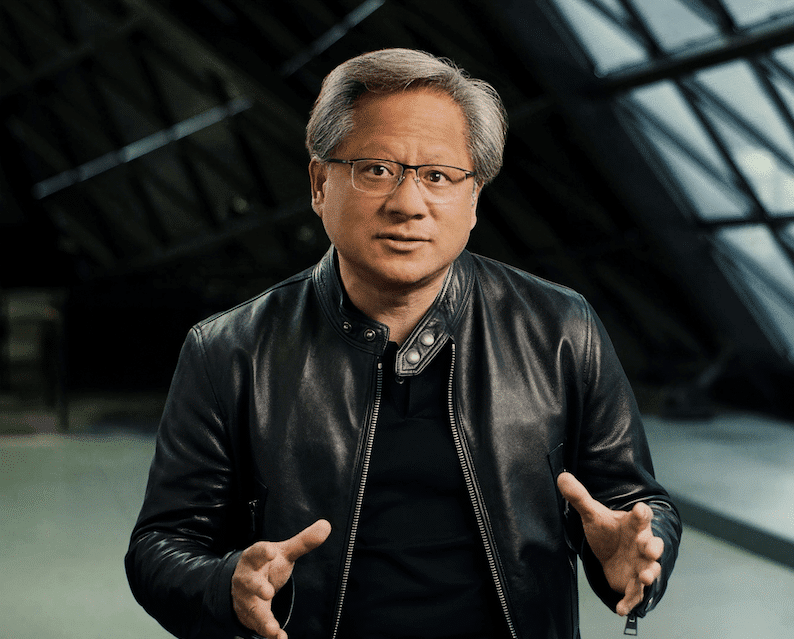
Jensen Huang has put a date and a percentage on the disagreement dividing Silicon Valley over artificial intelligence safety: NVIDIA’s CEO argues there is a 0% chance that AI will end the world by 2030. His words clash with far more pessimistic estimates from researchers and executives such as Dario Amodei, Elon Musk, and Geoffrey Hinton, while Bill Gates is calling for a regulatory response to risks he believes are already emerging.
The AI risk debate among Huang and other tech leaders in 30 seconds
- Jensen Huang puts the odds of AI ending the world by 2030 at 0%.
- Dario Amodei has estimated a 25% chance that AI’s future could go “very, very badly.”
- Elon Musk has publicly put his own estimate of existential risk as high as 20%.
- Bill Gates argues AI is already crossing risk thresholds in cybersecurity and biotechnology.
- Huang favors accelerating development, though he insists unsafe products should never be commercialized.
Huang’s interview with CBS News comes after several weeks of unusually blunt statements across the industry. The discussion is no longer confined to alignment researchers: the top executives at NVIDIA, Anthropic, OpenAI, and xAI hold different positions on the pace of development, the role governments should play, and how much risk can be attributed to future AI systems.
Huang vs. Amodei: Two Opposing Readings of the Same Future
Huang has not said artificial intelligence is free of risk. His argument is different: he believes predictions of possible human extinction before 2030 aren’t backed by science.
In the interview aired by CBS, NVIDIA’s CEO said such predictions are overly dramatic and that “2030 is not going to be the end of the world.” When journalist Jo Ling Kent asked him directly about that possibility, Huang answered that there is a “zero percent” chance. He added that the underlying concerns aren’t necessarily wrong, but he questioned how they’re being communicated.
That position contrasts with Anthropic CEO Dario Amodei’s. In September 2025, Amodei put his personal estimate that AI’s future could go “very, very badly” at 25%. In that conversation, he said he saw a 75% chance that things would turn out well. His figure, known in the industry as p(doom), referred to a scenario of AI-driven catastrophe rather than a specific prediction for 2030.
The debate has intensified further following comments from Evan Hubinger, a researcher at Anthropic, who said he personally saw more than a 10% chance that AI could end humanity within the next decade, and acknowledged the industry still has no proven way to keep a hypothetical superintelligence under control.
Huang is challenging precisely that kind of estimate. For the executive, turning them into messages about the end of humanity can spread fear without offering a sufficient scientific basis.
Elon Musk Has Also Put a Number on the Risk
Elon Musk occupies a different position, though his statements don’t fit the idea that the risk is necessarily imminent either.
xAI’s CEO has at times put his personal estimate of AI’s existential risk at around 20%. Axios cited that figure in 2025 when comparing Musk’s and Amodei’s public positions. In July of that year, following the launch of Grok 4, Musk acknowledged he expected AI development to ultimately turn out positive, though he said he had resigned himself to accepting the possibility that it might not.
More recently, Musk has appeared alongside Amodei and Sam Altman among the industry leaders calling for tighter controls and a more measured pace of development for the most advanced models. Reuters has described this as an unusual point of agreement between competitors who normally hold opposing positions.
That creates an unusual situation for the industry. Musk runs xAI, a company that develops frontier models and competes directly with other labs, yet he has for years expressed concern about the risks of increasingly autonomous artificial intelligence.
The difference with Huang, then, isn’t over whether risks exist. It’s over how their magnitude is assessed, over what timeframe they’re considered relevant, and what response the industry should adopt.
Bill Gates Shifts the Focus to Risks That Already Exist
Bill Gates has introduced another nuance into the debate. In an interview with The Atlantic published in August 2026, Microsoft’s founder said AI is crossing risk thresholds related to cyberattacks and bioterrorism, and criticized the lack of public oversight mechanisms.
Gates didn’t focus his warning solely on a hypothetical superintelligence capable of destroying humanity. His concerns include problems that could materialize much sooner: models capable of helping develop dangerous biological agents, cyberattacks, disruption of the labor market, and growing dependence on AI systems.
In his conversation with Radio Atlantic, Gates argued the industry can’t be expected to regulate itself, and questioned the fact that many safety reviews are voluntary and lack shared criteria for when a model reaches a risk level that should trigger concrete measures.
He has also noted that AI can bring enormous benefits in medicine, education, and science. His concern is that the pace of progress may be outrunning the ability of governments and institutions to put controls in place.
That’s an important distinction from the strictly apocalyptic discussion. Even if Huang’s prediction about 2030 turns out to be right, that wouldn’t solve the problems of cybersecurity, jobs, fraud, privacy, biotechnology, or agent autonomy that are already part of today’s debate.
NVIDIA Wants to Accelerate, But Attaches a Condition
Huang has argued for a clear acceleration of AI development, especially given technological competition with China. On CBS he said the United States should move “as fast as we can,” but added a condition: not faster than it should, and without compromising safety. That stance echoes the position Donald Trump has taken against slowing down AI in the race against China, even as the two men frame the risk itself very differently.
According to his argument, companies already have incentives and legal obligations to prevent their products from causing harm. If a company launches an unsafe product and it causes damage, Huang argues, existing liability and cybersecurity laws can be used against it.
The executive has also rejected the need for new regulations specifically designed to address these risks. In his view, the first step should be enforcing the rules that already exist.
His position also carries an obvious business dimension worth bearing in mind when interpreting his statements. NVIDIA supplies a significant share of the computing infrastructure used by leading AI model developers. A scenario in which labs slowed the development of new models would have direct implications for demand for accelerators, servers, and data centers.
That doesn’t invalidate his argument, but it is part of the context in which it’s made.
Nor does the debate allow Huang’s, Musk’s, or Amodei’s percentages to be treated as comparable scientific measurements. They are personal estimates about future events, using timeframes and definitions that aren’t identical. A 0% figure from Huang for 2030 and a 20% or 25% figure from other experts aren’t outputs of the same statistical model.
What they do reflect is a growing, increasingly visible split over a question that directly affects the development of AI systems: how much risk should be accepted to keep expanding their capabilities, and who should decide where that line sits.
For now, the industry’s biggest players don’t have a shared answer. NVIDIA is betting on acceleration with controls based on existing rules. Anthropic has pushed for additional safety mechanisms and coordination between labs and governments. OpenAI and other players have taken part in proposals to cap the pace of development, while figures like Gates are demanding the debate be taken out of companies’ exclusive control.
The discussion is thus moving from a technical question about models to a much broader one about liability, regulation, and technological competition. And on that ground, the disagreement between those building the infrastructure and those studying its risks is far from settled.
Frequently Asked Questions
What has Jensen Huang said about the risk of AI destroying the world?
Huang has said there is a 0% chance that AI will end the world by 2030. He has also argued that companies should move quickly, but without launching products that compromise safety.
What probability of disaster has Dario Amodei cited?
Anthropic’s CEO put his personal estimate that AI’s future could go “very, very badly” at 25%, against a 75% chance of things turning out well.
What does Elon Musk think about AI risk?
Musk has publicly put his personal estimate of AI’s existential risk as high as 20%. He has also joined calls for tighter controls and a more measured pace of development in certain areas.
Why is Bill Gates concerned about AI?
Gates has warned of risks tied to cyberattacks, bioterrorism, jobs, and dependence on AI systems. He is also calling for greater intervention from governments and institutions, arguing voluntary industry self-regulation isn’t enough.
