
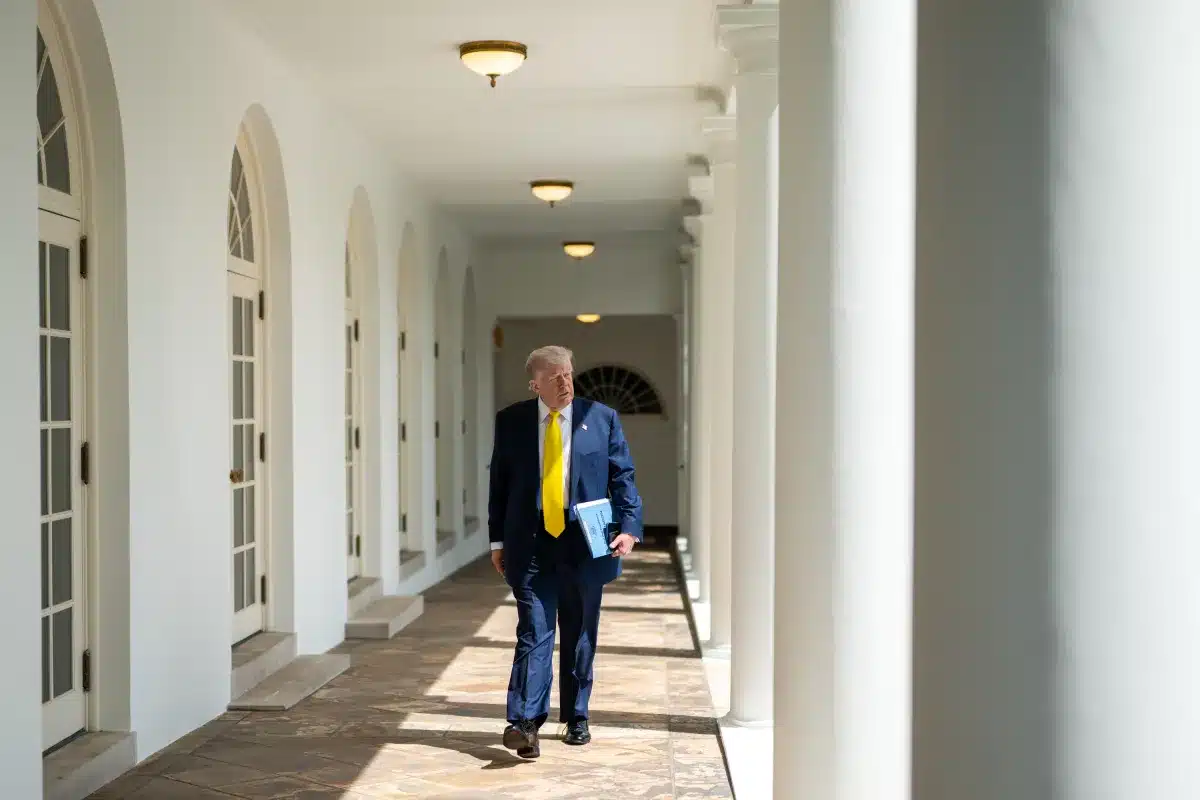
Donald Trump has made clear the United States’ priority amid growing warnings about the risks of artificial intelligence: keeping its lead over China. Asked on September 13 in Ireland whether the industry should slow its development or face tighter regulation, the US president admitted that limits could be set, but called some of the scenarios being raised exaggerated and summed up his position in one line: “Whoever wins AI wins.” The available recording confirms the content and context of his remarks.
Trump’s response on AI in 30 seconds
- Trump argues the United States currently leads the artificial intelligence race against China and wants to keep that position.
- The president accepts that safety measures could exist, though he didn’t specify which controls he’d support.
- His remarks come after leaders at Anthropic, OpenAI, xAI, and Google DeepMind backed slowing the advance of the most powerful models.
- The debate pits the risks of increasingly capable systems against a technological, economic, and military rivalry in which Washington sees China as its main competitor.
- Trump didn’t announce a new policy, nor did he rule out all regulation.
The remarks came during a conversation with reporters at Trump’s golf resort in Doonbeg, Ireland. The question was direct: given worrying reports about artificial intelligence, should the industry slow down or face heavier regulation?
Trump responded by immediately framing the issue around the competition between the United States and China.
“We’re ahead of China in AI. We’re the most sophisticated country in the world, and frankly, I want to keep it that way, because whoever wins AI wins.”
The president added that guardrails could be put in place, a term commonly used for safety limits or safeguards. He then went on to criticize what he called “negative forces” pushing scenarios that, in his view, “are not going to happen.”
He didn’t identify which of the warnings he considers overblown, nor did he explain what safety mechanisms he’d be willing to accept.
That nuance matters. Trump did not say AI should be developed with no rules at all, but he also didn’t endorse the request that has just emerged from some of the companies building the most advanced models.
AI labs themselves have started asking to slow the pace
The president’s words come after an unusual shift within the industry.
Dario Amodei, CEO of Anthropic, published an essay in September titled We Must Pace the Frontier, arguing that development of the most advanced systems should slow down to give safety measures time to keep pace with their capabilities.
Amodei isn’t proposing to halt artificial intelligence indefinitely. His approach is to slow the pace of the technological frontier and increase oversight, including deeper access for outside evaluators to companies’ systems.
Anthropic’s chief lists risks ranging from cyberattacks and the use of AI for biological threats to economic disruption and, in more extreme scenarios, loss of control over sufficiently capable systems.
The proposal gained further weight when other major lab leaders backed the need to act.
Sam Altman, CEO of OpenAI, who has previously discussed AI governance and superintelligence timelines, said he agreed with the need to pace the frontier and backed giving outside evaluators access. Elon Musk also publicly supported Amodei’s call, while Demis Hassabis, head of Google DeepMind, expressed support for the overall direction of the proposal.
That doesn’t mean the four companies have agreed to halt their models, nor is there currently a coordinated industry pause.
There’s also no consensus on what “slowing down” AI would actually mean: how much the pace should be reduced, which models would be affected, which capabilities would trigger controls, or who would have the authority to decide a system is too dangerous to train or deploy.
Still, the conversation has shifted now that some of the very companies racing to build the most powerful systems are the ones asking for more time to assess their risks.
China turns a safety question into a geopolitical race
That’s where the conflict Trump puts front and center comes in.
A US company could voluntarily choose to delay training or launching a model. Washington could even set mandatory requirements for labs operating on its soil.
But neither of those steps guarantees China would do the same.
The possibility that one country voluntarily slows down while its main competitor keeps advancing is one of the biggest obstacles to any international proposal on AI.
Amodei acknowledges that difficulty. His approach combines shared standards among democratic countries with later negotiations with authoritarian governments. At the same time, Anthropic supports keeping US restrictions on exporting the most advanced AI-training chips to China.
Beijing has rejected this approach whenever it sees it as an attempt to limit China’s technological development, and it favors international AI governance that isn’t built around blocking certain countries’ access to the technology.
Trump’s position is different.
For the US president, keeping the technological lead carries enough strategic value that he’s wary of measures that could slow American companies down while China keeps developing its own models.
This isn’t the first time he’s used almost the same words.
On September 4, asked about the possibility that artificial intelligence could spiral out of control and launch cyberattacks, Trump said his administration is watching it “very carefully,” again noted that the United States is ahead of China, and called AI something “bigger than the Internet.” He also said back then that the race is fundamentally being run between Washington and Beijing.
His latest remarks therefore reflect a position he’s held for weeks, rather than an improvised response solely to Amodei’s request.
The Trump administration does have AI controls in mind
Framing the US position as simply a choice between regulation and no regulation doesn’t capture the full picture of White House policy, either.
Throughout 2026, the Trump administration has pushed for federal regulation meant to preserve US competitiveness while also introducing certain safety measures.
In March it presented a national legislative framework for artificial intelligence that explicitly listed winning the global AI race among its goals, while also addressing public trust and safety issues.
In June, Trump also signed an executive order on AI-driven innovation and cybersecurity. Days later he signed a separate memorandum specifically covering its use in national security.
The latter orders faster adoption of advanced AI systems across the armed forces and intelligence services, but also requires that deployed systems remain controllable and keep clear lines of accountability.
The real difference lies mainly in how much control to apply before the technology advances further.
| Position | What it proposes |
|---|---|
| Donald Trump | Keep the US lead over China and accept some safeguards |
| Dario Amodei | Slow the pace of frontier models and increase independent evaluation |
| Sam Altman | Has backed pacing the frontier and using outside evaluators |
| Elon Musk | Has publicly supported Amodei’s request |
| Demis Hassabis | Has backed the general direction of more caution |
| Chinese government | Favors cooperation and international governance, rejects restrictions that single out China |
Nor does the disagreement necessarily come down to whether artificial intelligence is dangerous or safe. A large part of the debate is about what level of risk justifies delaying systems that can also deliver economic, scientific, and military advantages.
Trump puts the geopolitical cost of slowing down at the center of that decision.
Can the US slow down AI without China doing the same?
This is probably the toughest question underlying his remarks.
If AI systems keep improving quickly and the labs’ warnings turn out to be well-founded, stepping up evaluation and setting controls could reduce certain risks.
If those controls slow American development considerably while China keeps up its pace, Washington could lose part of its edge.
But there’s also the opposite argument: a race in which every participant speeds up because they fear the other will get there first can make it harder for anyone to spend enough time checking their systems are safe.
It’s the same dilemma behind why the most ambitious proposals are starting to talk about international coordination.
The problem is that the United States and China aren’t competing only to have the best chatbot. AI is tied to semiconductors, data centers, energy, cybersecurity, military intelligence, scientific research, and economic productivity.
Washington has spent years limiting exports to China of certain chips and technologies needed to manufacture advanced semiconductors. Beijing, in turn, is stepping up efforts to build a technology supply chain less dependent on US suppliers.
That’s why any eventual negotiation to slow down certain systems would first need to define what gets slowed and how compliance on both sides would be verified.
No such agreement currently exists.
Trump doesn’t deny every risk, but he’s clear about which one worries him most
His comments in Ireland make it possible to separate what Trump actually said from some of the interpretations that followed.
He didn’t say artificial intelligence carries no risks. Nor did he announce scrapping all safety rules, or order OpenAI, Anthropic, Google, or xAI to speed up their models.
What he did was question some of the more negative warnings, generically accept the possibility of setting safeguards, and immediately place one priority above all else: the United States must not lose its edge over China.
The debate also arrives at a particularly delicate moment. Leaders at some of the companies with the most to gain economically from increasingly capable models are the ones warning that the pace may be outrunning the ability to properly evaluate them.
That doesn’t automatically turn their most extreme forecasts into proven scientific fact, either. Estimates about future systems carry enormous uncertainty, and there’s an open debate even among specialists about how likely the most catastrophic scenarios really are.
But the shift within the industry forces Washington to answer a political question that Trump, for now, is resolving mainly through the lens of international competition.
The line “whoever wins AI wins” sums up that position well. It also points to the unresolved problem: the United States, China, and the companies themselves still have to define what it means to win a technological race in which some of its own participants are starting to wonder whether running at full speed is safe.
