
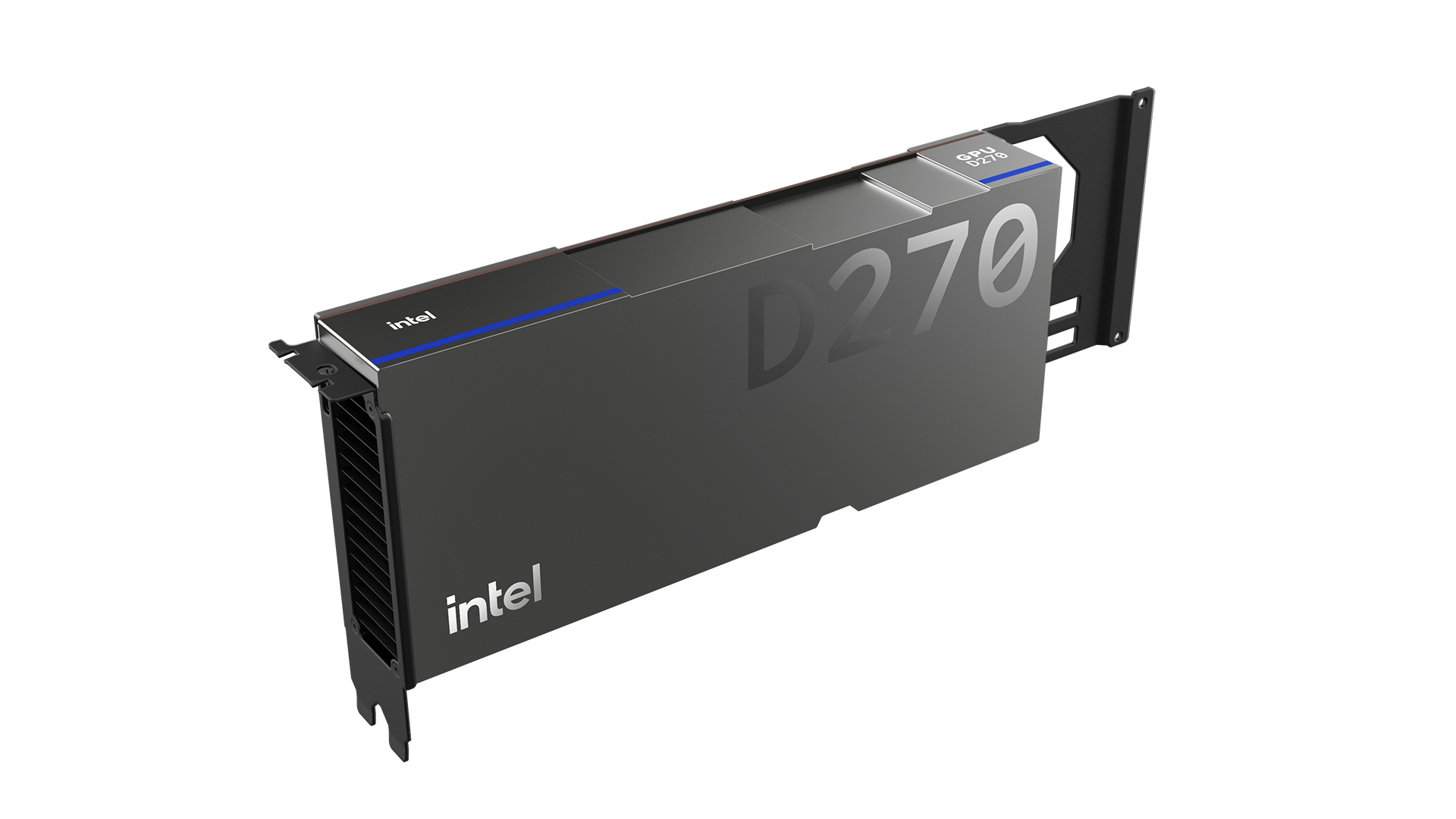
Intel has published the first performance figures for the GPU D270, the model in its D-series previously known as Crescent Island, and is pitching it as an option for high-performance computing (HPC), not just AI inference. The card combines the Xe3P architecture, 160GB of LPDDR5X memory with 1.5TB/s of bandwidth, and full-rate double-precision (FP64) compute in an air-cooled, 350W PCIe 5.0 form factor. The results it published come from Intel’s own tests on pre-production silicon.
The Intel GPU D270 in 30 seconds
- The D270 uses the Xe3P architecture with 32 Xe cores and 256 XMX engines.
- It carries 160GB of LPDDR5X at 1.5TB/s, expandable to 480GB in partner configurations.
- It offers full-rate FP64 and supports everything from FP4 to FP64 on a 350W card.
- Intel claims up to 5.9x the performance of an RTX PRO 6000 Blackwell in financial computing.
- There’s no launch date yet; Intel will show it off at SC26.
We’ve been following this chip since Intel explained it would use LPDDR5X instead of HBM, through to shipping the first samples in October. What’s new now is the push toward classic HPC, timed to coincide with the SC26 conference in Chicago.
Full double precision on a conventional card
The D270 packs 32 Xe cores and 256 XMX matrix engines, with 64 double-precision FMA operations per core. It natively supports formats from FP4 to FP64, and double precision runs at full rate — a notable detail, since many recent accelerators have cut back FP64 to focus on low-precision AI. Memory is 160GB of LPDDR5X at 1.5TB/s, and partners can build configurations up to 480GB. All of this on an air-cooled, 350W PCIe 5.0 card, aimed at standard servers and racks without liquid cooling. Intel hasn’t disclosed the manufacturing process.
Intel’s numbers against the RTX PRO 6000 Blackwell
Intel compares the D270 to the NVIDIA RTX PRO 6000 Blackwell Server Edition, a 600W card. In its FP64 financial-computing tests, it claims application performance 5.9 times higher in European Monte Carlo, 5.6 times in European Black-Scholes, 4.6 times in the binomial model, and 1.92 times in American Black-Scholes. On AI, it cites up to 29% lower latency in decision models and 1.12 times the throughput with the Qwen3-30B-A3B language model in FP8, at 350W versus 600W.
These figures are worth reading with caution. They’re Intel’s own tests on pre-production hardware, the company itself warns results may vary, and the comparison is against a workstation-and-server card that isn’t designed for intensive FP64, which favors the D270 on financial workloads.
Use cases: seismic imaging, disaggregated inference, and SYCL
Intel cites two customer examples. French geoscience company Viridien ported a seismic-imaging mini-application to the D270 in under a month using SYCL, and according to Intel, 90% of the compute cores performed well with no specific optimizations. SambaNova, for its part, proposes a disaggregated inference architecture in which the D270 handles the prefill stage, its SN50 units handle decoding, and Xeon 6 handles orchestration.
Software is the other leg of the pitch. Intel is backing an open stack built on SYCL, with tools to migrate code written in CUDA or HIP, plus Intel MPI, optimized Fortran, and C++ compilers. The company has live demos planned at SC26 but hasn’t given a release date or price.
Frequently asked questions
What is the Intel GPU D270?
It’s Intel’s data center GPU formerly known as Crescent Island, with Xe3P architecture, 160GB of LPDDR5X, and 350W.
Does it have strong double precision?
According to Intel, it offers full-rate FP64, with 64 double-precision FMA operations per Xe core.
When will it launch?
Intel hasn’t given a date or price; the tests were run on pre-production silicon.
Sources:
This article is also available in Spanish: “Intel GPU D270: 160 GB de LPDDR5X y FP64 completo en una tarjeta de 350 W,” on revistacloud.com.
