
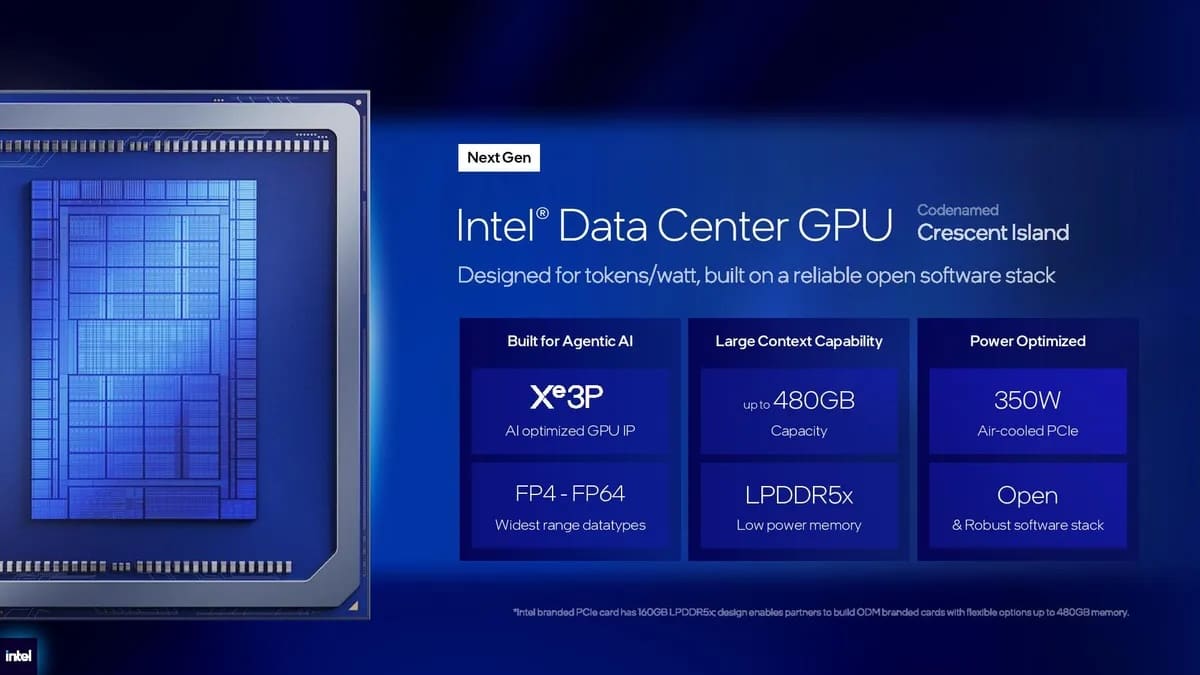
Intel has started shipping samples to customers of Crescent Island, its GPU for artificial intelligence (AI) inference in data centers, which will now be sold as the Intel GPU D-series. The company announced it at the OCP Global Summit, the Open Compute Project’s annual conference, on October 12, 2026, alongside new Xeon 6+ rack designs and a software package for deploying AI agents on its hardware.
Intel at the OCP Global Summit in 20 seconds
- The GPU D-series (Crescent Island) is now in the sampling stage, with no general-availability date yet.
- Intel’s own PCIe card carries 160 GB; the 480 GB figure is reserved for partner designs.
- Intel is showing Xeon 6+ racks with more than 46,000 cores and 133.45 kW of power draw.
The thread running through the announcement is inference. Intel argues that the rise of AI agents, which chain together many model calls to complete a task, is shifting spending away from training and toward running models in production, and that this load is better split across different types of processors and accelerators than concentrated in a single chip type. It’s the same thesis the company already made at Computex and Hot Chips, now backed by hardware in customers’ hands.
The GPU D-series, and the fine print on 480 GB
Crescent Island is based on the Xe3P graphics architecture and is built for memory-heavy inference, not for training models. According to Intel, it delivers 1.5 TB/s of memory bandwidth and 1.3 petaflops at FP8 precision, drawing 350 W on a standard, air-cooled PCIe card. The company says a single card can run models with up to 300 billion parameters, and a system with eight GPUs can handle models of more than a trillion.
The detail worth reading in the fine print is memory. Intel is still citing up to 480 GB of LPDDR5X, the figure that stood out when Intel first detailed Crescent Island, but a footnote clarifies that its own PCIe card carries 160 GB. The 480 GB figure will be an option for cards that partner manufacturers (ODMs) design. For anyone comparing it against other inference GPUs, that distinction matters: the headline figure isn’t the reference card’s.
The bet on LPDDR5X instead of HBM memory follows the same logic Intel has already laid out: it’s cheaper, easier to source amid an HBM shortage, and enough for workloads where capacity matters more than extreme bandwidth. Intel points to AI services shared across many customers, tasks with long contexts, and latency-sensitive applications such as robotics. The performance figures are vendor specifications; the note’s legal disclaimer says results depend on configuration and doesn’t show the underlying tests.
Xeon 6+ racks and software for agents
On the processor side, Intel showed rack designs built with partners around Xeon 6+, many of them following the Open Compute Project’s Open Rack v3 (ORv3) standard. Some configurations exceed 46,000 cores per rack with total power draw of 133.45 kW, a density that demands facilities built for electrical loads well beyond a traditional rack. The announcement doesn’t name the manufacturers offering them.
On the software side, Intel offers the AI for Enterprise Agent Toolkit, a set of tools for orchestrating AI-agent applications that runs on Xeon today, with plans to extend it to its GPUs, with no date given. It’s also announcing day-one support for Muse Glimmer, Meta’s model, and a common software layer, Xe, for moving workloads across its different GPUs. Intel notes it has made 116 contributions to the Open Compute Project since 2011, including one to the Open Adapter Card working group, which defines a standard accelerator card format inside the rack.
What Intel says
Nicolas Dubé, corporate vice president of the data center systems and solutions group, argues that “open models are expanding the options businesses have for deploying AI” and that organizations need infrastructure that matches each workload to the right type of intelligence. Anil Nanduri, vice president of AI products, says “inference is becoming the workload that defines AI.” Kevork Kechichian, executive vice president and general manager of the data center group, adds that success will depend on open, heterogeneous infrastructure, not a single component. Back in August, we covered how Intel was preparing Diamond Rapids and Crescent Island for the agent era.
Frequently asked questions
What is the Intel GPU D-series?
It’s the commercial name for Crescent Island, Intel’s GPU for AI inference in data centers, based on the Xe3P architecture and using LPDDR5X memory.
How much memory does the GPU D-series have?
Intel’s own PCIe card carries 160 GB. Partner manufacturers will be able to offer cards with up to 480 GB of LPDDR5X.
When will Crescent Island be available to buy?
Intel has only confirmed it’s shipping samples to customers. No general-availability date or price has been given.
How much power do the Xeon 6+ racks Intel showed draw?
Some configurations exceed 46,000 cores per rack with total power draw of 133.45 kW, according to Intel.
Sources:
