
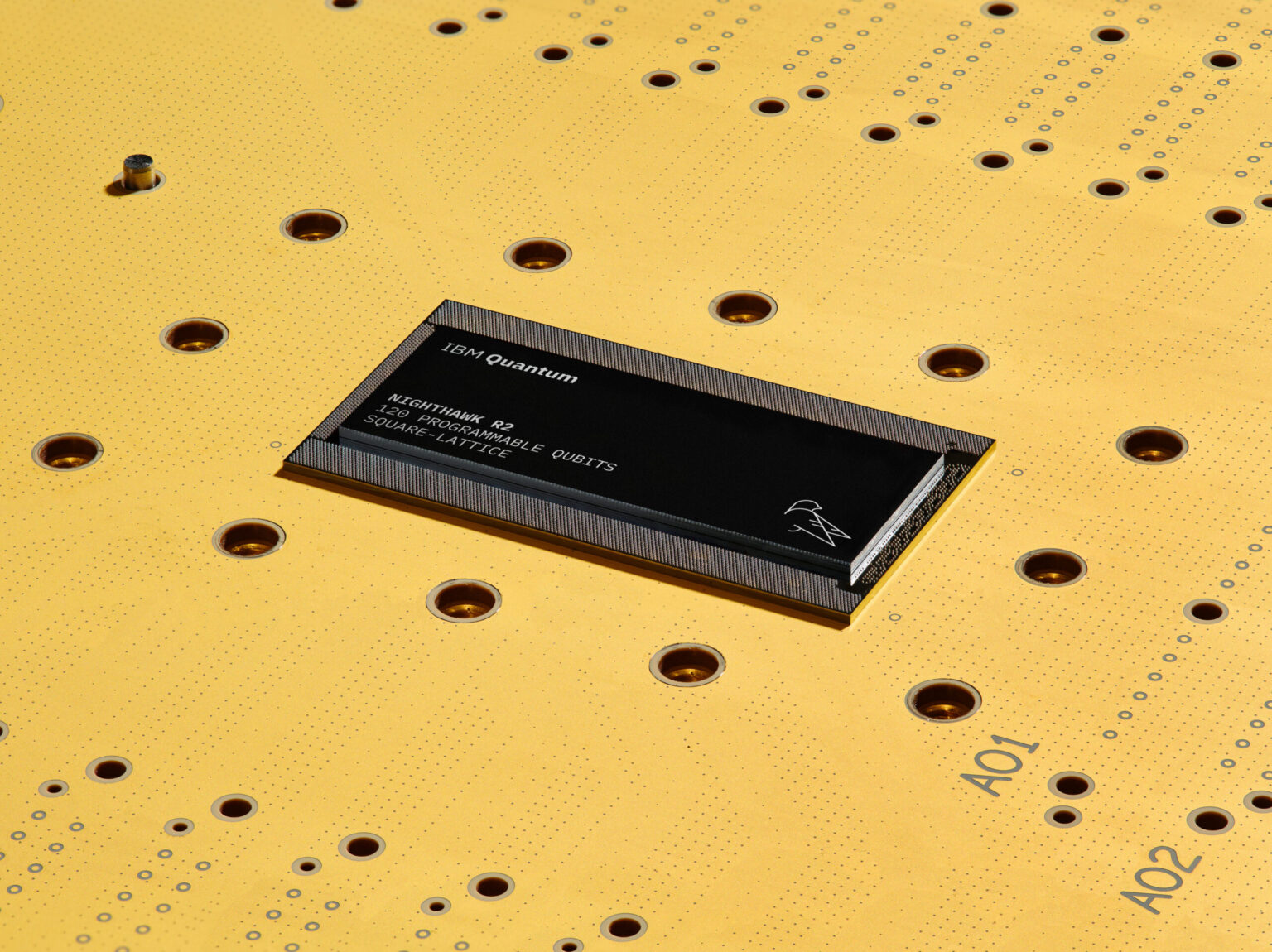
IBM has presented the first results from Nighthawk r2, the version of its quantum processor it introduced in September, and announced the next revision, Nighthawk r3, with which it aims to surpass 1,000 qubits in 2027. According to the company, r2 delivers up to 100,000 samples per second, and its partners have measured speedups of up to 19x compared to IBM’s previous processors. For r3, the plan is to build a chip with 520 programmable qubits and link two of them into a single 1,040-qubit system.
IBM Quantum Nighthawk in 30 seconds
- Nighthawk r2 runs more than 7,500 quantum operations across 120 qubits and up to 100,000 samples per second.
- E.ON, Algorithmiq, and Q-CTRL ran 34 billion circuits with speedups of up to 19x.
- Nighthawk r3 will have 520 programmable qubits and 10 chip-to-chip couplers.
- IBM plans to link two r3 chips into a 1,040-qubit system in 2027, with no commercial availability date yet.
The announcement, from November 11, 2026, reinforces an idea IBM keeps repeating: having more qubits isn’t enough—results also need to be accurate and fast. “Useful quantum computing hinges on whether results can be delivered with accuracy and speed, both are fundamental,” says Jay Gambetta, Director of IBM Research. In practice, speed matters because many current quantum algorithms need to run the same circuit millions of times to extract a statistical result.
What Nighthawk r2 already does
Nighthawk r2 has 120 qubits connected in a square lattice and supports more than 7,500 quantum operations per circuit. IBM’s partners, including utility company E.ON and software firms Algorithmiq and Q-CTRL, have run 34 billion circuits and report speedups of up to 19x over previous processors. Some examples cited by IBM:
- E.ON achieved a 15x speedup in quantum machine learning to optimize the power grid.
- A magnetic materials experiment by IBM and Oak Ridge National Laboratory (ORNL) ran 12x faster.
- An Algorithmiq simulation of a heterogeneous quantum material runs 8x faster than the original experiment on Heron. According to IBM, classical tensor-network methods would need around 240x more memory for comparable accuracy.
- On IBM Quantum Platform, a sample-based quantum diagonalization workflow from RIKEN ran about 5x faster while performing 100x more calculations, and Cleveland Clinic and RIKEN processed 608 million samples 33x faster by automating the workflow.
These figures come from IBM and its partners, and the comparisons are mostly against IBM’s own previous hardware. For its quantum-advantage claims, the company points to the Quantum Advantage Tracker, a community registry where experiments published in July, first run on Heron, are open for others to try to match using classical methods.
Nighthawk r3 and the jump to 1,040 qubits
Nighthawk r3 is designed to run 10,000 quantum operations across 520 programmable qubits, inside a chip with 2,034 physical qubits in total. It keeps r2’s square-lattice connectivity and adds 10 chip-to-chip couplers, which IBM calls l-couplers. The idea is to link two r3 processors into a single 1,040-qubit system in 2027. IBM presents this as something it will build, without giving a customer availability date.
The pieces for that link are being tested. Four l-couplers connected Nighthawk r1 processors with a quantum state transfer fidelity of 99.3%, still below the 99.9% target IBM has set for itself. It has also connected two cryogenic modules into a single system, which reached operating temperature in under five days and dropped below 15 millikelvin, as we reported in August. In parallel, IBM has installed Nighthawk alongside ORNL’s Umbra supercomputer, with AMD Instinct MI355X GPUs and fifth-generation AMD EPYC CPUs, as part of the co-design platform launched by AMD, IBM, and Oak Ridge to combine quantum computing and HPC.
Frequently asked questions
What is IBM Quantum Nighthawk?
IBM’s family of quantum processors with qubits connected in a square lattice. The r2 version, with 120 qubits, has been available since September.
When will IBM surpass 1,000 qubits?
IBM plans to link two Nighthawk r3 processors, each with 520 programmable qubits, into a 1,040-qubit system in 2027.
How much faster is Nighthawk r2?
According to IBM and its partners, up to 19x faster than IBM’s previous processors, with up to 100,000 samples per second.
Sources:
This article is also available in Spanish: “IBM Nighthawk acelera hasta 19 veces y apunta a 1.040 cúbits en 2027,” on revistacloud.com.
