
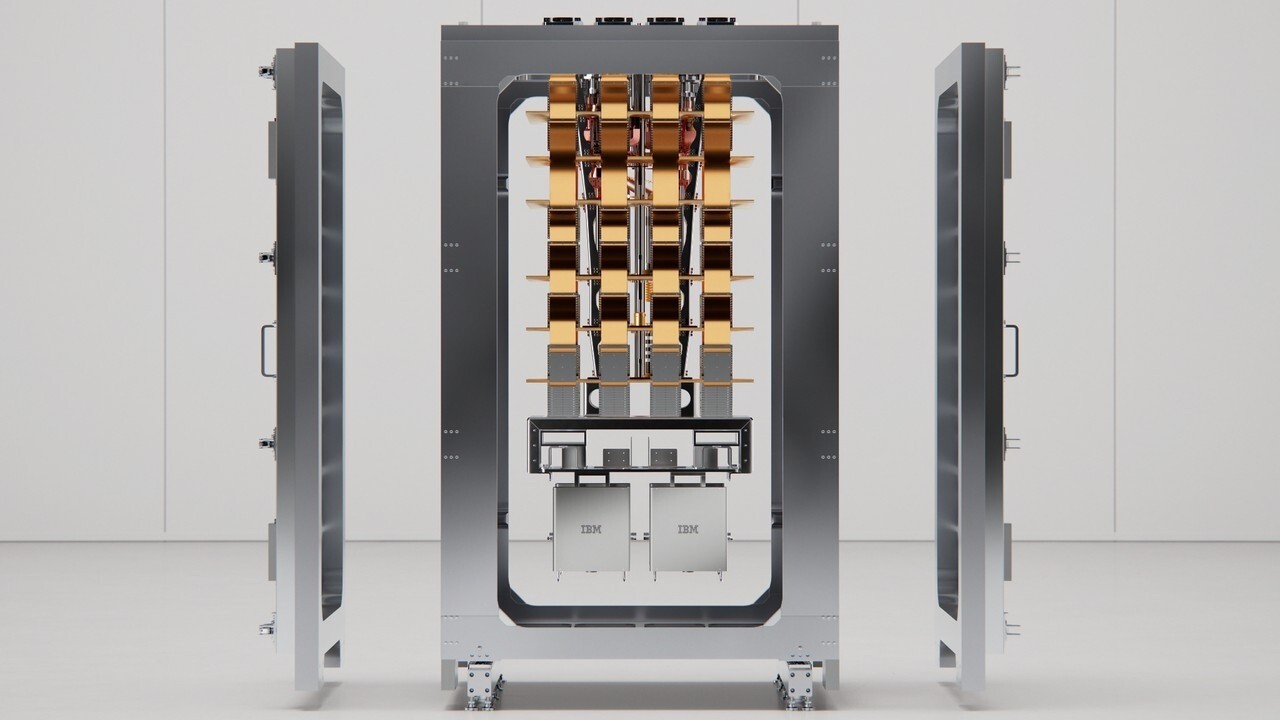
IBM has connected and cooled its first two quantum cryogenic modules together, an infrastructure meant to eventually link hundreds of chips in larger systems. Early tests brought the setup below 15 millikelvin, an engineering milestone the company ties to its goal of building IBM Quantum Starling, its fault-tolerant quantum computer planned for 2029.
IBM’s new cryogenic systems in 30 seconds
- IBM has connected two cryogenic modules to run within the same ultra-cold environment.
- The system reaches 4 kelvin in under five days, then drops below 15 millikelvin.
- Each module provides up to 12 times more wiring space than IBM’s most-used quantum systems today.
- The architecture lets IBM test connections between multiple processors, part of the path toward Starling in 2029.
It may sound less flashy than unveiling a processor with more qubits, but it addresses a basic physical hurdle in scaling quantum computing: making bigger chips isn’t enough. They also need power, control, connections, and maintenance in extreme cold, without that infrastructure becoming the limit.
A quantum computer needs more than qubits
Superconducting quantum processors run at extremely low temperatures. The point is to cut the thermal energy that can disturb the delicate state of qubits.
That’s why large quantum systems use dilution refrigerators, multi-stage structures that get close to absolute zero, which is 0 kelvin, or -273.15°C.
IBM’s new facility pushes this forward with a modular architecture.
The first two operational modules together stand more than 2.4 meters tall and wide. In early tests they reached 4 kelvin, around the temperature of liquid helium, in under five days. Then temperatures dropped below 15 millikelvin.
IBM compares that lowest temperature to deep space and notes it’s more than 180 times lower.
The number helps picture the environment, but temperature isn’t the only key part of this step.
Space matters too.
Each vacuum chamber offers up to 12 times more wiring space than IBM’s most-used quantum systems. That extra room is meant to hold many more connections between processors, both inside each module and across modules.
Which brings up one of the main challenges for the next generation of quantum computers.
IBM wants to scale by connecting processors
The industry has raised qubit counts for years, but building ever-larger monolithic processors runs into technical trouble.
An alternative echoes, with all the differences quantum computing brings, the path other computing architectures took: combining several modules into larger systems.
IBM’s new cryogenic design looks like a box, so different units can sit side by side in a single row.
Inside, IBM uses so-called L-couplers, connections built to link separate quantum chips so they can form larger systems.
The company plans to use this technology in 2027 to connect multiple processors and reach at least 1,000 programmable qubits. The roadmap has Nighthawk scaling up to nine modules of 120 qubits each, for up to 1,080 qubits and circuits of 10,000 gates in that window.
Next it has to see how the infrastructure holds up with real processors.
IBM plans to install Quantum Nighthawk processors in the new cryogenic modules during 2026 to widen operational testing.
Nighthawk currently has 120 programmable qubits and uses a square-grid topology where each qubit can connect to up to four neighbors. IBM treats it as the platform for gradually raising the complexity of quantum workloads before moving to large-scale fault-tolerant systems.
The goal isn’t just to cram more qubits into a quantum fridge. IBM has to show it can hold cryogenic conditions and control multiple processors while sharply increasing the number of connections.
From Nighthawk to Starling: aiming for 2029
A key piece for understanding this announcement is IBM Quantum Starling.
The company has long set 2029 as the year it expects to offer clients its first large-scale fault-tolerant quantum computer.
Fault tolerance aims to overcome a major limit of current quantum computing: qubits are highly sensitive to noise and can accumulate errors during operations. To run long, reliable algorithms, you need ways to detect and correct those errors mid-calculation.
IBM is building an architecture based on error-correction codes and multiple generations of processors and interconnects to get there.
Its roadmap includes Nighthawk for scaling circuit complexity, plus architectures like Kookaburra and Cockatoo meant to demonstrate key components for future fault-tolerant systems.
Starling is the next big milestone.
IBM expects the system to have 200 logical qubits and to run 100 million quantum operations, or gates, far beyond simply raising the physical qubit count.
A logical qubit is built from many physical qubits plus error correction. So don’t confuse the thousands of physical qubits inside the cryogenic modules with the 200 logical qubits planned for Starling.
The company projects even more beyond that, with Blue Jay set for 2033 or later, up to 2,000 qubits and the capacity to run 1 billion quantum operations.
These are business and technology goals, not current capabilities. IBM itself notes in its roadmap that these plans are current intentions and may change.
Infrastructure is becoming as important as the processor
The new cryogenic system also points to an interesting shift in quantum computing.
For years, most of the attention went to processors and qubit counts. As systems grow, the infrastructure around the chip matters more.
Refrigeration, control electronics, cabling, interconnects, error decoding, and high-performance classical computing all have to work together.
IBM Quantum System Two already reflects some of this. Its architecture combines scalable cryogenic infrastructure, modular control electronics, and classical servers, letting multiple quantum processing units (QPUs) run in a data center.
Three essential components used in System Two have gone into the new modular cryogenic architecture too. The idea is to test and change these components on their own, rather than redesign the whole system each time one part changes.
The challenge will grow a lot in the coming years.
IBM acknowledges in its planning that reaching future systems like Blue Jay will need new control electronics and cryogenic infrastructure, plus improvements to cut space, energy, and cost.
So connecting two large refrigerators and running them together below 15 millikelvin doesn’t mean fault-tolerant quantum computing is here. It shows a key engineering milestone IBM needs if it wants to turn hundreds of independent chips into a large-scale quantum machine.
The next challenge is doing that with more processors, more connections, and increasingly complex error correction, without losing qubit stability.
Frequently Asked Questions
What temperature do IBM’s new cryogenic systems operate at?
Early tests brought the connected modules below 15 millikelvin, after reaching 4 kelvin in under five days.
Why does IBM need such large refrigerators?
Superconducting processors need extremely low temperatures. On top of that, future systems will need far more space for wiring and connections among many quantum chips.
What is IBM Quantum Starling?
Starling is the fault-tolerant quantum computer IBM plans to make available to clients in 2029. The company expects it to have 200 logical qubits and run 100 million quantum operations.
Does this mean IBM already has a fault-tolerant quantum computer?
No. The cryogenic system is one piece of the infrastructure needed to get there. IBM still has to develop more advances in processors, interconnects, error correction, decoding, and software.
via: IBM Video
