
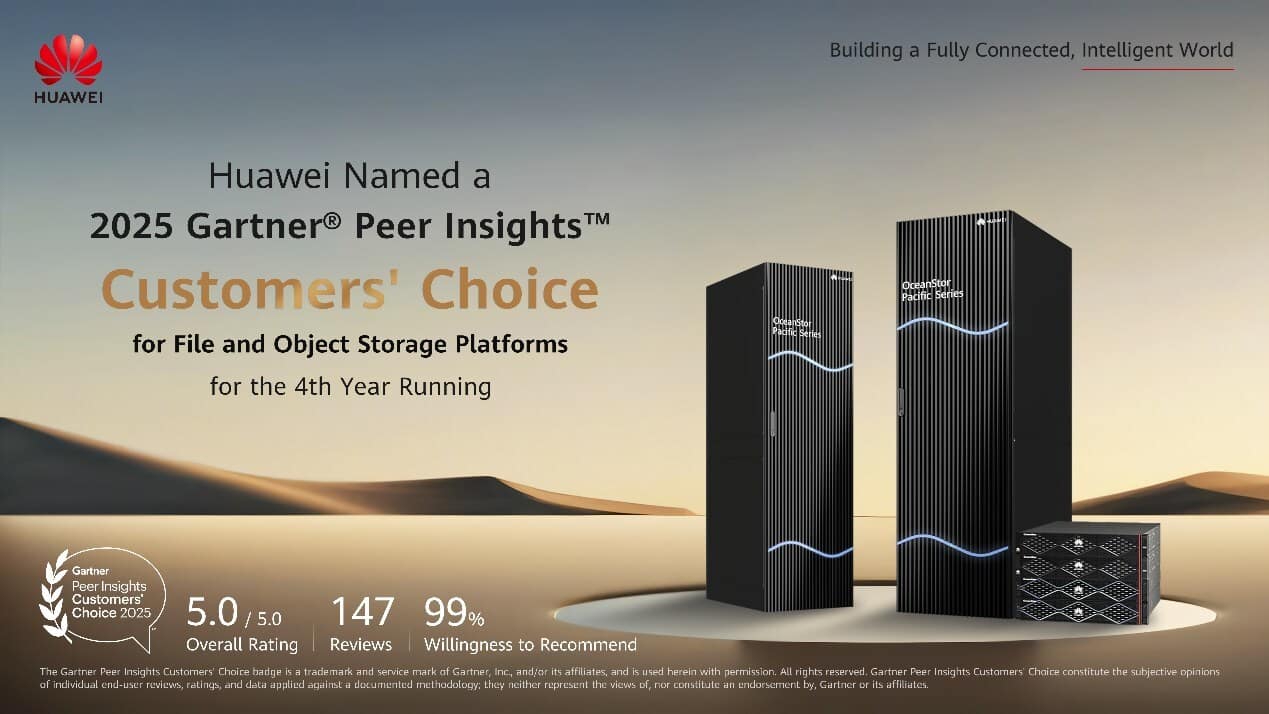
Huawei has been recognized as a Leader in Gartner’s 2026 Magic Quadrant for enterprise storage platforms, a position that reinforces the Chinese company’s presence in one of the technology markets most critical to businesses and data centers. According to information released by Huawei, it is also the only non-North American vendor placed in the Leaders quadrant in this edition.
The recognition comes at a particularly interesting moment for the storage market. The growth of artificial intelligence, enterprise applications, and the massive generation of information are forcing organizations to rethink infrastructure whose sole job is no longer just to keep data safe.
Now it also has to deliver performance, availability, energy efficiency, and the ability to respond to incidents, on top of integrating with environments increasingly geared toward AI workloads.
OceanStor, Huawei’s Bet on Enterprise Storage
Huawei’s strategy in this market centers mainly on its OceanStor Data Storage family, built to cover a range of storage needs within organizations — a segment where Chinese rivals such as YMTC are also racing to expand their footprint in NAND flash production.
According to the company, its offering is built on a unified, AI-ready data platform designed to combine efficiency, storage density, power consumption, and resiliency.
This combination is especially relevant given the growth of AI-related workloads. Training models, running inference systems, or working with huge datasets can substantially increase storage needs and, above all, the demands placed on data access.
It’s no longer enough, therefore, to keep growing available capacity. Platforms need to be able to manage huge amounts of information while maintaining high performance and keeping storage from becoming a bottleneck for the infrastructure.
Energy Efficiency Is Gaining Importance in Data Centers
Another element Huawei highlights about OceanStor is the combination of capacity density and energy efficiency.
It’s an aspect that is gaining weight as the technology density of data centers increases. Reducing the physical space needed to store large amounts of information and cutting power consumption can have a direct impact on the operating costs of an infrastructure.
This is even more evident in environments where storage, servers, and AI accelerators all have to share increasingly scarce power and cooling resources.
Resiliency is likewise another pillar of Huawei’s strategy. Companies need to protect their data against technical failures, operational disruptions, and other incidents capable of compromising the availability of their systems.
Huawei Data Storage Operates in More Than 150 Countries
The company says its storage division currently operates in more than 150 countries and regions, with customers across Europe, Latin America, the Middle East, Africa, and Asia-Pacific.
Its solutions are also used in sectors especially dependent on data availability, including financial services, telecommunications, manufacturing, healthcare, government, and essential-services companies.
This international footprint is especially significant for Huawei, given the trade and political restrictions the company has faced in recent years in certain Western markets, at a time when China is also curbing Nvidia’s H200 at home while racing to build its own AI chips.
Storage Is Moving Back to the Center of Tech Strategy
Huawei’s position also reflects how a market that for years drew less media attention than processors, GPUs, or cloud services is evolving.
The expansion of artificial intelligence is changing that. Companies can have enormous amounts of compute capacity available, but that infrastructure loses some of its usefulness if the systems can’t deliver data fast enough.
Enterprise storage is thus becoming an increasingly strategic piece of new digital infrastructure.
For Huawei, appearing as a Leader in Gartner’s 2026 Magic Quadrant is an important endorsement of its OceanStor strategy and, in particular, of its effort to compete globally in enterprise infrastructure against the big US vendors.
The challenge will be holding on to that position as storage evolves from traditional infrastructure mainly meant to preserve information into data platforms designed to power applications, cloud services, and AI at scale.
Frequently Asked Questions
What recognition has Huawei received in enterprise storage?
Huawei has been recognized as a Leader in Gartner’s 2026 Magic Quadrant for enterprise storage platforms, and is also the only non-North American vendor placed in the Leaders quadrant in this edition.
What is Huawei’s enterprise storage product family?
Huawei’s strategy centers on its OceanStor Data Storage family, a unified, AI-ready data platform that combines efficiency, storage density, power consumption, and resiliency.
In how many countries does Huawei’s storage division operate?
Huawei says its storage division currently operates in more than 150 countries and regions, with customers in Europe, Latin America, the Middle East, Africa, and Asia-Pacific.
What sectors use Huawei Data Storage solutions?
Its solutions are used in sectors especially dependent on data availability, including financial services, telecommunications, manufacturing, healthcare, government, and essential-services companies.
